

Atal Bihari Vajpayee was born on 25 December 1924 in Gwalior, then a princely state in central India, and died on 16 August 2018 in New Delhi at the age of ninety-three, having lived a public life that stretched from the last decades of British rule to the second decade of the twenty-first century and having shaped, in different ways, almost every phase of independent India's political story. He was at once a poet who wrote and recited Hindi verse throughout his life, a journalist who edited newspapers and journals in the formative years after Independence, and a parliamentarian for more than five decades, elected ten times to the Lok Sabha and twice to the Rajya Sabha, a longevity in the legislature matched by very few of his contemporaries. With Lal Krishna Advani and others he was a co-founder of the Bharatiya Janata Party in 1980, the party that carried the tradition of the earlier Bharatiya Jana Sangh into a new era and eventually became the principal alternative to the Indian National Congress at the centre. He served as Prime Minister of India three times, first for thirteen days in May 1996, then from 1998 to 1999, and then for a full term from 1999 to 2004, becoming the first non-Congress Prime Minister to complete a full five-year term in office. That final government is remembered for the Pokhran-II nuclear tests of May 1998, conducted in his first months in power, for the Lahore bus journey of February 1999 and the attempt at a new opening with Pakistan, for the Kargil War that followed only months later in the summer of 1999 and for the restraint shown during it, and for an ambitious programme of national highways, including the Golden Quadrilateral, that changed how India moved and traded. He was awarded the Bharat Ratna, India's highest civilian honour, in 2015, and his birthday, 25 December, was marked by his government successors as Good Governance Day. To understand the Prime Minister, however, one must begin long before Delhi, with the schoolteacher's son from Gwalior who learned languages, joined movements, went to prison as a teenager, edited journals on small salaries, lost elections, won them, and spent decades in opposition learning the Parliament he would one day lead.
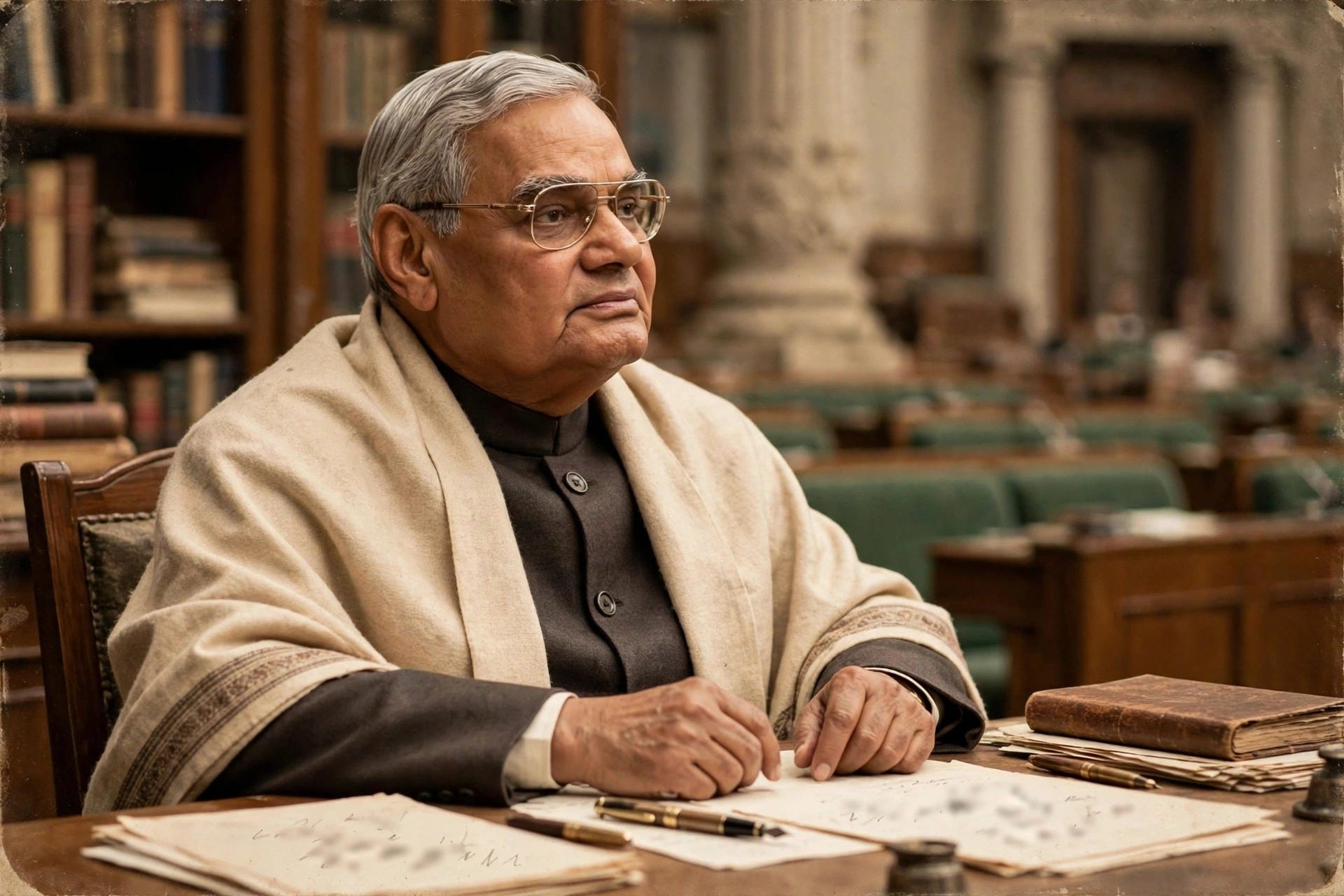
Gwalior: Birth and Family
Atal Bihari Vajpayee was born in Gwalior on Christmas Day, 25 December 1924, into a Kanyakubja Brahmin family whose roots lay not in the princely city itself but further north, in Bateshwar in the Agra district of what is now Uttar Pradesh. Bateshwar, a town on the Yamuna known for its temples and its cattle fair, was the ancestral home of his grandfather, Shyam Lal Vajpayee. Like many families of modest means in that region, the Vajpayees had moved in search of steadier work and education, and Shyam Lal settled in Morena, in the Gwalior region, where the family's connection with the princely state began.
His father, Krishna Bihari Vajpayee, was a schoolteacher and a poet in Hindi, a combination that mattered greatly in the son's formation. Teaching in the princely state was a respectable but not a wealthy profession, and the family lived the careful, bookish life of the educated middle class of the period. Krishna Bihari rose in time to become a headmaster and later an education official, and his own interest in poetry and in the Hindi language meant that verse, recitation and public speaking were not distant accomplishments in the household but part of ordinary life. A boy growing up in such a home heard language used with care, and learned early that words could be both a livelihood and a calling.
His mother, Krishna Devi, is remembered in family accounts as the steadier, domestic centre of the household, managing a large family on a teacher's income in an age when such management demanded constant economy. Atal Bihari was one of several children, and the family included his elder brother Prem Bihari Vajpayee, with whom he would share some of the defining experiences of his youth, including imprisonment during the Quit India Movement.
Gwalior itself shaped the child as much as the household did. In the 1920s and 1930s it was the capital of one of India's larger princely states, ruled by the Scindias, with its fort, its palaces and its schools existing alongside the political currents running through British India next door. A princely state was not directly administered by the British, but it was not independent of the larger struggle either, and news of the Congress, of Gandhi, and of movements in the provinces reached Gwalior's schools and reading rooms. The family's Brahmin background and its connection with the Arya Samaj milieu of north and central India also belong in this picture. The Kanyakubja Brahmins of the Agra and Kanpur region had a long tradition of Sanskrit learning, and in the Vajpayee household that tradition met the newer, reformist emphasis on Hindi and on accessible education. That linguistic inheritance, begun at home in Gwalior, would become one of the most recognisable features of the adult politician: a Hindi oratory rooted in classical learning but delivered in a language ordinary listeners could follow and remember.
Schooling in Gwalior and Ujjain
Vajpayee's earliest schooling was at the Saraswati Shishu Mandir in Gwalior, a school whose name itself tells something about the educational world into which he was born. Saraswati, the goddess of learning, gave her name to many schools founded in that period by teachers and reformers who wanted education in an Indian idiom, and a shishu mandir was, in essence, a children's school for the first years of learning. There the young Atal learned his letters, his arithmetic and the habits of recitation and memory that the Indian schoolroom of the 1930s prized. It was an ordinary beginning for an extraordinary career, and its ordinariness matters: he was not educated in an elite English-medium institution set apart from his society, but in the local schools that served families like his own.
His schooling was broadened by his father's postings, as was common for the children of teachers who were transferred between schools. When Krishna Bihari Vajpayee became headmaster of a school at Barnagar, near Ujjain, Atal studied at the Anglo-Vernacular Middle School there, generally referred to as the AVM School, Barnagar. Barnagar is a small town in the Ujjain district of present-day Madhya Pradesh, and the move exposed the boy to a different part of central India, one steeped in the religious and literary associations of Ujjain, one of Hinduism's seven sacred cities and a centre of Sanskrit learning associated with the poet Kalidasa. The description Anglo-Vernacular in the school's name captured the dual character of education at the time: English for advancement and administration, the vernacular — in this region, Hindi — for home, literature and public life. Pupils moved between the two, and Vajpayee's later ease in Hindi public speaking, combined with his ability to use English in Parliament and in foreign affairs, had its roots in precisely this kind of schooling.
He later attended the Gorkhi School in Gwalior, one of the established schools of the princely state, for his higher school education. Gorkhi, associated with the Gorkhi locality near the palace area of Gwalior, educated many of the sons of the state's service families, and there Vajpayee completed the schooling that prepared him for college. Accounts of his school years consistently emphasise not examination results alone but participation: debating, recitation, and an early appetite for poetry and public speaking.
Those school years also coincided with a quickening political atmosphere. The late 1930s brought the provincial elections of 1937, Congress ministries in the neighbouring provinces, the outbreak of the Second World War in 1939 and growing argument about India's future. In Gwalior's schools, as elsewhere, students discussed these events, joined youth organisations and read newspapers and pamphlets that circulated far beyond the classroom. Vajpayee's involvement with the Arya Kumar Sabha and, from 1939, with the Rashtriya Swayamsevak Sangh belongs to his school and early college years rather than to a later conversion. By the time he left school for Victoria College, he was already more than a promising student of languages; he was a young activist with organisational experience, and his education and his politics would develop together, each feeding the other, for the next several years.
Victoria College and the Love of Language
From school in Gwalior, Vajpayee went on to Victoria College in the same city, the leading institution of higher education in the princely state, named in the manner of its age after Queen Victoria and housed in the buildings that later became part of Maharani Laxmi Bai Government College. For a teacher's son from Gwalior, admission to Victoria College was the natural and ambitious next step: it offered a Bachelor of Arts degree, a faculty in the humanities, and the company of the brightest students of the region. He took his BA with Hindi, English and Sanskrit as his subjects, a combination that deserves attention because it maps almost exactly onto the intellectual equipment of the adult man.
Hindi was the language of his home, his father's poetry and his own emerging verse, and studying it formally meant studying its literature, its metres and its modern prose as they were then being shaped by writers who believed Hindi would be the national language of a free India. English gave him access to a wider world of political thought, history and literature, and to the language in which Parliament and diplomacy would later require him to work. Sanskrit connected him to the classical tradition of his family and region, to the epics, to classical poetry and drama, and to the store of image and allusion on which Hindi oratory has always drawn. A speaker who had studied all three could move between registers in a way that a speaker formed in only one of them rarely could.
College life in the early 1940s was not confined to lectures. Victoria College, like other Indian colleges of the period, had literary societies, debating unions and student associations in which reputations were made long before examinations were sat. Vajpayee's reputation as a speaker and poet grew in these settings. The discipline of writing verse — choosing the exact word, hearing rhythm, building an image — trained the ear that later made his parliamentary speeches memorable even to opponents who disagreed with every proposition in them.
The war years overshadowed his undergraduate life. He entered college as the Second World War was transforming Indian politics, and the Quit India Movement of August 1942 erupted while he was a young student. His arrest and imprisonment in 1942 and 1943 interrupted the smooth progress of a degree, as it did for thousands of students across India. When he completed his BA at Victoria College, the direction of his life was already double. On one side lay further study and the possibility of teaching or administration; on the other lay full-time organisational and journalistic work for the movement he had joined as a schoolboy. The love of language formed at Victoria College never left him, and it explains a paradox of his later career: a politician most widely admired, across party lines, for the quality of his speech, his humour and his ability to make a legislature listen.
Kanpur: Political Science and Foreign Affairs
After his BA in Gwalior, Vajpayee moved to Kanpur to study for a master's degree at DAV College, one of the best-known colleges of the city, run in the tradition of the Dayananda Anglo-Vedic movement founded in the name of Swami Dayananda Saraswati, the founder of the Arya Samaj. Moving there took the young graduate out of the princely-state world in which he had grown up and into the rougher, more argumentative politics of a large British Indian city.
His subject at DAV College was political science, and he took his MA in that subject under Agra University, to which the college was then affiliated. The choice was deliberate and revealing. A student intending only a teaching career in language might have taken his master's in Hindi or Sanskrit; Vajpayee chose the systematic study of politics, government, constitutions and international relations. Within political science, his particular interest in foreign affairs is consistently noted in accounts of his studies, and it foreshadows the portfolio he would hold decades later as Minister of External Affairs and the preoccupation with India's place in the world that marked his premiership. The student who studied how states behaved towards one another became the minister who addressed the United Nations General Assembly in Hindi and the Prime Minister who ordered nuclear tests and then boarded a bus to Lahore.
His postgraduate study was supported by a scholarship of seventy-five rupees a month from the Gwalior state, a detail preserved in biographical accounts because it captures both his merit and his means. Seventy-five rupees was a meaningful sum for a student in the 1940s, sufficient to make study in another city possible for a teacher's son who could not simply be maintained at leisure by his family, and a state scholarship was awarded on academic promise.
Kanpur in the mid-1940s was alive with the end of empire. The war ended in 1945, the Cabinet Mission came in 1946, and the argument over Partition, the princely states and the shape of a free India filled college common rooms and public meetings. Vajpayee's studies proceeded in that atmosphere, and his organisational work did not pause for his examinations; by this period he was moving towards the life of a full-time worker, a pracharak, for the RSS, and towards journalism as his profession. The MA was completed in that double life, which is why his academic record should not be read as a retreat from activism into scholarship, but as activism acquiring a formal education to match it. Geographically, it moved him into the Hindi heartland politics of Uttar Pradesh, the state from which he would first be elected to Parliament and which he would represent for most of his career, notably from Lucknow. Intellectually, it confirmed foreign affairs as his special interest, a thread that runs unbroken from the DAV College classroom to the External Affairs Ministry of 1977 and to the diplomacy of 1998 and 1999.
Arya Samaj, the RSS and Early Activism
Vajpayee's public life began not with a political party but with the youth organisations of the Arya Samaj and the Rashtriya Swayamsevak Sangh, and understanding those beginnings is essential to understanding the man. The Arya Samaj, founded by Swami Dayananda Saraswati in 1875, was a reform movement within Hinduism that emphasised the authority of the Vedas, opposed caste by birth, and promoted education, including through its network of DAV schools and colleges. In north and central India it was a formative influence on exactly the class to which the Vajpayees belonged: educated, Hindi-speaking, reform-minded families who wanted both modern schooling and cultural self-respect.
His first organisational role was in the Arya Kumar Sabha, the youth wing associated with the Arya Samaj, in Gwalior. He rose to become its general secretary in 1944, a position that required organising meetings, keeping records, arranging programmes and speaking in public while he was still a very young man of nineteen or twenty. The future parliamentary leader who could manage a legislature and a coalition first learned organisation in a youth sabha in his home city.
Alongside this, and more consequentially, he joined the Rashtriya Swayamsevak Sangh in 1939 as a swayamsevak, a volunteer, while still a schoolboy. The RSS, founded by Keshav Baliram Hedgewar at Nagpur in 1925, organised its members through shakhas, gatherings combining physical drill, games, songs, discussion and talks on history and national questions. For a teenager in Gwalior in 1939, joining meant discipline, companionship and a framework for thinking about the nation at precisely the moment when the Second World War was beginning and India's freedom struggle was entering a new phase. His membership was therefore not a later political calculation; it predated Independence, Partition and every party he would ever belong to, and he remained associated with the Sangh's worldview throughout his life, even when, as Prime Minister, he had to govern well beyond it.
In time he became a pracharak, a full-time organiser who gave his working life to the Sangh, without a settled home or a conventional career, travelling and organising in the manner the RSS expected of its pracharaks. This step, taken in the years after his studies in Kanpur, was the decisive renunciation of an ordinary professional future. A master's graduate in political science might have expected a lectureship, a government post or the law; the pracharak's life offered none of these securities. It offered instead a network, a discipline and a cause. The relationship between his Arya Samaj upbringing and his RSS commitment also helps explain the character of his later nationalism: cultural and linguistic before it was electoral, centred on Hindi, on education and on the idea of India as a civilisation to be renewed rather than merely a state to be administered. By the mid-1940s, before India was free and before any party had offered him a ticket, Vajpayee had already chosen the life of an organiser and writer in that tradition, and everything that followed grew directly from that early choice.
The Quit India Movement and Imprisonment
In August 1942, the Indian National Congress launched the Quit India Movement, demanding an end to British rule, and the British authorities responded by arresting Gandhi and the Congress leadership and suppressing the movement across the country. What followed was one of the largest upsurges of the freedom struggle: strikes, processions and, in many districts, weeks of disorder met by severe repression. Students were central to the movement everywhere, leaving colleges and schools to join processions and underground work, and the princely states were not insulated from it. In Gwalior and its surrounding region, as in the rest of central India, young men who had been discussing nationalism in sabhas and shakhas now faced the practical question of what they would do when the movement came.
Vajpayee, then seventeen and a student, was drawn into that upsurge, and in 1942 he was arrested and imprisoned, along with his elder brother Prem Bihari Vajpayee. Biographical accounts record that the brothers were held for a period in 1942 and into 1943 in connection with the movement, in the Gwalior region, after participating in the protests that followed the Quit India call. That both brothers were involved suggests a household in which the sons' nationalist sympathies were active and shared.
The episode requires care in the telling, because Vajpayee himself, in later life, spoke about his 1942 experience with a frankness that biographers have noted, distinguishing his own role from grander claims sometimes made on behalf of political leaders. The documented core is clear enough: he took part in the movement as a young student activist, he was arrested, and he spent time in custody with his brother before being released. He was not a national leader of the movement, and he never built his career on pretending otherwise; he was one of the very large number of young Indians whose lives were marked by a first experience of prison in 1942.
Prison at seventeen or eighteen teaches lessons that stay. For Vajpayee, the Quit India imprisonment also connected his Sangh and Arya Samaj activism to the mainstream of the freedom struggle in the public memory of his region. After his release, he returned to his studies and his organisational work, completing his education and moving towards full-time work as a pracharak and journalist. The movement itself was crushed by 1943 and 1944, but its memory shaped the politics of the new nation: when India became independent in August 1947, the men and women who governed it, in Delhi and in the opposition that slowly formed, were largely people whose credentials had been earned in the movements of the 1930s and 1940s. Vajpayee entered that world younger than most of them, with a prison term from 1942 already behind him, a degree still to finish, and a pen as his first professional instrument. Journalism, not electioneering, was the next step.
Journalism: Rashtradharma, Panchjanya and Veer Arjun
Before he was a parliamentarian, Vajpayee was a working journalist, and journalism remained the profession to which he most naturally belonged after politics itself. In the years immediately after Independence he worked in Lucknow with Deendayal Upadhyaya, the RSS pracharak and thinker who became his closest political mentor and collaborator, on the journals through which the Sangh's ideas were carried to a Hindi-reading public. The first of these was Rashtradharma, a Hindi monthly launched from Lucknow in 1947, with Upadhyaya as its guiding figure and Vajpayee as its editor.
From Rashtradharma came Panchjanya, the Hindi weekly launched in 1948, again from Lucknow and again under Upadhyaya's direction, with Vajpayee as its first editor. Panchjanya took its name from the conch of Krishna in the Mahabharata, and it set out to present news, commentary and cultural writing from a nationalist standpoint distinct from both the Congress-supporting press and the communist journals of the period. It survived, with interruptions, to become one of the longest-lived Hindi weeklies associated with the Sangh tradition. For its young editor, the weekly was a school of politics as rigorous as any university: a weekly editor must follow Parliament, foreign affairs, provincial politics and cultural controversy simultaneously, and must write clearly about all of them to a deadline.
His journalistic work extended beyond the Sangh's own publications. He was associated with Swadesh, a Hindi daily published from Lucknow, and he edited Veer Arjun, a Hindi daily published from Delhi, in the early 1950s. Daily newspaper work in the capital in the first years of the Republic placed him close to the centre of the new nation's politics at exactly the moment when the first general elections were being prepared and the party system of independent India was taking shape. Vajpayee's move from the editor's desk to active party work was therefore a short step, taken with a journalist's knowledge of the issues and the personalities involved.
Journalism also fixed his style. The Hindi journalism of that era, at its best, valued clarity, compression and a literary finish, and an editor who wrote his own leaders and corrected the prose of others learned to respect the reader's time. Those habits are visible in his later speeches, which were built like well-made editorials: an opening that seized attention, an argument developed through illustration and contrast, and a closing that an audience could carry away. It is worth pausing on how poorly paid and insecure this life was. Movement journalism in the 1940s and 1950s offered neither wealth nor stability, and editors of small journals lived modestly, dependent on circulation, donations and the organisation behind the paper. That Vajpayee spent his twenties in this work, rather than in the government service or university post his degrees made possible, confirms the choice he had made as a pracharak. When the Bharatiya Jana Sangh was founded in 1951 and needed organisers, speakers and writers who could argue its case in Hindi, it did not need to recruit him from outside. He was already there, with a decade of activism and several years of editing behind him.
The Bharatiya Jana Sangh, 1951
The Bharatiya Jana Sangh was founded in Delhi on 21 October 1951 by Syama Prasad Mukherjee, the former minister in Jawaharlal Nehru's first cabinet who had resigned in 1950 over the government's policy towards East Bengal and the Nehru–Liaquat Pact, and who had earlier led the Hindu Mahasabha. Mukherjee wanted a new national party that could offer an alternative to the Congress in the first general elections, due in the winter of 1951–52, and he drew around him a combination of former Mahasabha supporters, independents who shared his views on national unity and refugee rehabilitation, and, crucially, a body of full-time organisers lent by the RSS. Among those organisers, Deendayal Upadhyaya became the party's principal organiser and general secretary, and Vajpayee, his young colleague from the Lucknow journals, became a founding member of the new party.
Vajpayee's role in the founding was that of a secretary and organiser rather than a national figure in his own right; he was twenty-six, known within the movement as an editor and speaker, and unknown to the wider public. The party contested the 1951–52 elections on a programme emphasising national unity, rehabilitation of refugees from Pakistan, opposition to what it saw as appeasement in foreign and domestic policy, and an economic approach that would later be articulated by Upadhyaya as integral humanism. It won only a small number of seats nationally, three in the Lok Sabha, Mukherjee among them, but it established a parliamentary presence and a distinct voice.
Mukherjee himself gave that voice its first authority. A scholar and former vice-chancellor of Calcutta University, he led the opposition benches with learning and force until his death in June 1953 in detention in Jammu and Kashmir, where he had gone to protest against the permit system and the state's separate constitutional arrangements, defying the requirement of a permit for Indian citizens entering the state. His death in custody, in circumstances his supporters bitterly questioned, deprived the young party of its founder within two years of its birth and left its leadership to the generation of Upadhyaya and, in Parliament and public speaking, increasingly to Vajpayee.
For Vajpayee personally, 1951 settled the institutional form of his life's work. He had been a swayamsevak, a pracharak and an editor; he now became a party worker of the Jana Sangh, serving as a secretary to Mukherjee and in the party's organisation, and travelling in Uttar Pradesh and beyond to build it. The Jana Sangh remained a small party for most of its existence, never approaching Congress dominance in the 1950s, but it built durable pockets of strength in the Hindi-speaking states, in Delhi and in municipal politics, and it trained a cadre that outlasted it. Its importance in Vajpayee's biography is that it gave him both a platform and a discipline: a platform from which a brilliant speaker could be heard nationally despite his party's small numbers, and a discipline of opposition, of fighting elections that would mostly be lost, that shaped his temperament for the forty-five years that followed.
First Election: Balrampur, 1957
Vajpayee's first elections were a lesson in the realities of Indian democracy. In the 1957 general election he contested from three constituencies — Lucknow and Mathura in addition to Balrampur — a practice then permitted, in which a young candidate of a small party was fielded in several seats to spread the party's message and maximise its chances. He lost in Mathura, where he forfeited his deposit, and he finished second in Lucknow. In Balrampur, in eastern Uttar Pradesh, he won, and at the age of thirty-two he entered the second Lok Sabha.
Balrampur deserves a place in any account of his career. It was a largely rural constituency in the Terai region of Uttar Pradesh, far from the metropolitan constituencies from which national reputations were usually made, and winning it required the kind of ground-level organisation at which the Jana Sangh's workers excelled: village meetings, local workers who stayed after the candidate had moved on, and a message carried in a Hindi that voters recognised as their own. His victory there announced the pattern of his electoral life.
The Parliament he entered in 1957 was dominated, in numbers and in prestige, by the Congress under Nehru, then at the height of its authority after its second successive general election victory. The opposition was fragmented among socialists, communists, the Jana Sangh and independents, and a new member from a party with only a handful of seats might easily have remained unheard. Vajpayee did not remain unheard. Within his first years in the House his speeches in Hindi, particularly on foreign affairs, began to attract attention beyond his own benches. Senior leaders across parties recognised a debater of unusual gifts, and the regard in which Nehru himself held the young member's abilities, whatever embellishments later retelling added, rests on a real foundation: his interventions were noticed, remembered and discussed in the lobbies.
His arrival in Parliament also fixed the centre of his working life. From 1957 until his final election victory from Lucknow in 2004, with interruptions when he sat in the Rajya Sabha or lost a Lok Sabha contest, he was a parliamentarian first and a party organiser second. The House gave him the stage his talents required, and he gave the House, in return, a loyalty to its procedures and courtesies that he maintained even as Prime Minister. The 1957 result also needs to be kept in proportion. The Jana Sangh won only four Lok Sabha seats in that election, and Vajpayee was one of a very small group carrying the party's case in a House of nearly five hundred. His personal victory did not make his party a national alternative, and no one in 1957 could responsibly have predicted that the member from Balrampur would one day be Prime Minister. What could be seen was the combination that made the later career possible: an organiser who could win a rural seat, an editor who could frame an argument, and a speaker who could make a small party sound larger than its numbers whenever he rose to speak.
A Parliamentarian in Opposition
For most of the next four decades, Vajpayee's natural place was on the opposition benches, and he made that place into one of the distinguished parliamentary careers of independent India. Re-elected from Balrampur in 1962, he also served in the Rajya Sabha in the 1960s, and over the following years he sat in one House or the other through the premierships of Nehru, Lal Bahadur Shastri and Indira Gandhi, learning Parliament from the vantage point of those who must persuade because they cannot command. Opposition in a legislature is often treated as a waiting room for power.
His reputation rested above all on oratory. He spoke in Hindi at a time when much of the prestige of parliamentary debate still attached to English, and he demonstrated, year after year, that Hindi could carry the full range of parliamentary business, from the technicalities of a budget to the gravest questions of war and foreign policy, with precision as well as passion. His delivery was famous for its pauses, its shifts of tempo, its humour and its sudden changes of volume, techniques that owed something to poetry recitation and something to long practice in public meetings.
Foreign affairs was his chosen field, continuous with his postgraduate interests at Kanpur. In the Nehru-era Parliament he took part in debates on India's relations with China and Pakistan, on the United Nations, on non-alignment and on the crises that punctuated the period, including the war with China in 1962, which shook the assumptions of Indian foreign policy and produced some of the most searching parliamentary debates of the era. The Jana Sangh criticised the government's China policy and its handling of defence preparedness, and Vajpayee was among the opposition speakers who pressed those criticisms in the House. He also travelled abroad as a member of parliamentary delegations, acquiring the first-hand acquaintance with foreign capitals that later served him in government.
What distinguished his opposition career was its personal tone. He attacked policies, sometimes fiercely, without making a practice of attacking the personal honour of his opponents, and he maintained friendships across the House that survived sharp exchanges in the chamber. In a Parliament that contained men and women who had known one another since the freedom struggle, such courtesies were part of how a young democracy kept its disagreements within constitutional bounds. The opposition years were not, however, merely a school of eloquence. They were years of organisational work, of elections lost as well as won, and of national crises in which the opposition had responsibilities as well as opportunities. He supported the government during the wars of 1965 and 1971 in the manner expected of a responsible opposition on questions of national defence, while continuing to criticise policy where his party differed. That balance — solidarity in war, criticism in debate — became a signature of his statesmanship, learned in these years long before he had to practise it from the treasury benches during Kargil.
The Jana Sangh in the 1960s
The Jana Sangh that Vajpayee helped lead through the 1960s was a party rebuilding itself after a founding trauma and finding, slowly, a wider place in Indian politics. Syama Prasad Mukherjee's death in detention in Srinagar in June 1953 had removed its founder before the party had completed even one full Parliament, and the years that followed required the second generation to supply both organisation and doctrine. Deendayal Upadhyaya, general secretary from the beginning and the party's principal thinker, became its president in late 1967, only weeks before his own death in February 1968, when he was found dead near Mughalsarai railway station in circumstances that were never satisfactorily explained to his followers. Between those two deaths the party's character was formed, and Vajpayee's place within it steadily grew.
Upadhyaya's doctrine of integral humanism, set out in lectures in 1965 and adopted as the party's philosophy, attempted to present an Indian alternative both to capitalism and to communism, centred on the integrated development of the individual, society and the nation. Vajpayee, who had worked beside Upadhyaya since the Lucknow journals of 1947, was among the doctrine's principal public interpreters, translating a somewhat abstract philosophy into speeches and election appeals that ordinary voters could grasp. The partnership of the two men, thinker-organiser and orator-parliamentarian, was the central working relationship of his early political life, and Upadhyaya's death in 1968 was a personal as well as a political blow.
Electorally, the 1960s brought real if limited expansion. In the 1967 general election, fought against a Congress weakened by food shortages, economic difficulty and the deaths of two Prime Ministers in quick succession, the Jana Sangh won thirty-five Lok Sabha seats, its best result, and shared power in several state coalition governments in north India as Congress dominance cracked for the first time. Vajpayee was elected from Balrampur again in 1967 and became the leader of the Jana Sangh's parliamentary party, the position from which he led its debates through the turbulent years that followed, including the Congress split of 1969 and the rise of Indira Gandhi's more populist politics.
He also became president of the Jana Sangh in 1968, succeeding to the party's leadership after Upadhyaya's death and holding the presidency into the early 1970s. That he combined the presidency with leadership in Parliament made him, by the end of the 1960s, the party's most recognisable national face, and prepared the role he would play in the larger opposition movements of the 1970s. The decade closed with Indian politics entering a period of upheaval: the Bangladesh war of 1971, the movements of 1974 and 1975, the Emergency, and the merger of the Jana Sangh into the Janata Party in 1977, in which Vajpayee would become Minister of External Affairs. What the 1960s had settled was his standing. The schoolteacher's son from Gwalior who had edited small journals in Lucknow was now, in his forties, a national leader: president of his party, its voice in Parliament, and a politician known and respected far beyond the ranks of those who voted for him.
The Emergency and Imprisonment, 1975–1977
On 25 June 1975, Prime Minister Indira Gandhi advised the President to proclaim a state of Emergency, citing internal disturbance, and in the hours that followed the government moved swiftly against the opposition. Atal Bihari Vajpayee, then a senior leader of the Bharatiya Jana Sangh and one of the most recognisable opposition voices in Parliament, was arrested along with L. K. Advani, Madhu Dandavate and many others. He was in Bangalore at the time, where he had gone in connection with party and parliamentary work, and he was detained there rather than returned to Delhi. The arrests formed part of a much wider crackdown in which opposition politicians, trade unionists, journalists and activists were held under preventive detention laws, the press was subjected to censorship, and fundamental rights were suspended for the duration of the proclamation.
Vajpayee spent a substantial part of the Emergency period in custody in Bangalore, initially in prison and subsequently, as his health deteriorated, under medical supervision. He suffered from health problems during detention that required treatment, and accounts of the period record that he was moved to hospital and later held under conditions shaped partly by his medical condition. For Vajpayee, whose reputation rested heavily on parliamentary debate and open political contest, imprisonment without trial embodied precisely the kind of governance he had spent his career opposing through speech and electioneering.
The political context of his detention was the movement led by Jayaprakash Narayan, universally known as JP, the veteran Gandhian and socialist leader who had come out of retirement to lead a campaign against corruption and what he described as authoritarian tendencies in the government. JP's call for total revolution, his movement in Bihar, and the agitation by students and opposition parties in 1974 and 1975 had created the backdrop against which the Allahabad High Court judgment disqualifying Indira Gandhi from holding office, delivered in June 1975, became a national crisis. The Jana Sangh, Vajpayee's party, was a constituent of the broad opposition alignment that rallied behind JP, and its cadres, drawn in part from the Rashtriya Swayamsevak Sangh's networks, played a significant organisational role in sustaining underground resistance, circulating uncensored literature and maintaining contact among detained leaders' families during the Emergency months.
When the Emergency was lifted in early 1977 and fresh elections to the Lok Sabha were announced, Vajpayee was released along with the other detained leaders and threw himself immediately into the campaign. He contested from New Delhi and won, part of a sweeping opposition victory in northern India that ended Congress rule at the Centre for the first time since independence. The Emergency years left a permanent mark on his politics. In later speeches and interviews he returned repeatedly to the defence of civil liberties and a free press, and colleagues across party lines acknowledged that his conduct during and after the period — he bore no public bitterness towards individual jailers and argued for restoring democratic norms rather than exacting retribution — reinforced the reputation for personal decency that would define his later career.
The Janata Party and the External Affairs Ministry, 1977–1979
The victory of 1977 was won not by a single party but by a merger. In January 1977, as the Emergency loosened, the Bharatiya Jana Sangh joined the Congress (Organisation), the Bharatiya Lok Dal, the Socialist Party and Congress defectors led by Jagjivan Ram to form the Janata Party, a single opposition formation that fought the election under one symbol. The Jana Sangh thus dissolved its separate identity into the new party, a step that Vajpayee supported as necessary to prevent a split in the anti-Congress vote and to give the country a credible alternative government. When Morarji Desai became Prime Minister in March 1977, Vajpayee was appointed Minister of External Affairs, a portfolio that surprised some observers who had associated him chiefly with domestic opposition politics, but which drew on his long membership of parliamentary committees on foreign affairs and his extensive travel and reading.
As foreign minister, Vajpayee set out to pursue what the Janata government described as genuine non-alignment, correcting what it saw as a tilt towards the Soviet Union in the preceding years while maintaining India's established relationships. A central theme of his tenure was improving relations with India's immediate neighbours. With Pakistan, where General Zia-ul-Haq had taken power in a military coup in July 1977, Vajpayee pursued a careful opening. He visited Islamabad in February 1978, the first visit by an Indian foreign minister to Pakistan in many years, and worked to expand practical cooperation, including on the Salal hydroelectric project on the Chenab, where agreement was reached in 1978 after prolonged negotiation. The visit did not resolve the fundamental disputes between the two countries, but it was widely read as a signal that the Janata government intended neighbourhood relations to rest on dialogue rather than rhetoric.
The other landmark of his tenure was China. Relations between India and China had remained frozen at a low level since the border war of 1962; ambassadors had been restored only in 1976. In February 1979 Vajpayee travelled to Beijing, the first visit by an Indian foreign minister to China since the war and the highest-level political contact between the two countries in nearly two decades. He held talks with Chinese leaders including Foreign Minister Huang Hua and met Deng Xiaoping, who was then consolidating his position as China's paramount leader. The discussions addressed the border question without resolving it, and explored trade and cultural exchanges. The visit was cut into by events: while Vajpayee was in China, China launched its attack on Vietnam in February 1979, a development that embarrassed the Indian side and led him to shorten his programme and return home, registering India's disquiet. Even so, the visit is generally treated by historians as the beginning of the long, slow normalisation that later governments continued.
Hindi at the United Nations, 1977
In October 1977, within months of taking office as Minister of External Affairs, Vajpayee travelled to New York to lead the Indian delegation to the session of the United Nations General Assembly. When he rose to deliver India's statement in the general debate, he spoke in Hindi. It was the first time an Indian leader had addressed the General Assembly in Hindi, and the moment was widely noted in India and reported prominently in the press at home.
The decision reflected several strands in Vajpayee's politics. He had been a lifelong advocate of Hindi and of Indian languages more broadly, arguing since his early parliamentary years that a democracy could not conduct its public life indefinitely in a language understood fully by only a small section of its people. The Jana Sangh had historically championed Hindi, and Vajpayee himself was celebrated as one of the finest Hindi orators of his generation, a poet-politician whose command of the language was central to his public identity. To speak Hindi on the world's most visible diplomatic platform was, for his supporters, a statement that India's cultural self-confidence need not be set aside at the door of international institutions.
At the same time, the speech was not a gesture of linguistic chauvinism, and its content was conventional in the best diplomatic sense. Vajpayee set out India's positions on the major questions before the Assembly: disarmament, the restructuring of the international economic order in favour of developing countries, opposition to apartheid in South Africa and to colonial rule in southern Africa, support for the Palestinian cause as then framed in Indian policy, and India's commitment to non-alignment and to the United Nations itself. Contemporary accounts stress that the substance was received respectfully and that Vajpayee's delivery, measured and literary without being theatrical, suited the occasion. He was, in effect, demonstrating that an Indian language could carry the full register of formal diplomacy, from technical economic argument to moral appeal.
The episode entered Vajpayee's public legend and stayed there. It was recalled at every subsequent stage of his career, cited by admirers as evidence of cultural rootedness and by the Bharatiya Janata Party in later years as an early instance of the civilisational self-assurance it wished to project. Vajpayee himself would address international gatherings in Hindi again as prime minister, including at the United Nations, by which time the practice no longer carried novelty but had become associated personally with him. For historians of Indian foreign policy, the 1977 address remains a small but telling marker of the Janata period: a government elected in defence of democracy at home also wished, in this symbolic register at least, to democratise the language in which India spoke to the world.
The Fall of Janata and the Birth of the BJP, 1980
The Janata Party government unravelled with remarkable speed. Fractious leadership contests, the rivalry between Morarji Desai and Charan Singh, and disputes over economic and social policy weakened it through 1978, and in July 1979 Desai resigned as defections destroyed his majority. Charan Singh formed a brief government with Congress support that collapsed within weeks, and fresh elections in January 1980 returned Indira Gandhi and the Congress to power with a large majority. The Janata experiment, which had begun amid such hope in 1977, ended in fragmentation, and its constituents began to separate into their original and new formations. For the former Jana Sangh members within Janata, the decisive question was the issue that came to be known as dual membership.
During the Janata years, critics within the party, most vocally the socialist leader Madhu Limaye, had objected that former Jana Sangh members retained their membership of the Rashtriya Swayamsevak Sangh while holding membership of the Janata Party, and demanded that they choose between the two. The issue was partly organisational and partly ideological: it became the vehicle for a wider argument about whether the Jana Sangh's cadre base and worldview were compatible with the Janata Party's professed secular and Gandhian socialist commitments. In March 1980 the Janata Party's national executive adopted a resolution barring its members from participating in the RSS's daily activities, a decision directed in practice at the former Jana Sangh bloc. Vajpayee and his colleagues regarded the resolution as an act of exclusion aimed at expelling them while avoiding an open split, and they declined to sever their association.
The consequence was a parting of ways. The former Jana Sangh members and their allies left the Janata Party and, on 6 April 1980 in New Delhi, founded a new party, the Bharatiya Janata Party. Vajpayee was chosen as its first president, with L. K. Advani and Sikander Bakht among its general secretaries, and Vijaya Raje Scindia among its vice-presidents. The choice of Vajpayee as founding president was significant. He was the new party's most widely acceptable face, a parliamentarian respected beyond his own camp, and his leadership signalled that the BJP, while heir to the Jana Sangh's organisation and much of its support base, intended to present itself as a broad national party rather than a revived Jana Sangh under a new name. The party adopted the lotus as its election symbol, and its founding documents set out five commitments: nationalism and national integration, democracy, positive secularism, Gandhian socialism and value-based politics. Vajpayee now faced the task of building a party from a reduced base in a landscape again dominated by Indira Gandhi's Congress, but the decision of April 1980 fixed the vehicle for the next two decades of his politics.
Gandhian Socialism and the BJP’s Early Years
The ideology the Bharatiya Janata Party proclaimed at its founding in 1980 was, on paper, a deliberate departure from the programme of the old Jana Sangh. The party adopted Gandhian socialism as its economic and social philosophy, a formulation associated in the founding debates with the attempt to ground the new party in an indigenous framework rather than in either Western capitalism or Marxist socialism. In this framing, Gandhian socialism meant decentralisation of economic and political power, encouragement of small and cottage industries alongside modern enterprise, trusteeship in place of class conflict, and development judged by its effect on the poorest, an idea captured in the wider political vocabulary of the time by the concept of Antyodaya, the rise of the last person. Vajpayee, as founding president, was the principal public exponent of this positioning.
The choice served strategic as well as philosophical purposes. The BJP's founders were conscious that the Jana Sangh had been perceived, fairly or not, as a party of a particular social base, strongest among urban traders and sections of the Hindi-speaking north, and vulnerable to being characterised by opponents as communal and narrow. By adopting the Janata period's language of Gandhian socialism, positive secularism and value-based politics, Vajpayee sought to widen the party's appeal to voters and potential allies who would not have considered supporting the Jana Sangh. His own moderate image was integral to the strategy. He was known for parliamentary courtesy, for friendships across the aisle, and for speeches that argued fiercely without personal abuse, and the party's early public presentation leaned heavily on those qualities.
In practice, the early BJP struggled to convert positioning into votes. The party contested state elections and by-elections in the early 1980s with modest results, and it faced the formidable task of rebuilding an organisation whose cadres had spent three years inside the Janata structure. There was also an unresolved tension at the party's heart. Its activist base remained substantially the Jana Sangh's base, many of whose members had joined politics through the RSS and held views on cultural nationalism that sat uneasily beside the founding programme's ecumenical language. Critics inside the wider Sangh Parivar argued that Gandhian socialism was an imported garment worn for respectability and that it diluted the party's core convictions, while Vajpayee and his supporters countered that a party aspiring to govern India had to speak to the whole country. The founding framing gave the BJP a claim to be a party of governance rather than protest and kept doors open to future coalition partners. When the party later formalised integral humanism, the philosophy associated with Deendayal Upadhyaya, as its basic doctrine, the change was presented as continuity, though the phrase Gandhian socialism itself receded from its discourse.
Defeat in 1984 and the Long Rebuilding
The general election of December 1984, held in the aftermath of Indira Gandhi's assassination on 31 October that year, produced one of the most lopsided results in Indian electoral history. The Congress, led by Rajiv Gandhi, won more than four hundred seats in the Lok Sabha on a wave of sympathy and a call for national unity. The Bharatiya Janata Party, contesting a national election for the first time, won only two seats. The survivors were A. K. Patel, elected from Mehsana in Gujarat, and C. Janga Reddy, who defeated the former prime minister P. V. Narasimha Rao at Hanamkonda in Andhra Pradesh. For a party that had supplied a foreign minister only five years earlier, the result was a humiliation, and it is still cited as the low point from which the BJP's later rise is measured.
Vajpayee himself was among the defeated. He contested from Gwalior in Madhya Pradesh, a constituency with deep associations for his party — his colleague and friend Vijaya Raje Scindia was the Rajmata of Gwalior — and lost to Madhavrao Scindia of the Congress, her son, who was then one of the Congress's most prominent young leaders. The defeat removed Vajpayee from the Lok Sabha for the first time in many years and deprived the two-member BJP parliamentary party of its natural leader in the lower house. He subsequently entered the Rajya Sabha in 1986 from Madhya Pradesh, and continued to speak for the party in the upper house, where his interventions on foreign policy and national affairs kept him at the centre of opposition politics despite his party's numerical insignificance.
The scale of the defeat forced an internal reckoning. Within the BJP and the wider Sangh Parivar, the post-mortem questioned the strategy of the founding years: whether Gandhian socialism and the pursuit of respectability had blurred the party's identity without winning it new voters, and whether the organisation had neglected its core constituency. The argument strengthened those who favoured a clearer assertion of the party's Hindu nationalist commitments and a return to cadre-based mobilisation. In 1986 Vajpayee stepped down as party president and L. K. Advani succeeded him. The transition was orderly and without public rancour, and it is generally read not as a repudiation of Vajpayee personally — his popularity with the general public remained high — but as a change of direction and generation in the party's leadership.
Advani's presidency marked the beginning of the long rebuilding. The party sharpened its campaigns on issues such as the Shah Bano controversy and the government's handling of it, opposed the Congress on corruption, notably during the Bofors scandal that dominated the late 1980s, and, most consequentially, aligned itself with the movement for a Ram temple at Ayodhya, adopting a resolution in support of the temple's construction at its Palampur executive meeting in June 1989. In the 1989 general election the BJP rose from two seats to eighty-five, benefiting also from seat adjustments with the Janata Dal. Vajpayee, still in the Rajya Sabha, played the role of elder statesman through this transformation: less its organisational architect than its most persuasive public voice, lending the harder-edged campaign a parliamentary respectability that broadened its reach.
Ayodhya, the Rath Yatra and the Question of Moderation
The campaign to build a Ram temple at the site, led principally by the Vishwa Hindu Parishad and supported by the Rashtriya Swayamsevak Sangh, gathered force through the 1980s. The Bharatiya Janata Party formally committed itself to the temple’s construction in 1989, and in the 1989 election and afterwards the issue became central to the party’s mobilisation, transforming its electoral fortunes and, at the same time, raising persistent questions about its relationship to religious polarisation and to the secular framework of the Constitution.
In September 1990, L. K. Advani began a rath yatra, a procession in a vehicle fashioned as a chariot, from Somnath in Gujarat towards Ayodhya, intended to mobilise support for the temple. The yatra passed through several states drawing large crowds, and it also coincided with communal tension and violence in a number of places along and beyond its route. In October 1990 Advani was arrested in Bihar at Samastipur on the orders of the state government of Lalu Prasad Yadav, and the BJP withdrew its support from the National Front government of V. P. Singh at the Centre, precipitating that government’s fall.
Vajpayee’s position within this movement was a subject of comment at the time and has remained one since. He was not the organiser of the yatra and did not lead the temple campaign in the manner of Advani or the VHP’s leaders; his public role was that of the party’s senior parliamentarian, defending the BJP’s political positions in the Lok Sabha and in election campaigns. Supporters pointed to his long record of moderate language and institutional politics and described him as the party’s acceptable face, the leader who could speak to voters and potential allies unpersuaded by the temple movement itself. Critics argued that this division of labour allowed the party to benefit simultaneously from mobilisation on a religious issue and from Vajpayee’s reputation for moderation, and that he did not break with the movement at its decisive moments. Both readings were already current in the early 1990s, and the tension between them became a defining feature of how his leadership was discussed.
What can be stated factually is that the strategy, however interpreted, worked electorally and reshaped the party around him. The BJP won 120 seats in the 1991 general election and formed governments in several northern states, becoming the principal opposition in the Lok Sabha. On 6 December 1992, a large gathering of kar sevaks at Ayodhya demolished the Babri Masjid, an event that led to widespread communal violence, the dismissal of BJP state governments by the Centre, and the temporary banning of several organisations. Vajpayee publicly expressed regret and anguish over the demolition in Parliament and elsewhere, describing it as an unfortunate event, while the party as a whole faced the political consequences. The episode deepened the debate about moderation that has accompanied assessments of his career ever since, even as it left him, by the mid-1990s, as the BJP’s undisputed candidate for the prime ministership.
Leader of the Opposition and the Padma Vibhushan
Through the first half of the 1990s, Vajpayee occupied a position in Indian politics that had no exact precedent: he was the acknowledged prime ministerial face of a rising party that had not yet governed at the Centre, and simultaneously one of the most respected parliamentarians of his era across party divisions. After the 1991 general election, in which the Congress returned to power as a minority government under P. V. Narasimha Rao, the Bharatiya Janata Party became the principal opposition party in the Lok Sabha. Vajpayee had returned to the lower house in 1991, elected from Lucknow, the Uttar Pradesh capital, a constituency he would represent continuously thereafter and which became closely identified with him. He also won from Gandhinagar in the same election and chose to retain Lucknow. From 1993, when he succeeded L. K. Advani in the role, he served as Leader of the Opposition in the Lok Sabha, a position he held until the BJP came to power in 1996.
As Leader of the Opposition, Vajpayee led his party’s response to the Rao government’s defining measures, including the economic liberalisation programme begun in 1991. The BJP’s position on liberalisation was internally divided between advocates of swadeshi, or economic self-reliance, and those favouring faster integration with global markets, and Vajpayee’s speeches characteristically sought a middle formulation: support for reform and an end to the licence-permit system, combined with caution about foreign capital in sensitive sectors and concern for Indian industry. On foreign policy he was frequently constructive, and the Rao government on occasion used him as an emissary of India’s bipartisan consensus. Most notably, in 1994 he led the Indian delegation that included opposition representation to the United Nations Human Rights Commission in Geneva, where India successfully resisted a Pakistan-backed resolution on Kashmir. The episode is regularly cited as an example of the establishment’s trust in him on national questions regardless of party.
In 1992 the Government of India conferred on Vajpayee the Padma Vibhushan, the country’s second-highest civilian honour, for his contribution to public affairs. The award, made by a Congress government headed by Narasimha Rao, was a striking acknowledgement that his standing extended beyond his party’s fortunes. It placed him in a small company of opposition politicians honoured at that level while still active in partisan politics, and it formalised what parliamentary folklore already held: that Vajpayee was regarded in the capital as a national figure first and a party leader second. The opposition years completed his preparation in practical terms: he led a parliamentary party of more than a hundred members and managed relations with the regional parties whose support any future coalition would require, and he presented the BJP’s case to the country in successive general election campaigns.
Thirteen Days: Prime Minister in 1996
The general election of April and May 1996 produced a fractured verdict. The Bharatiya Janata Party emerged as the single largest party in the Lok Sabha with 161 seats, well short of the majority mark, while the Congress fell to 140 and a collection of regional and left parties grouped in and around the United Front held the balance. In accordance with the convention that the leader of the largest party should first be given the opportunity to form a government and prove his majority on the floor of the House, President Shankar Dayal Sharma invited Vajpayee to form the government. Vajpayee accepted, knowing that the arithmetic was against him but judging, as he explained at the time in substance, that the mandate required the attempt and that refusing would amount to declining the responsibility the electorate had placed on the largest party.
Vajpayee was sworn in as Prime Minister on 16 May 1996, at the head of a BJP ministry. He retained key portfolios and set about seeking support, but the political isolation of the BJP in that Parliament quickly became apparent. Most other parties, including those that had fought the election against the Congress, were unwilling to support or even abstain for a BJP government, citing their opposition to the party’s ideology and its record on Ayodhya. Negotiations with potential partners produced no commitments sufficient to close the gap, and as the deadline for the vote of confidence approached at the end of May, it was clear that the government would be defeated if the motion were put to a vote.
The confidence debate in the Lok Sabha on 27 and 28 May 1996 became one of the celebrated parliamentary occasions of the decade, largely because of Vajpayee’s speech in defence of his government. Speaking for over an hour, he argued the case for his party’s right to govern, reviewed the circumstances in which he had accepted office, and addressed his opponents with a mixture of defiance on questions of principle and courtesy towards individuals. He made plain that he would not purchase a majority by the kinds of inducements that had disfigured earlier confidence contests, and that a government that could not command the House honestly should not cling to office. The speech was praised across much of the press, including by publications critical of the BJP, for its dignity and its acceptance of the parliamentary verdict in advance.
On 28 May 1996, before the vote of confidence was taken, Vajpayee announced his resignation on the floor of the House and drove to Rashtrapati Bhavan to submit it to the President. His government had lasted thirteen days. He was succeeded, after negotiations among the United Front parties, by H. D. Deve Gowda. Politically, the brief episode achieved more for Vajpayee and his party than a longer but compromised tenure might have done. It established that the BJP could be invited to govern, that Vajpayee would observe constitutional propriety under pressure, and that the barrier to his premiership was arithmetic rather than personal acceptability. When the United Front experiment faltered within two years, the memory of May 1996 — and of the speech that closed it — was central to the BJP’s claim that it was the natural alternative awaiting its turn.
The Road Back: 1998 and the National Democratic Alliance
The United Front governments that followed Vajpayee’s resignation — first under H. D. Deve Gowda and then, from April 1997, under I. K. Gujral — depended on the outside support of the Congress, and that support was withdrawn in November 1997, bringing down the Gujral government and precipitating a mid-term general election. The Bharatiya Janata Party entered the campaign of February and March 1998 having learned the central lesson of 1996: that it could not govern alone, and that it needed allies before the election, not after it. Under Vajpayee’s leadership, and with L. K. Advani and others conducting the negotiations, the party assembled a pre-poll alliance of regional and smaller parties, the formation that took shape as the National Democratic Alliance.
The alliance brought together parties of very different characters and regions. Among its important constituents were the All India Anna Dravida Munnetra Kazhagam in Tamil Nadu, the Samata Party, the Biju Janata Dal in Odisha, the Shiromani Akali Dal in Punjab, the Trinamool Congress in West Bengal, the Shiv Sena in Maharashtra, which was the BJP’s older ally, and others. What united them was opposition to the Congress, a willingness to accept Vajpayee as prime minister, and agreement on a common programme, the National Agenda for Governance, which deliberately set aside the BJP’s most contentious commitments. The agenda committed the coalition to governance priorities such as economic reform, federalism and national security, while the party’s positions on the construction of the Ram temple, Article 370 and a uniform civil code were not included as coalition commitments. This act of programmatic restraint was the price, and the condition, of coalition.
In the election, the BJP won 182 seats, again the largest single party, and with its allies commanded a workable if narrow majority. Vajpayee staked his claim, the President satisfied himself that the alliance had the numbers, and on 19 March 1998 Vajpayee was sworn in as Prime Minister for the second time, heading a coalition cabinet in which senior portfolios were shared with alliance partners. George Fernandes of the Samata Party became Defence Minister, and other allies took significant ministries, while the BJP retained the premiership, home affairs under Advani, and finance. The government won its vote of confidence in the Lok Sabha later that month.
The 1998 government was a new kind of experiment for the BJP and, in some respects, for India: the first national government led by the party, resting on a negotiated common programme rather than a single party’s manifesto. Its majority was fragile, dependent in particular on the AIADMK, whose leader J. Jayalalithaa proved a demanding partner, and the government’s first year was marked by repeated negotiations to hold the coalition together. Nevertheless, the formation of the National Democratic Alliance changed the structure of national politics durably. It demonstrated that a BJP-led coalition under Vajpayee could attract partners across regions and ideologies, and the alliance framework, in changing compositions, remained the vehicle of his governments for the rest of his premiership.
Pokhran-II: The Nuclear Tests of May 1998
On 11 May 1998, less than two months after taking office, India conducted three underground nuclear tests at the Pokhran test range in the Rajasthan desert. Two days later, on 13 May, two further devices were detonated, bringing the total to five. The series, given the codename Operation Shakti, was announced by Vajpayee at a press conference in New Delhi on the first day, in a brief statement informing the country that the tests had been carried out. India had conducted a single nuclear explosion in 1974, described at the time as a peaceful nuclear explosion, but had refrained from weaponisation and further testing for twenty-four years, during which successive governments had kept the option open while resisting international pressure to sign the Nuclear Non-Proliferation Treaty and, in 1996, the Comprehensive Test Ban Treaty, both of which India regarded as discriminatory.
The devices tested, according to the official Indian account, included a thermonuclear device, a fission device and sub-kiloton devices, and the government stated that the tests had achieved their intended yields and had given India the data necessary for a credible minimum nuclear deterrent. The programme had been prepared by the Department of Atomic Energy and the Defence Research and Development Organisation, whose leaders, R. Chidambaram and A. P. J. Abdul Kalam, appeared alongside the Prime Minister and became public figures in the days that followed. Accounts by participants and historians record that an earlier opportunity to test, under Prime Minister Narasimha Rao in 1995, had not been taken, and that Vajpayee’s government resolved on the tests soon after assuming office, consistent with the BJP’s longstanding manifesto commitment to exercise the nuclear option.
Vajpayee explained the decision to the world in letters and statements, most significantly in a letter to the President of the United States, Bill Clinton, the contents of which were reported in the American press shortly afterwards. In substance, the letter pointed to India’s security environment: a nuclear-armed China with which India had fought a war and with which a border dispute remained unresolved, China’s assistance to Pakistan’s nuclear and missile programmes, and Pakistan’s own clandestine weapons capability. Domestically, the tests were greeted with widespread public approval and celebration across much of the political spectrum, though the Congress and the Left criticised the government on aspects of timing and consequence, and some scientists and commentators debated the claimed yield of the thermonuclear device, a technical controversy that continued for years.
Pakistan responded on 28 and 30 May 1998 with its own series of tests at Chagai, formalising an overt nuclear competition in South Asia. For Vajpayee, Pokhran-II was the defining act of his first year in office, and it embodied the strand of his politics that placed national security and strategic autonomy above international approval. He marked the anniversary in office in the years that followed, and the tests remained central to his government’s self-presentation. At the same time, he paired the demonstration of capability with a declaration that India would observe a voluntary moratorium on further testing and would not be the first to use nuclear weapons, the elements of the doctrine his government subsequently formalised.
Sanctions and the Diplomacy That Followed
The international reaction to the Pokhran-II tests was swift and, in its initial phase, severe. The United States, acting under the Glenn Amendment to its arms export legislation, imposed sanctions on India that cut off most economic and military assistance, required American opposition to loans from international financial institutions, and restricted the export of sensitive technology. Japan, then India’s largest bilateral aid donor, suspended new yen loans and grant assistance. Several other countries imposed lesser measures or recalled ambassadors for consultations, the United Nations Security Council adopted a resolution deploring the tests by both India and Pakistan and calling on them to join the non-proliferation regime, and the G8 states issued condemnations. The Indian economy, already affected by the Asian financial crisis of the preceding year, faced the prospect of capital flight and reduced access to international lending.
The Vajpayee government’s response combined public defiance of the pressure with a sustained diplomatic campaign to explain India’s position and to limit the damage. At home, the government launched the Resurgent India Bonds scheme to raise foreign exchange from non-resident Indians, which brought in several billion dollars and steadied confidence. Abroad, India argued that its security concerns were legitimate, that it had exercised restraint for decades while the nuclear weapon states retained their arsenals, and that it would not sign treaties it considered discriminatory, while offering the moratorium on further tests and a willingness to discuss the Fissile Material Cut-off Treaty and elements of the test ban regime. This combination — firmness on the core decision, flexibility on the surrounding arrangements — became the template of the diplomacy that followed.
The centrepiece of that diplomacy was the dialogue between Jaswant Singh, who served first as the Prime Minister’s special envoy and later as Minister of External Affairs, and Strobe Talbott, the United States Deputy Secretary of State. Beginning in June 1998, Singh and Talbott met repeatedly — fourteen rounds of talks in seven countries over more than two years, by Talbott’s own later account — in what became the most intensive strategic engagement between India and the United States in decades. The talks ranged well beyond the nuclear question to the whole architecture of the bilateral relationship, and although they did not produce Indian accession to the Comprehensive Test Ban Treaty, which the Clinton administration had set as a benchmark, they produced something arguably more durable: a mutual education between the two establishments and a progressive easing of American sanctions, many of which were waived in stages from late 1998 onwards under congressional authority. By the time President Clinton visited India in March 2000, the first visit by an American president in twenty-two years, the sanctions episode had largely run its course and the bilateral relationship had been recast on new terms.
The Lahore Bus Journey, February 1999
On 20 February 1999 Atal Bihari Vajpayee crossed the Wagah border by bus, becoming the first Indian prime minister to travel to Pakistan by road. He was a passenger on the inaugural run of the Delhi–Lahore bus service, a new scheduled link between the two capitals that had been agreed as part of the composite dialogue process revived the previous autumn. The journey was deliberately symbolic as well as practical. Less than a year earlier, in May 1998, India and Pakistan had conducted successive nuclear tests, drawing international sanctions and widespread alarm. Vajpayee’s government, which had ordered the Pokhran tests, now sought to demonstrate that deterrence and diplomacy could proceed together, and that a nuclear-armed India was prepared to pursue normal relations with its neighbour.
He was received at Wagah by Pakistan’s prime minister, Nawaz Sharif, and the two leaders embraced on the border in an image carried around the world. In Lahore, Vajpayee attended a civic reception at the Governor’s House. Most significant was his visit to Minar-e-Pakistan, the tower marking the spot where the Muslim League adopted the Lahore Resolution in 1940, which set the demand for a separate Muslim homeland on its formal course. By going there, an Indian prime minister publicly acknowledged Pakistan’s existence and permanence. In his public remarks, paraphrased in contemporary reports, he conveyed India’s wish for a stable, prosperous Pakistan.
The diplomatic substance of the visit was the Lahore Declaration, signed by Vajpayee and Sharif on 21 February 1999. The declaration committed both countries to intensify efforts to resolve all outstanding issues, including Jammu and Kashmir, to implement confidence-building measures, and to observe a moratorium on further nuclear tests except where either side judged its supreme national interests required otherwise. An accompanying memorandum of understanding, signed by the two foreign secretaries, set out concrete measures: advance notification of ballistic missile flight tests, bilateral consultations on nuclear doctrines and security concepts, immediate communication of any accidental or unauthorised incident that might risk nuclear escalation, and a review of existing communication links, including the hotline between directors general of military operations.
The bus service began regular operations shortly afterwards, allowing ordinary travellers, traders and divided families a direct road connection. The Lahore process suggested Vajpayee’s answer to the question hanging over policy since 1998 — whether nuclear weapons made war more or less likely: the new reality made structured dialogue and risk reduction more urgent, not less.
The promise of Lahore was cut short within months. By May 1999 Indian patrols had discovered intrusions across the Line of Control in Kargil, and the two countries were at war. Sharif later maintained that the infiltration had been planned by the Pakistan Army without his full knowledge, a claim that remains disputed. The contrast between February’s handshake and the summer’s fighting shaped how the initiative has been remembered: as a genuine attempt at reconciliation, undertaken at political risk, whose collapse deepened his government’s insistence that dialogue could only follow the restoration of trust on the ground.
Fallen by One Vote, April 1999
The government that made the Lahore journey was already living on borrowed time. Vajpayee’s second ministry, sworn in on 19 March 1998, rested on the National Democratic Alliance and outside support, and its majority was thin and fractious. Among its most demanding constituents was the All India Anna Dravida Munnetra Kazhagam, led by J. Jayalalithaa, whose eighteen Lok Sabha members were arithmetically crucial. Relations between the BJP and the AIADMK deteriorated through late 1998 and early 1999 over demands reported at the time to include dismissal of the rival Dravida Munnetra Kazhagam government in Tamil Nadu. The Union government declined to use Article 356 to dismiss the state government, and the alliance frayed in public.
In April 1999 the AIADMK withdrew its support. The President, K. R. Narayanan, directed Vajpayee to seek a vote of confidence in the Lok Sabha, and the debate was held on 17 April 1999. The motion of confidence was defeated by the narrowest margin in Indian parliamentary history: 269 votes in favour, 270 against. A single vote decided the fate of the government. The arithmetic turned on absences, cross-currents and individual decisions — among them the vote against the government by Giridhar Gamang, who had recently become chief minister of Odisha but had not yet resigned his Lok Sabha seat, and the abstention patterns of smaller parties that had been courted by both sides until the final hours.
Vajpayee resigned the same day. The President asked him to continue as caretaker prime minister while alternatives were explored. The Congress party, under Sonia Gandhi, attempted to assemble a majority and Gandhi publicly indicated that she had the support of 272 members, the figure required for a bare majority in the effective House. That claim could not be sustained when the Samajwadi Party, led by Mulayam Singh Yadav, declined to support a Congress-led government. With no alternative combination able to demonstrate a majority, President Narayanan dissolved the Lok Sabha and fresh general elections were called for September and October 1999.
The caretaker period that followed was far from quiet. Within weeks of the confidence defeat, the intrusions in Kargil were detected, and it fell to a caretaker government — by convention expected to avoid major new policy decisions — to direct a military response and conduct wartime diplomacy. Vajpayee and his ministers maintained that the defence of territory was not a partisan choice but a constitutional duty, and opposition leaders were briefed through all-party meetings during the conflict. The conduct of the Kargil operation by a government that had already lost the confidence of the House became a central theme of the election campaign that followed.
For Vajpayee personally, the one-vote defeat reinforced an image that helped him in that campaign: of a leader who had accepted a parliamentary verdict without attempting to engineer defections. The loss also exposed the weakness of the coalition politics of the 1990s, in which three governments had fallen in three years. When voters went to the polls in the autumn, stability itself was the principal argument the NDA placed before them.
Kargil, 1999
In early May 1999, Indian Army patrols investigating reports from local shepherds in the Batalik and Kargil sectors of Ladakh discovered that intruders had occupied high-altitude positions on the Indian side of the Line of Control. What was first assessed as a limited infiltration soon emerged as a substantial operation: well-prepared positions, supplied across the LoC, held dominating heights above National Highway 1A, the road linking Srinagar to Leh and the lifeline for Indian forces in Ladakh and at Siachen. The intruders, later established to include regular soldiers of Pakistan’s Northern Light Infantry alongside militants, had exploited winter vacancies in terrain where both sides traditionally withdrew from the highest posts in extreme cold.
The Indian response, codenamed Operation Vijay, combined a ground offensive to evict the intruders peak by peak with air operations under Operation Safed Sagar and a naval deployment under Operation Talwar. The fighting, between May and July 1999, was conducted at altitudes among the highest of any modern war, against defenders holding prepared positions above the attackers. Indian troops retook Tololing in June, a success widely seen as a turning point, and in early July captured Tiger Hill, the prominent feature overlooking the highway near Dras, after a night assault. Point 4875 and other heights in the Mushkoh valley followed, each engagement costly on both sides.
Vajpayee’s government imposed a clear political restriction on its forces: Indian troops and aircraft were not to cross the Line of Control. The decision complicated the military task, ruling out flanking movements across the line, but it carried decisive diplomatic advantages. India presented itself internationally as the victim of aggression exercising restraint, and that framing won support from governments that had sanctioned India only a year earlier over the nuclear tests. The United States in particular pressed Pakistan to withdraw. On 4 July 1999, after a meeting in Washington between President Bill Clinton and Nawaz Sharif, a joint statement recorded Pakistan’s agreement to take concrete steps to restore the sanctity of the Line of Control, with an appeal for an end to the fighting and a resumption of the Lahore process. Sharif’s hurried Independence Day visit to Washington, on the American national holiday itself, underlined how isolated Pakistan’s position had become.
Pakistan announced a withdrawal, and by 26 July 1999 India declared Operation Vijay successfully concluded, with all intrusions vacated. That date is commemorated annually as Kargil Vijay Diwas. Indian official figures recorded more than five hundred Indian soldiers killed; Pakistani losses remain contested. The conflict also prompted the government to appoint the Kargil Review Committee, chaired by K. Subrahmanyam, whose report led to wide-ranging reforms in intelligence coordination, border management and higher defence organisation.
In domestic politics, Kargil transformed Vajpayee’s standing ahead of the autumn election. The caretaker prime minister who had lost office by one vote in April was now the leader who had presided over a military victory while keeping India within the Line of Control and winning international backing. The NDA campaigned on that record, and the conflict’s outcome — rather than its origins in intelligence failures, which the opposition raised — dominated the public verdict that followed.
The Election of 1999 and a Full Term
The general election of September and October 1999, held in phases across the country, was India’s third in three and a half years. The National Democratic Alliance fought it as a pre-poll coalition, a significant development in itself: rather than assembling a majority after the result, the Bharatiya Janata Party and its allies presented voters with a common programme, the NDA’s agenda for governance, and a single prime ministerial candidate in Vajpayee. The alliance had also learned from the collapse of the previous government. Its partners were bound by the shared manifesto, contentious items from the BJP’s own platform — including the construction of a temple at Ayodhya, the abrogation of Article 370 and a uniform civil code — were set aside for the duration of the coalition, and regional parties gained a formal stake in the government’s survival.
The NDA won 303 seats in the 543-member Lok Sabha, with the BJP itself taking 182, the same tally it had won in 1998 but now embedded in a far more stable arrangement. The Congress party fell to 114 seats, its lowest total to that point. The verdict reflected several currents at once: approval of the government’s conduct during Kargil, a public appetite for stability after the short-lived governments of 1996 to 1999, and the arithmetic of alliances in key states, where NDA partners such as the Telugu Desam Party in Andhra Pradesh, the Janata Dal (United) in Bihar, the Dravida Munnetra Kazhagam in Tamil Nadu — now aligned with the BJP against its state rival — and the Shiv Sena in Maharashtra delivered the coalition its breadth.
Vajpayee was sworn in for his third term as prime minister on 13 October 1999, at the head of a council of ministers drawn from across the alliance. The government that resulted lasted its full five-year term, until May 2004 — the first non-Congress government in Indian history to complete a full term in office. That durability, unremarkable in many democracies, marked a turning point in India’s coalition era. It demonstrated that a multi-party government led by a national party could survive internal disagreements, by-elections, state election reverses and crises without the majority unravelling, provided the prime minister invested continuously in managing partners.
Vajpayee’s method of coalition management became a study in itself. Major decisions were routed through consultation with allies; partner leaders were accommodated in cabinet portfolios roughly proportionate to their strength; and disputes — over economic policy, communal violence and relations with Pakistan — were absorbed rather than allowed to become confidence questions. Critics argued that this consensus came at the price of reform postponed. Supporters countered that the alternative, demonstrated repeatedly in the preceding decade, was not bolder government but no government at all.
The full term also gave the administration time to pursue projects whose results only appeared over years: the highways programme, rural roads, disinvestment, telecom reform and elementary education, each described in the sections that follow. When the government eventually sought re-election in 2004, it did so having redefined what longevity a coalition could achieve — a precedent every subsequent Indian government has been measured against.
Economic Reform and Disinvestment
Economic policy under Vajpayee’s full-term government extended the liberalisation begun in 1991 into areas its originators had left untouched, most controversially the ownership of public sector enterprises. In December 1999 the government created a dedicated Department of Disinvestment, elevated in 2001 into a full Ministry of Disinvestment, with Arun Shourie as its most prominent minister. Shourie’s tenure gave the programme both its momentum and its public face: a journalist and economist by background, he argued, in paraphrase, that government had no business running hotels, bakeries and airlines, and that the capital locked in public enterprises could serve wider public purposes if released through transparent sale.
The programme proceeded by strategic sale rather than the piecemeal sale of minority shareholdings that had characterised the 1990s. Under a strategic sale, management control passed to a private buyer selected through competitive bidding, typically with the government retaining a residual stake. The early and most contested case was BALCO, the Bharat Aluminium Company, in which a 51 per cent stake was sold to Sterlite Industries in 2001 for a sum the opposition and trade unions argued understated the company’s asset value. Workers at BALCO’s Korba plant struck in protest, and the valuation question was debated in Parliament and in the press for months. The government held to the sale, pointing to the independent valuation methods used and to the company’s subsequent investment, and the episode set the pattern for the argument that followed every major disinvestment.
Further strategic sales included Videsh Sanchar Nigam Limited, whose control passed to the Tata group in 2002; Hindustan Zinc; the Indian Petrochemicals Corporation; Maruti Udyog, where the government progressively ceded control to Suzuki; and a number of ITDC hotels. Modern Food Industries had been the first strategic sale of the period, completed in 2000. Proceeds were modest beside the Union Budget, and economists debated whether sale receipts should fund current spending or capital creation. The deeper significance lay elsewhere: in establishing that public ownership was a policy choice open to reversal, not a permanent settlement.
Opposition came from several directions. Trade unions, including the Bharatiya Mazdoor Sangh affiliated with the BJP’s own wider movement, resisted sales on employment grounds. Coalition partners varied in enthusiasm. In 2003 the Supreme Court, ruling on the proposed disinvestment of the oil companies HPCL and BPCL, held that enterprises created by Acts of Parliament could not be privatised by executive decision alone, requiring legislative approval — a judgment that halted the oil sales and slowed the programme in the government’s final year.
Alongside disinvestment, fiscal policy sought to institutionalise discipline. The Fiscal Responsibility and Budget Management Act was enacted in 2003, setting targets for reducing the revenue and fiscal deficits, though its implementation belonged to the succeeding government. Tax reform and insurance liberalisation completed a record business opinion generally rated as the most reformist since 1991 — even as critics noted that agriculture, employment growth and public health spending lagged behind.
The Golden Quadrilateral
If one programme is most closely associated with Vajpayee’s years in office, it is the building of modern highways. In 1998 the government announced the National Highways Development Project, to be executed by the National Highways Authority of India, and its centrepiece was the Golden Quadrilateral: a network of four- and six-lane highways connecting India’s four great metropolitan cities — Delhi, Mumbai, Chennai and Kolkata — in a rough quadrilateral across the country. The total length of the quadrilateral was about 5,846 kilometres, passing through thirteen states and linking many of the country’s largest industrial and port cities, including Bengaluru, Pune, Ahmedabad, Surat, Kanpur, Allahabad, Varanasi and Bhubaneswar along its arms.
The scale of the undertaking needs to be set against what preceded it. At the end of the 1990s India’s national highways, though carrying a large share of road traffic, were mostly two-lane roads, often passing through the centre of congested towns, with surfaces and safety standards that made long-distance freight slow and expensive. Journeys that the quadrilateral would later cover in a day could take several. The project therefore proposed not merely widening but a new standard of access-controlled, divided carriageway for the country’s principal economic arteries, built to designs and contract structures the Indian road sector had not previously sustained at this scale.
Two companion corridors formed the other major component of the project’s first phases: the North–South corridor from Srinagar to Kanyakumari and the East–West corridor from Silchar to Porbandar, together adding roughly 7,300 kilometres. Port connectivity roads were included as a further component. The National Highways Authority of India, given real operational weight under this government, managed the programme through stretches awarded to contractors, increasingly under build-operate-transfer and annuity models that drew private capital into the sector.
Financing was the programme’s quiet innovation. A dedicated cess on petrol and diesel, levied under the Central Road Fund Act of 2000, channelled a share of fuel taxation directly into road development, supplemented by multilateral loans from institutions such as the World Bank and the Asian Development Bank and by market borrowings raised by the highways authority. The cess gave the project a revenue stream insulated, at least partly, from annual budgetary bargaining, and it established the principle that road users would fund road building through the price of fuel — a model later governments retained and extended.
Vajpayee took a personal interest in the programme’s progress, reviewing it regularly. Progress was slower than the earliest schedules — land acquisition and contractor capacity caused delays — and the quadrilateral was not fully complete when the government left office in 2004, though the great majority of its length was finished or under construction. Successor governments completed the network. The economic effects attributed to the corridors unfolded over the following decade, but the decision to build them, and the machinery that made building possible, belonged to this period.
Roads to the Villages: Pradhan Mantri Gram Sadak Yojana
The highways programme connected India’s cities. The Pradhan Mantri Gram Sadak Yojana, launched by Vajpayee on 25 December 2000 — his birthday — addressed the opposite end of the road network: the absence of all-weather roads to hundreds of thousands of villages. Surveys at the time indicated that a large proportion of rural habitations, by some official estimates around 40 per cent of eligible habitations, lacked a metalled road connection, leaving them cut off or reachable only by tracks impassable in the monsoon. For such villages, the absence of a road meant more than inconvenience: it governed access to markets for produce, to secondary schools, to hospitals in an emergency, and to the administrative services of the state itself.
The scheme’s design set it apart from earlier rural road efforts, which had typically been absorbed into general employment or rural development programmes with diffuse standards. The Gram Sadak Yojana was a dedicated, centrally sponsored programme with defined eligibility: habitations with a population of 1,000 and above in the plains, and 500 and above in hill states, tribal areas and desert regions, were to be connected by an all-weather road, with targets phased over the following years. A core network of through routes and link routes was to be identified for each district, so that construction followed a plan for complete connectivity rather than the piecemeal sanction of individual roads according to local influence.
Technical arrangements reflected lessons from the highways programme. The National Rural Roads Development Agency was created to support the scheme, state agencies executed the work, and standard bidding documents, three-tier quality monitoring and a computerised monitoring system were built into the design. Contractors were required to maintain roads for five years after construction, addressing the familiar pattern in which rural roads were built and then allowed to disintegrate. Funding came principally from the diesel cess that financed the highways, with half of the cess on high-speed diesel earmarked for rural roads.
The programme’s ambitions exceeded its early pace. Targets slipped, costs rose, and states varied widely in execution capacity, weaknesses later addressed through revised phases and extensions under successor governments. Yet the Gram Sadak Yojana endured as a permanent feature of rural policy, continued by governments of both national parties, and evaluations associated new connections with improved school attendance, better access to health care, higher agricultural incomes and the arrival of services an all-weather road makes possible.
Together, the Golden Quadrilateral and the Gram Sadak Yojana expressed a single conviction: that physical connectivity was a precondition of economic integration, and that the state retained a central role in providing it even in an era of liberalisation. Both treated the road as an instrument of citizenship as much as of trade.
Telecom, Technology and a Changing Economy
The New Telecom Policy of 1999, announced in the first months of the year and carried into effect during the full-term government, resolved a crisis that had threatened to strangle India’s mobile revolution at birth. Under the earlier policy of 1994, private operators had bid large fixed licence fees for cellular and basic service licences. The bids proved unsustainable: revenues fell far short of projections, operators accumulated arrears, and litigation and defaults loomed. The 1999 policy offered operators a migration package — a shift from fixed licence fees to a revenue-share arrangement, under which licensees paid a percentage of adjusted gross revenue, together with spectrum charges. The package was controversial, since it relieved companies of commitments they had voluntarily bid, and it drew scrutiny from auditors and the opposition; but it kept the sector solvent and set the framework within which Indian telephony expanded.
The results were dramatic. Tariffs fell as competition intensified and as calling-party-pays was introduced in 2003, ending charges for incoming calls — a change widely credited with bringing mobile ownership within reach of lower-income users. Teledensity rose from under three telephones per hundred people at the end of the 1990s to more than seven by 2004, with mobile subscribers overtaking fixed-line subscribers in the same period. A country long accustomed to waiting years for a landline acquired, within a single parliamentary term, the beginnings of mass mobile telephony.
Institutional changes supported the expansion. The Telecom Regulatory Authority of India, created in 1997, was restructured in 2000 with the establishment of the Telecom Disputes Settlement and Appellate Tribunal, separating its adjudicatory functions. Bharat Sanchar Nigam Limited was corporatised in 2000, converting the government’s service-providing department into a public sector company expected to compete with private operators. Unified access licensing, introduced in 2003, allowed operators to offer both mobile and fixed services under one licence and regularised the position of limited-mobility services, another contested decision that nevertheless widened consumer choice.
In parallel, the information technology sector consolidated India’s position in global services. The Ministry of Information Technology was created in 1999, and the Information Technology Act of 2000 gave legal recognition to electronic records and digital signatures, laying a statutory foundation for e-commerce. Software exports grew through the global technology downturn of 2001–02 with less damage than competitors had predicted, and business process outsourcing brought a new category of urban employment into prominence. The government promoted the sector through software technology parks and the projection of India abroad as a technology partner.
Telecom and technology together changed how Indians experienced the economy: the mobile phone became the period’s emblematic consumer good, crossing class and regional lines faster than any previous technology. The policy choices of 1999–2003 did not create that transformation alone — global technology costs were falling everywhere — but they removed the licensing deadlock that had blocked it in India, and the revenue-share model they established remained the sector’s fiscal framework, and the subject of its disputes, for two decades.
Education for All: Sarva Shiksha Abhiyan
Sarva Shiksha Abhiyan, launched in 2001, was the Vajpayee government’s principal programme in elementary education and its answer to one of independent India’s oldest unfulfilled promises: universal schooling for children between six and fourteen. The Directive Principles of the Constitution had enjoined the state to provide free and compulsory education, yet at the turn of the century tens of millions of children remained out of school, with girls, Dalit and Adivasi children, and children in the poorest states disproportionately represented among them. The programme set time-bound goals, including all children in school by 2003, completion of five years of primary schooling by 2007 and eight years of elementary schooling by 2010 — targets that were not met on schedule but which framed education, for the first time, as a mission with deadlines rather than a departmental routine.
The Abhiyan’s structure was distinctive. It operated as a partnership between the central government, state governments and local communities, with funding shared between the Centre and the states and planning built upward from the habitation and district level. Village education committees and parent bodies were given roles in school oversight and in the use of grants for maintenance, teaching materials and teacher training. Interventions ranged from building classrooms and schools in unserved habitations to appointing additional teachers, providing free textbooks for girls and children from Scheduled Castes and Tribes, supporting education guarantee centres and alternative schooling for children who had never enrolled or had dropped out, and special provisions for children with disabilities under an inclusive education component.
The programme developed alongside two related changes. The midday meal scheme, begun nationally in 1995 as a dry-ration programme, was transformed by a Supreme Court order of November 2001 in the right-to-food litigation, which directed states to provide cooked meals in government primary schools. Governments implemented the expansion during 2002 and 2003, and the enrolment and attendance effects widely attributed to the meal — particularly for the poorest children — reinforced the Abhiyan’s enrolment drives. Separately, the 86th Constitutional Amendment of 2002 inserted Article 21A, making free and compulsory education for children aged six to fourteen a fundamental right, though the legislation to give it operative form was enacted only in 2009.
Measured outcomes in the early years included a sharp rise in enrolment ratios and a narrowing of the gender gap at the primary stage, alongside persistent problems the mission’s own reviews acknowledged: teacher absence, multi-grade teaching by single teachers, and learning levels that lagged far behind enrolment. Critics also questioned whether shared funding disadvantaged the poorest states, which had the greatest need and the weakest fiscal capacity.
Nonetheless, Sarva Shiksha Abhiyan established the framework within which elementary education was financed and administered for the next two decades. It illustrates the domestic breadth of Vajpayee’s full term: the same administration associated with highways, disinvestment and nuclear diplomacy also committed the Union to the long-horizon work of putting every Indian child into a classroom.
The Agra Summit, July 2001
In the summer of 2001 Vajpayee made his second major attempt at a settlement with Pakistan, this time with its military ruler. General Pervez Musharraf, who had seized power from Nawaz Sharif in October 1999 and was widely held in India to have been the architect of the Kargil operation as army chief, had since taken the title of president. Vajpayee’s invitation to him, extended in May 2001 alongside a unilateral ceasefire in Kashmir that had run from November 2000 to May 2001, surprised observers in both countries: the prime minister who had fought Kargil now proposed to receive its planner. His reasoning, as presented by his government, was that peace required talking to whoever held power in Pakistan, and that India’s earlier insistence on dealing only with an elected government had produced no process at all.
Musharraf arrived in Delhi on 14 July 2001, visited his birthplace in the old city and was received ceremonially, before the leaders travelled to Agra for the summit proper on 15 and 16 July. The talks there, including a long one-to-one session between Vajpayee and Musharraf, centred on the drafting of a joint declaration. The negotiations broke down over the wording of that document — specifically, over how it would describe Jammu and Kashmir and cross-border terrorism. The Pakistani side sought language recognising Kashmir as the central or core dispute between the two countries and resisted formulations that characterised violence in Kashmir as terrorism sponsored from across the border. The Indian side sought the reverse balance: acknowledgement of cross-border terrorism as a present reality to be addressed, and treatment of Kashmir as one issue among several within a composite dialogue. Drafts were exchanged and revised through the night of 15–16 July, with foreign ministers and officials attempting to bridge formulations, but no text secured the agreement of both principals.
A further complication was Musharraf’s breakfast interaction with Indian editors on 16 July, broadcast live, in which he set out Pakistan’s position at length while the summit was still in session. Indian ministers regarded it as an attempt to negotiate through the media; whatever its intention, it hardened positions on the final day. Musharraf departed that night without a declaration, and the summit was publicly recorded as a failure, though both sides stopped short of blaming the other in terms that would foreclose future contact.
The Agra failure shaped the remainder of Vajpayee’s Pakistan policy. It reinforced the view in New Delhi that a durable process required preparatory work at official level before summitry. Yet the channel opened at Agra was not wholly wasted: when conditions changed after 2003, the eventual January 2004 Islamabad statement, in which Pakistan committed not to permit its territory to be used for terrorism against India, adopted a balance of language that Agra had failed to reach. Agra thus stands both as a collapse and as a preliminary to the more carefully prepared diplomacy that followed.
The Attack on Parliament and Operation Parakram
On the morning of 13 December 2001, five armed attackers drove into the Parliament House complex in New Delhi in a car bearing official-looking passes and opened fire. The assault, carried out while Parliament was in session and senior ministers were present, was stopped by security personnel before the attackers could enter the building itself. All five attackers were killed, along with security personnel and a gardener; the dead included members of the Delhi Police, Central Reserve Police Force personnel and Parliament’s watch and ward staff. Vajpayee, who had left the complex shortly before or was in his office within it according to differing contemporary accounts of his movements that morning, addressed the nation the same day. India attributed the attack to Pakistan-based groups, Jaish-e-Mohammed and Lashkar-e-Taiba, and demanded that Pakistan act against them and hand over named fugitives.
The government’s response escalated into the largest military mobilisation since the war of 1971. Under Operation Parakram, India moved its strike formations to the western border, recalled leave and deployed the army in offensive readiness across Rajasthan, Punjab and Jammu and Kashmir, while the navy deployed to the northern Arabian Sea. Pakistan mobilised in response, and for ten months through 2002 the two nuclear-armed states faced each other in a state of near-war, with heavy exchanges of artillery fire along the Line of Control in the early months and two peaks of acute crisis: the initial deployment in December and January, and a second escalation in May 2002 after militants attacked an army camp at Kaluchak in Jammu, killing soldiers’ family members among others, which brought the countries close to war before intensive international diplomacy intervened.
The United States and other governments, engaged in Afghanistan after the attacks of September 2001 and anxious to keep Pakistan’s cooperation there, pressed both sides — but pressed Pakistan specifically to end cross-border infiltration. Musharraf’s televised address of 12 January 2002 banned Jaish-e-Mohammed and Lashkar-e-Taiba and pledged that Pakistani territory would not be used for terrorism; in June 2002, assurances conveyed to Washington and passed to New Delhi that infiltration would end permanently formed part of the basis on which the second crisis eased. India meanwhile pursued coercive diplomacy short of war: it recalled its high commissioner from Islamabad, suspended the Delhi–Lahore bus service and the Samjhauta Express train, banned Pakistani overflights and expelled Pakistani diplomatic staff in a later episode.
In October 2002 India announced a phased withdrawal from the international border, while retaining deployments along the Line of Control, and the standoff ended after ten months. Operation Parakram had not achieved all its stated aims — Pakistan’s militant infrastructure was not dismantled, and the costs of the mobilisation, including deaths from mines and accidents, were substantial — and it was debated as a cautionary example of the limits of coercive mobilisation without war. Its political effect, however, was to establish the framework for Vajpayee’s final peace initiative of 2003–04: Pakistan had publicly committed, under pressure, to the proposition that infiltration and terrorism were incompatible with dialogue.
Gujarat, 2002
On 27 February 2002, a fire in a coach of the Sabarmati Express at Godhra station killed fifty-nine passengers, most of them Hindu pilgrims and activists returning from Ayodhya. The cause of the fire became the subject of competing investigations and litigation for years afterwards. In the days that followed, Gujarat experienced the worst communal violence in India since Partition: riots in Ahmedabad and across the state, in which the official figure presented to Parliament recorded 790 Muslims and 254 Hindus killed, with further persons missing; independent estimates placed total deaths higher. Thousands were displaced into relief camps, and the violence drew sustained criticism of the Gujarat government, led by chief minister Narendra Modi, over the speed and impartiality of the police response — allegations the state government disputed, maintaining that it had acted promptly.
The violence presented Vajpayee’s government with its gravest domestic crisis. The Union government deployed the army in the affected areas at the state government’s request in the first days of March, and Vajpayee himself visited Gujarat on 4 April 2002, touring Ahmedabad and a relief camp at Shah Alam. It was in this period that his remark on rajdharma — the duty of a ruler to govern impartially — was widely reported. At a press interaction in Ahmedabad on 4 April 2002, with Modi seated beside him, Vajpayee was reported by multiple news outlets as having reminded the chief minister to follow rajdharma, understood in the reporting as a call to protect all citizens without discrimination. When Modi responded, as reported, that this was what his government was doing, Vajpayee was reported as agreeing that he believed so. The exchange was interpreted variously at the time and since — as a rebuke, as a public reminder, or as a formality — and this account records it as it was reported, without adding wording beyond those reports.
Within the BJP and the NDA, pressure developed in both directions. At the party’s national executive meeting in Goa in April 2002, Modi offered to resign; the offer was not accepted, and he remained in office, later winning the state election of December 2002. Several NDA allies expressed public disquiet, and an opposition censure motion under Rule 184 was debated in the Lok Sabha at the end of April and defeated. Vajpayee condemned the violence in that debate and on other occasions, while his government resisted demands to dismiss the state government under Article 356 — a step he argued should not be taken against an elected state administration.
The violence remained a defining controversy of Vajpayee’s tenure. Commissions of inquiry, Supreme Court-monitored investigations and trials continued for many years, producing convictions in several major cases. For Vajpayee’s reputation — built substantially on an image of moderation — the episode raised enduring questions about the distance between his public counsel of impartial governance and his government’s decision to retain the state administration. Those questions form an unavoidable part of any factual account of his full term.
Foreign Policy in the Full Term: America, China and Russia
The full term from 1999 to 2004 gave Vajpayee the continuity his two brief earlier governments had denied him, and foreign policy was where it showed most clearly. With Jaswant Singh and then Yashwant Sinha as external affairs ministers, and Brajesh Mishra as national security adviser, the government broadened India’s relationships without abandoning older ones. The premise was that India should engage the major powers on its own interests, rather than through Cold War alignments. The nuclear tests of 1998 had brought sanctions and strain, particularly with the United States, and much of the term’s work consisted of converting that difficult beginning into durable, pragmatic partnerships.
The turning point with Washington came with President Bill Clinton’s visit in March 2000, the first by an American president since Jimmy Carter in 1978. He addressed a joint session of Parliament, visited Delhi, Agra, Jaipur, Hyderabad and Mumbai, and signed with Vajpayee a vision statement establishing regular dialogue on security, trade, energy and the environment. The visit did not remove disagreements over India’s nuclear programme or the test ban treaty it had not signed, but it normalised a relationship that had been distant for decades.
Vajpayee’s own visit to the United States in September 2000 completed that phase. He addressed a joint meeting of Congress and met Clinton at the White House. Trade, information technology and cooperation against terrorism featured prominently, concerns that sharpened after September 2001. Under President George W. Bush the dialogue continued and cooperation on civilian space and high-technology trade gradually expanded, even as India kept its independent position on Iraq in 2003 and declined to send troops without a United Nations mandate. The relationship he left in 2004 was markedly warmer than the one he had inherited, and formed the platform for the civil nuclear negotiations that followed under his successor.
With China the approach was cautious, incremental and institutional. Trade was expanding rapidly, but the boundary question remained unresolved after the war of 1962 and decades of inconclusive talks. Vajpayee’s visit in June 2003, the first by an Indian prime minister in a decade, sought a mechanism that could outlast individual meetings. In Beijing he met President Hu Jintao and Premier Wen Jiabao, and the two sides issued a declaration on principles for relations and comprehensive cooperation. India reiterated its position on Tibet, while exchanges concerning trade through Nathu La moved China towards a clearer acknowledgement of Sikkim’s status, a process that unfolded over following years. Most consequentially, both countries agreed to appoint special representatives to explore a framework for a boundary settlement from the political perspective of the overall relationship. Vajpayee named Brajesh Mishra; China named Dai Bingguo. That mechanism became the principal channel for boundary discussions for two decades.
Russia, meanwhile, was renewed rather than managed down. Vajpayee met President Vladimir Putin repeatedly, including during Putin’s visit in October 2000, when the two countries signed a declaration on strategic partnership, the first such agreement India concluded with any country. Defence cooperation remained central, and the agenda also covered energy, trade and coordination in multilateral forums.
The Peace Process of 2003–2004
By early 2003, India and Pakistan had only recently stepped back from a prolonged military stand-off. The attack on Parliament in December 2001 had led to Operation Parakram, a large mobilisation that lasted for months and raised international concern about escalation between two nuclear-armed neighbours. Diplomatic relations were downgraded, transport links suspended and public rhetoric severe. Against that unpromising background Vajpayee chose, once again, to attempt an opening. The decision reflected a pattern throughout his career: after Lahore in 1999 and the Agra summit in 2001, he appeared to regard a failed attempt at peace as a reason to prepare a better one, rather than as proof that no attempt should be made.
On 18 April 2003, addressing a public meeting in Srinagar, Vajpayee extended what was widely described as a hand of friendship to Pakistan. He indicated, in substance, that India was prepared to extend that hand again but that it had to be reciprocated, and he linked progress to an end to cross-border terrorism and to an atmosphere in which talks could be meaningful. The speech mattered because of where it was delivered. Srinagar placed the people of Jammu and Kashmir at the centre of the gesture, and Vajpayee combined the external opening with an internal one, speaking of dialogue within a framework of humanity, democracy and Kashmir’s own traditions. Pakistan’s leadership responded cautiously, then constructively, and a sequence of confidence-building steps followed through the year.
Those steps were practical as well as symbolic. High commissioners returned, air and bus links were discussed and restored, and sporting and parliamentary contacts resumed. In November 2003 a ceasefire along the Line of Control and the international border came into effect, announced by Pakistan and reciprocated by India, taking hold around Eid. It substantially reduced near-daily firing, brought border communities immediate relief, and created the calm in which a structured dialogue could be contemplated. The ceasefire broadly held for several years and is often counted among the most concrete achievements of the period, measurable in lives not lost and villages not shelled.
The diplomatic climax came in January 2004, when Vajpayee travelled to Islamabad for the summit of the South Asian Association for Regional Cooperation. On its margins he met President Pervez Musharraf, and on 6 January the two sides issued a joint statement that became the foundation for the next phase. Pakistan assured that territory under its control would not be used to support terrorism in any manner, and the two leaders agreed that a composite dialogue would resume, covering the full range of bilateral issues including Jammu and Kashmir, beginning the following month. Foreign secretaries met in February 2004 to set it in motion.
Vajpayee knew he faced a general election within months, so the Islamabad statement was an act of political risk as well as diplomacy. Critics within his own wider political family were sceptical, and the opposition questioned the timing. Yet the process survived his defeat: Manmohan Singh’s government continued the composite dialogue and back-channel discussions. Vajpayee’s contribution was to demonstrate, for a third time, that an Indian prime minister drawn from the Hindu nationalist tradition could pursue peace with Pakistan with a credibility that critics at home and abroad could not easily dismiss.
India Shining and the Defeat of 2004
The decision to call the general election of 2004 slightly ahead of schedule was taken from a position of apparent strength. The economy had grown at around eight per cent in 2003–04, foreign exchange reserves were comfortable, the peace process with Pakistan had improved the government’s standing, and the Bharatiya Janata Party had won state elections in Madhya Pradesh, Rajasthan and Chhattisgarh in December 2003. Vajpayee’s personal popularity remained high across party lines.
The campaign built around that calculation became famous, and then notorious, under the slogan India Shining. The phrase originated in a government advertising campaign promoting India’s economic achievements abroad, and was adopted as the centrepiece of the BJP’s election communication. Television spots, newspaper advertisements and hoardings presented rising incomes, new highways, mobile telephones and consumer confidence. As a description of urban, middle-class experience it had a basis in fact. As a message addressed to a country where large numbers still depended on uncertain monsoons, informal work and inadequate public services, it carried an obvious vulnerability. The opposition, led by Congress under Sonia Gandhi, turned the slogan against its authors, arguing that the shine had not reached farmers in distress, unemployed young people or households facing rising costs.
The election was held in four phases between 20 April and 10 May 2004, and the results declared on 13 May confounded almost every forecast. Exit polls had predicted an NDA victory, albeit reduced. Instead the BJP’s tally fell to 138 seats and the alliance fell well short of a majority, while Congress won 145 seats and, with its allies in the United Progressive Alliance and outside support from the Left parties, formed a government. The defeat was not a rout, but modest swings in Andhra Pradesh, Tamil Nadu and elsewhere produced a decisive parliamentary outcome, and the collapse of allied ground in Andhra Pradesh mattered as much as the BJP’s own performance.
Analysts have debated the causes ever since, and no single explanation suffices. Rural discontent, uneven employment growth, anti-incumbency against allied state governments, alliance arithmetic and Congress’s more effective seat-sharing all played a part. India Shining became the symbol of the defeat because it appeared to crystallise a distance between the government’s self-image and many voters’ experience, but serious assessments treat the slogan as more a symptom than the sole cause. Vajpayee himself accepted the verdict without rancour. He did not blame the electorate, question the process or attempt to hold office through manoeuvre.
On 22 May 2004, after the new government was sworn in under Manmohan Singh, Vajpayee resigned as prime minister, ending a tenure that, across three spells, had made him the first non-Congress prime minister to complete a full five-year term. The transfer of power was orderly and gracious, and his farewell address was widely noted for its dignity. He remained in Parliament, but the defeat closed his governing chapter. It also clarified his historical position: he had proved that a coalition led by his party could govern India for a full term and hand over power peacefully, a normalisation of alternation that strengthened the democratic system he had served since the 1950s.
Retirement and the Elder Statesman
Vajpayee’s withdrawal from active politics was gradual, announced clearly and then honoured in practice. After the defeat of 2004 he remained member of Parliament for Lucknow, which he had represented since 1991, and spoke on major occasions, but the daily burdens of party leadership passed increasingly to L. K. Advani, his colleague of several decades.
The formal announcement came at the end of 2005. Addressing a public rally in Mumbai on 29 December 2005, held in connection with the BJP’s silver jubilee national executive, Vajpayee declared in substance that he would not contest the next election and that the party’s future lay with the next generation, naming Advani and Pramod Mahajan as the leaders under whom it would move forward, in imagery drawn from the Ramayana that his audience understood at once. The announcement was reported as his retirement from electoral and active politics, though he remained a parliamentarian until the Lok Sabha’s term ended and continued to be consulted.
The 2009 general election was therefore the first in decades fought without Vajpayee as a candidate. He did not contest Lucknow, which passed to another BJP candidate, and although the party used his image and record, he played no active part in the campaign. The BJP lost that election too, and the succession question his retirement had opened remained unresolved for several more years, until a new generation took control after 2013. Vajpayee’s absence from that transformation was complete. He neither endorsed nor criticised his successors in public, a silence some read as statesmanship and others as a consequence of failing health, but which preserved his position above the party’s internal contests.
Health was increasingly the governing fact of his retirement. He had undergone knee surgery during his premiership, but in 2009 he suffered a stroke that affected his speech, the faculty on which so much of his public life had depended. Thereafter his appearances became rare and brief. He was seen at his residence on Krishna Menon Marg in Delhi receiving a small number of visitors, and photographs released on his birthdays showed a frail figure, usually seated and silent, attended by family. Reports over following years described a steady decline in recognition and mobility, and those close to him made clear that he was no longer following public affairs in detail.
Yet the elder statesman’s standing did not depend on activity. Leaders of all parties continued to call on him while he could receive them, and to mark his birthdays after he could not. His name was invoked across the spectrum as a standard of parliamentary civility, coalition management and rhetorical grace, sometimes by parties that had opposed him fiercely in office. That afterlife is familiar in democracies, where a retired leader becomes a shared reference point, but in Vajpayee’s case it rested on something genuine: a long record of treating opponents as adversaries within a common system rather than as enemies of it. By the time active politics moved on, he had become a measure of how it might be conducted.
The Poet
Poetry was not an ornament added to Vajpayee’s career in later life; it preceded that career and accompanied it throughout. He began writing verse as a schoolboy in Gwalior, in the charged atmosphere of the freedom movement, and his early poems were shaped by the Hindi literary culture of the period, by patriotic sentiment and by the cadence of public recitation at kavi sammelans, gatherings at which Hindi poets performed before large, responsive audiences. For Vajpayee a poem was a public act as much as a private one, meant to be heard.
His best-known collection, Meri Ikyaavan Kavitayen, meaning my fifty-one poems, was published in 1995, on the eve of his first, brief premiership. The selection brought together work from across his life and introduced readers who knew him only as a politician to the consistency of his concerns. The themes recur with variations: resolve in the face of defeat, refusal to accept that a setback is final, the dignity of ordinary people, attachment to the idea of India without triumphalism, and meditation on mortality and time. Some poems are overtly political, addressing struggle and national purpose; others are quieter and more personal, concerned with loss, ageing and the passage of seasons. The collection went through multiple printings and remains the standard point of entry to his verse.
Public readings were central to his reputation. Vajpayee recited at sammelans throughout his career, and his delivery, with its measured pace, strategic pauses and sudden lifts of volume, was recognisable even to those who disagreed with his politics. Recordings of his readings circulated widely, and individual poems entered popular memory through repetition at political and cultural gatherings. His best-known poem, with its refrain of resolve not to accept defeat, was quoted after elections won and lost and treated by supporters as a statement of his personal philosophy.
His poems reached a wider audience when set to music. The ghazal singer Jagjit Singh recorded an album of Vajpayee’s poems, Samvedna, released in the mid-1990s, giving the verse a melodic setting that carried it beyond the readership for Hindi poetry collections. The collaboration brought together a politician-poet and one of the country’s most popular musical voices, and for listeners who might never open a printed collection the recordings made the poems part of everyday listening, detached from any immediate political context. It is a measure of their durability that they continued to be recited and sung after their author had left public life.
An honest assessment must note the limits as well as the reach of this work. Vajpayee was a popular poet rather than an experimental one; he worked within established forms and a familiar vocabulary, and critics have generally placed him in the tradition of nationalist and public verse rather than among the innovators of modern Hindi poetry. But that was the tradition he chose, and within it he achieved something rare: poems that functioned simultaneously as literature, as political communication and as personal consolation for their readers.
A Private Life and a Public Character
Vajpayee never married, and his private arrangements were, for an Indian public figure of his generation, both unconventional and remarkably undisputed. He explained his bachelorhood in terms of the demands of his early life in the Sangh and in politics, where he had worked full-time with little expectation of a settled household. He did not present bachelorhood as a sacrifice to be pitied or a virtue to be advertised, but simply as the shape his life had taken, and the public largely respected the absence of further inquiry.
His household, however, was not solitary. For many years he lived with the family of Rajkumari Kaul, a friend from his student days in Gwalior, whose husband, Braj Narain Kaul, was an academic. After Professor Kaul’s death, Mrs Kaul and her family continued to form Vajpayee’s domestic circle, and when he became prime minister they lived with him at the official residence. Her daughter Namita was regarded by Vajpayee as his foster daughter, and Namita and her husband, Ranjan Bhattacharya, were his closest family in his final years and performed central roles at his funeral. Mrs Kaul died in 2014. The arrangement was reported openly in profiles throughout his career and accepted as a family in every sense that mattered, an illustration of Indian public life at its best accommodating a household that did not follow the standard pattern.
His private tastes were well documented and formed part of his public charm. He was a committed reader, principally of Hindi literature and history, and retained the habits of the journalist he had once been, following newspapers closely and annotating speeches in his own hand. He enjoyed food and made no attempt to hide it; aides and journalists recalled his fondness for sweets, for the cooking of his home region and for seafood, and meals with him were remembered as occasions of conversation rather than ceremony.
Humour was the most distinctive element of his public character. Vajpayee’s wit was rarely cruel and often directed at himself: at his age, his party’s reverses and the predicaments of coalition management. In Parliament he could defuse a heated exchange with a remark that allowed both sides to laugh without either losing face, a skill opposition leaders acknowledged while resisting his policies. The humour lowered the temperature of conflict, but it also appeared temperamentally genuine, the reflex of a man who did not take himself as seriously as he took his office.
Above all there were the pauses. Vajpayee’s oratory in Hindi was famous for silences held a beat longer than an audience expected, during which a hall would fall quiet before the next phrase arrived with added weight. Commentators analysed the technique, imitators reproduced it and cartoonists made it his signature. The pauses were partly craft, learned on the platforms of a lifetime, and partly deliberateness, a refusal to be hurried into a formulation he had not chosen. Together with the humour, the reading and the unconventional household, they composed a public character that even his opponents found difficult to dislike, and that helps to explain why his personal standing so often exceeded his party’s.
The Bharat Ratna and Good Governance Day
Recognition at the highest level came to Vajpayee late, in a form that linked his personal honour to a claim about how government should be conducted. In 2014 the government of Narendra Modi, which had taken office in May after the BJP’s first single-party majority, announced that 25 December, Vajpayee’s birthday, would be observed annually as Good Governance Day. The choice made the association explicit: the qualities attributed to his administration, steadiness, coalition consultation and emphasis on delivery in areas such as highways and telecommunications, were to be held up as a standard for officials. Departments marked the day with programmes on administrative reform, citizen services and reducing bureaucratic delay, and the observance has continued since, with varying prominence.
Critics noted that 25 December is also Christmas Day, and questioned the scheduling of official functions on a major festival, a debate that recurred in later years and led to adjustments in some states and institutions. Supporters replied that the intention was commemorative rather than competitive. The controversy is worth recording because it shows how even an honour intended to be unifying can enter ordinary political contention. What was not contested, across party lines, was the underlying judgement that Vajpayee’s name was a plausible emblem for governance conducted with restraint and competence.
The greater honour followed within days. In December 2014 the government announced that Vajpayee would receive the Bharat Ratna, India’s highest civilian honour, alongside a posthumous award for the educationist and freedom fighter Madan Mohan Malaviya. Demands for the award had been made for years, including by figures outside his own party, and it had been publicly discussed during the preceding United Progressive Alliance government. The announcement was therefore welcomed well beyond the BJP and treated in much commentary as overdue rather than partisan. For the party, the award to its first prime minister confirmed his place in the national rather than merely the partisan pantheon.
Because of his ill health, the conferral could not follow the usual pattern of an investiture at Rashtrapati Bhavan. Instead, on 27 March 2015, President Pranab Mukherjee travelled to Vajpayee’s residence on Krishna Menon Marg in New Delhi and presented the award there, in a brief ceremony attended by senior leaders including Prime Minister Modi and by members of Vajpayee’s family. Photographs showed the former prime minister seated and frail, and the departure from protocol was universally understood as a mark of respect. He was ninety years old, and it was among the last public images of him.
The Bharat Ratna placed Vajpayee in a small company of prime ministers so honoured, and settled, as far as official honours can, the argument about his national standing. Good Governance Day ensured that his name recurred annually in the administrative life of the country rather than only in political commemoration. Together the two decisions of December 2014 framed the terms in which the state wished him to be remembered: not primarily as a party founder or election winner, but as a practitioner of government whose manner of exercising power was itself the achievement. Whether that framing captures the whole of a long, contentious career is a question for assessment rather than ceremony, but as an official verdict it was striking in the breadth of assent it commanded.
Final Years, Death and State Funeral
Vajpayee’s final years were lived almost entirely out of public view. After the Bharat Ratna ceremony in 2015, appearances ceased altogether, and information about his condition came only in brief statements from his family, his party and, during his last illness, the hospital treating him. He remained at his Delhi residence, cared for by family and medical attendants, while the political world he had helped to shape continued without him. The BJP he had co-founded governed with a majority he had never enjoyed, led by men who invoked his name as a founding blessing.
In June 2018 he was admitted to the All India Institute of Medical Sciences in New Delhi for treatment of a kidney tract infection and related complications. AIIMS issued regular bulletins, and senior leaders of all parties visited the hospital. Over following weeks his condition was described as stable but dependent on support, and the bulletins gradually prepared the public for the outcome. On 15 August his condition deteriorated sharply and he was placed on life support. Crowds and camera crews gathered outside AIIMS, and the prime minister and other leaders visited repeatedly as it became clear that the end was near.
Atal Bihari Vajpayee died on 16 August 2018, aged ninety-three. The AIIMS bulletin recorded that he passed away at 5.05 in the afternoon, after a long illness. The government declared seven days of national mourning, during which the national flag flew at half-mast across India and at Indian missions abroad, and several state governments declared holidays and their own periods of mourning. His body was taken first to his residence and then to the BJP headquarters, where large crowds filed past to pay their respects, alongside leaders of every major party, foreign diplomats and citizens who had travelled through the night to be present.
The funeral took place on 17 August 2018 at Rashtriya Smriti Sthal, the memorial ground on the banks of the Yamuna in Delhi reserved for national leaders. Vajpayee was cremated with full state honours in the presence of the President, the Prime Minister, former prime ministers, chief ministers, foreign dignitaries from across South Asia and thousands of mourners who walked with the cortège through the Delhi heat. His foster daughter Namita performed the ritual of lighting the pyre. The ceremony was broadcast live, and the images of crowds lining the route from the party headquarters to the cremation ground conveyed the scale of public regard more directly than any official statement could.
In the days that followed, his ashes were immersed in rivers across the country in ceremonies organised by his party, beginning with the Ganga at Haridwar and extending to rivers in state capitals and in his home region of Madhya Pradesh and Uttar Pradesh. The immersion programme, conducted over several days in August 2018, turned a private ritual into a national act of remembrance, allowing communities far from Delhi to share in the farewell. Vajpayee had left active politics thirteen years earlier and public life nearly a decade before his death, yet the mourning of August 2018 had the character of a nation farewelling a contemporary, not merely honouring a figure from its past.
Tributes Across Party Lines and Across Borders
The tributes that followed Vajpayee’s death were remarkable less for their warmth, which might have been expected, than for their source. Leaders of Congress, which he had opposed for half a century, spoke of a statesman whose absence diminished Parliament itself. Former prime minister Manmohan Singh, who had succeeded him in 2004, recorded his respect for Vajpayee’s dignity and commitment to democratic institutions. Sonia Gandhi wrote to his family in terms of personal loss, and Rahul Gandhi attended the funeral. Regional leaders, from the Dravidian parties of Tamil Nadu to the Left in West Bengal and Kerala, recalled specific acts of consideration and fairness in his dealings with state governments, a federal courtesy that opposition chief ministers had often remarked upon while he was in office.
Within his own political family the grief was of a different order. Prime Minister Narendra Modi, who had served as a chief minister during Vajpayee’s premiership, wrote and spoke at length about his personal debt and described the loss as the end of an era. L. K. Advani, his colleague since the 1950s and the other principal architect of the BJP’s rise, was visibly bereft, and his tribute dwelt on a partnership that had survived the ordinary rivalries of politics for six decades.
Foreign tributes reflected the geography of his diplomacy. The United States recalled the transformation of relations during his tenure, describing him in official statements as a visionary who had recognised the potential of partnership between the two democracies. Russia remembered a friend of long standing and a builder of the strategic partnership formalised in 2000. Messages came from across South Asia, where his peace initiatives had made him a familiar, respected figure: Pakistan’s leadership recalled his bus journey to Lahore and his efforts for peace, Bangladesh remembered his support and his role in regional cooperation, and leaders from Nepal, Sri Lanka, Bhutan and Afghanistan issued condolences referring to specific encounters. China, Japan and the countries of South-East Asia, towards which his Look East policy had been directed, also recorded their respect.
Commemoration in naming followed quickly and has continued. The memorial at the site of his cremation was named Sadaiv Atal, meaning forever Atal, and was inaugurated on his birth anniversary in December 2018, its design centred on a central platform with inscriptions of his poetry. In October 2020 the strategic tunnel beneath the Rohtang Pass in Himachal Pradesh, a project whose decision dated to his government, was named the Atal Tunnel, connecting Manali to the Lahaul-Spiti valley throughout the year. Institutions, roads and academic chairs bearing his name multiplied, from universities and medical institutes to the renamed Ekana cricket stadium in his old constituency of Lucknow.
That settlement has proved durable since 2018, even as arguments about his record, on economic policy, on Kashmir and on the events of 2002, continue among historians and partisans. Tribute is not the same as verdict, and the unanimity of August 2018 did not dissolve legitimate disagreement about his decisions.
Legacy: An Assessment
Any assessment of Vajpayee must begin with the transformation he led in Indian party politics. When he entered Parliament in 1957, the tradition he represented, first the Bharatiya Jana Sangh and then the Bharatiya Janata Party, was marginal in a Congress-dominated system. When he left office in 2004, that tradition had governed India for six years, held together a coalition of more than twenty parties, and established alternation in power as a normal feature of national politics.
In government, his record divides into durable achievement and legitimate criticism. The achievements most often cited are concrete: the Golden Quadrilateral and the rural roads programme changed the country’s physical connectivity; telecommunications reform helped produce the mobile revolution; disinvestment and the Fiscal Responsibility and Budget Management Act expressed an economic direction his successors largely continued; and the Pokhran tests, whatever view is taken of them, settled India’s nuclear status in a way later diplomacy converted into acceptance. Against this stand the failures. Employment growth did not match output growth, agrarian distress persisted, and reform of labour and agriculture remained incomplete. Above all, the violence in Gujarat in 2002, under a BJP state government while he was prime minister, remains the gravest charge against his tenure. He expressed anguish publicly and invoked the duty of rulers, but he did not dismiss the state government, and critics have held that omission against him ever since. A balanced assessment cannot set that episode aside.
His foreign and security policy has worn better than most. The Lahore initiative, the management of Kargil, the opening to the United States, the institutional mechanism with China and the final peace process with Pakistan amount to a coherent doctrine: India should be firm in defence, unembarrassed about its strength and persistently willing to negotiate. Much of what followed under other governments was built on foundations he laid.
For a reader trying to weigh all this, the sheer volume of material is itself a problem, and this is where the habits of private study matter more than any single biography. Keeping a personal research archive of notes on a figure like Vajpayee, gathered over months of reading in a tool such as VaultBook, allows a reader to set a speech beside a policy paper, a poem beside a parliamentary intervention, and a critic’s charge beside the documentary record, rather than relying on the compressed judgements of anniversary journalism. Vajpayee rewards that kind of slow attention because his career resists summary: the RSS worker who became a coalition prime minister, the nationalist who pursued peace with Pakistan three times, the poet who authorised nuclear tests. An archive built patiently, with dates checked and sources compared, is the surest way to hold those contradictions together without flattening them.
His final legacy may be temperamental. In an era of Indian politics that has grown louder and more polarised since his retirement, Vajpayee is remembered for slowness of speech and speed of reconciliation, for losing elections without bitterness and winning them without triumphalism. On the evidence of a career stretching from the first decade of the republic to the twenty-first century, that judgement is the one he would most have wished to survive him.
Conclusion
Atal Bihari Vajpayee’s life encompassed nearly the whole history of independent India, from an unusual vantage point. Born in 1924, before independence, in a Gwalior schoolmaster’s family, he was formed by the last years of the freedom movement, drawn into the Rashtriya Swayamsevak Sangh as a young man, and sent into politics as one of the founding generation of the Bharatiya Jana Sangh. When power came in 1996 it lasted thirteen days; when it came again in 1998 it lasted thirteen months; and when it came a third time in 1999 he held it for a full term, governed through war, crisis and coalition strain, and surrendered it in 2004 with a grace that completed the lesson his career had been teaching about democratic conduct.
The substance of that term remains the core of any final judgement. He tested nuclear weapons and then built the diplomatic relationships that absorbed the shock. He went to Lahore by bus and fought the Kargil war within the same year, and saw no contradiction between the two, because both expressed a conviction that India must negotiate from confidence rather than from fear or weakness. He built highways across the country and roads into its villages, opened its telecommunications market, kept a fractious coalition together, and left office with the economy growing and a peace process with Pakistan under way. Set against that record are the failures this biography has not concealed: the incomplete reach of prosperity that voters judged in 2004, and the events of Gujarat in 2002, on which his response fell short of his own stated principles.
What distinguished him, in the end, was the union of qualities seldom found together in one political life. He was an ideologue who could compromise, a nationalist who could extend a hand of friendship, an orator who used silence as effectively as speech, and a poet who understood budgets, highways and missile programmes. He carried a movement from the margins to the centre of Indian politics without, in his own conduct, surrendering the courtesies that make a plural democracy workable. His opponents trusted his word even when they defeated his motions, his allies accepted his decisions even when they doubted them, and the electorate, which gave him power late and took it away without ceremony, continued to hold him in an affection that survived both events.
He died in August 2018, thirteen years after announcing his retirement and nearly a decade after illness had silenced the voice that had defined him. The mourning that followed, across party lines and across borders, was the final confirmation of a standing no election result had ever quite captured. India has had prime ministers who served longer, won larger majorities and transformed the country more radically. It has had few who were so widely believed, by those who agreed with them and those who did not, to have enlarged the possibilities of the politics they practised. That belief, tested across sixty years of public life and surviving the scrutiny this long biography has attempted to apply, is Atal Bihari Vajpayee’s most durable monument, more lasting than any tunnel, memorial or renamed institution that now bears his name.