

There are lives that change a laboratory, and lives that change a country, and then there are the very few lives that change what a country believes is possible for itself. Mankombu Sambasivan Swaminathan, born on 7 August 1925 in Kumbakonam and dead in Chennai on 28 September 2023 at the age of ninety-eight, belonged to that rarest third kind. He was a geneticist by training, a cytogeneticist by craft, an institution builder by temperament, and, in the phrase that followed him for more than half a century, the father of India’s Green Revolution. But those labels, accurate as they are, flatten the arc if they are left to stand alone. The fuller story is of a surgeon’s son who grew up watching farmers borrow, sow, wait for rain, and still go hungry on land they worked from dawn to dark; of a young zoologist who watched a famine consume Bengal in 1943 and decided that animal life was not the study that would answer the question burning in him; of a student who refused a police post after passing the civil service examinations because a fellowship to study potato genetics in the Netherlands promised something more useful than a uniform; of a Cambridge doctorate who came home in 1954 when many brilliant Indians were building careers abroad; of a scientist who understood, earlier and more clearly than almost anyone around him, that India did not lack hard-working farmers — it lacked seed, science, and a system willing to carry knowledge from the laboratory bench to the furrow. When that understanding met Norman Borlaug’s Mexican dwarf wheat, when a hundred kilograms of seed became eighteen thousand tons, when wheat production rose from twelve million tons in 1964 to twenty million tons in 1970, a nation that had lived ship to mouth began, haltingly and imperfectly, to feed itself. And then, having helped engineer that transformation, Swaminathan spent the second half of his long life questioning its costs, insisting on an evergreen revolution instead of a merely green one, chairing a National Commission on Farmers that demanded a minimum support price at least fifty per cent above the weighted average cost of production, speaking for women farmers whom policy had rendered invisible, and warning against hidden hunger in a land that had learned to count calories. To tell his life properly is therefore to tell two revolutions at once: the one that filled India’s granaries, and the quieter, unfinished one that tried to make that abundance just, ecological, and shared.
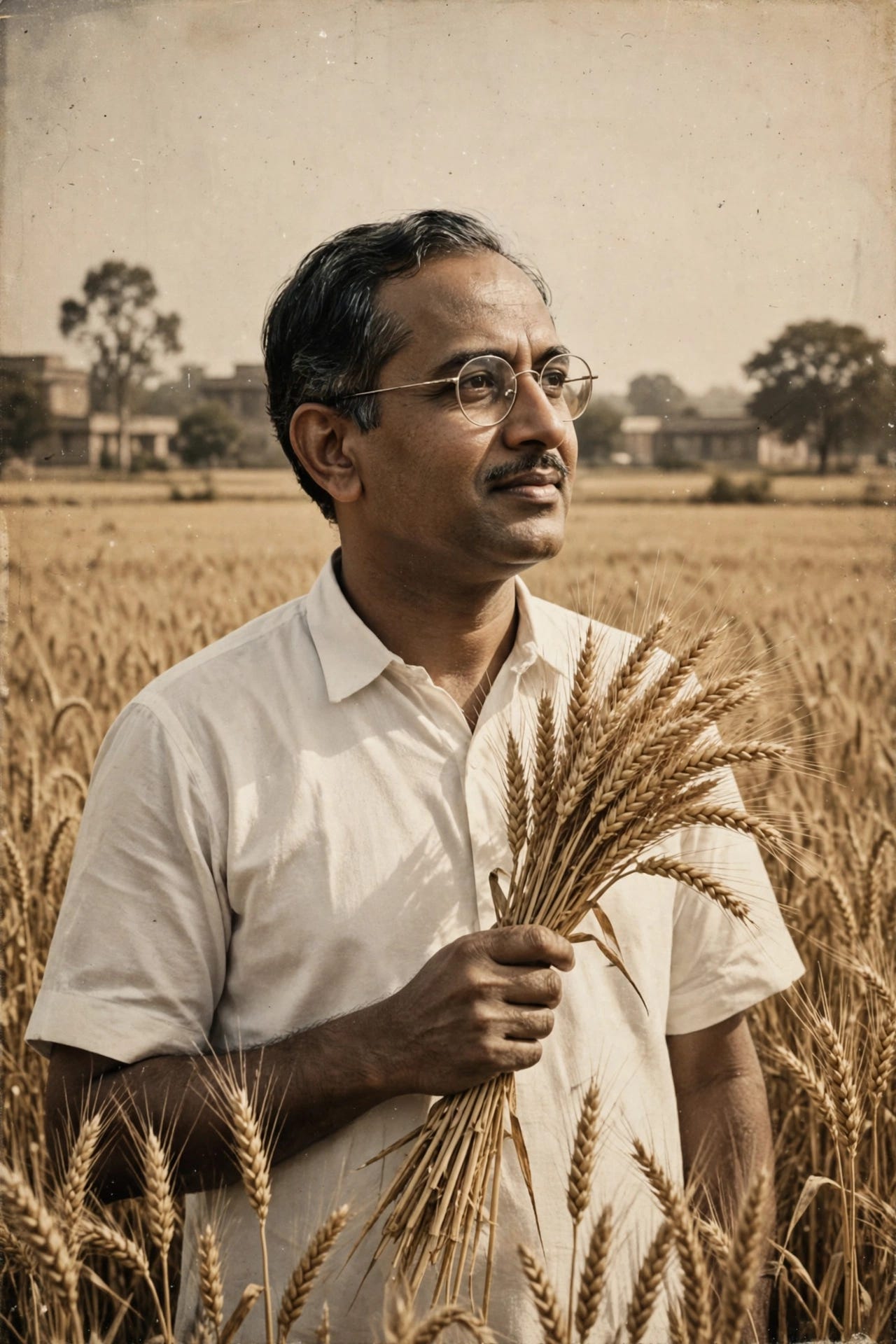
A Surgeon’s Son in Kumbakonam
Kumbakonam, in the Kaveri delta country of what was then the Madras Presidency and is now Tamil Nadu, is a temple town, a market town, and an agricultural town all at once, and a child growing up there in the nineteen-twenties and thirties could not easily separate those identities. The rhythms of worship, of trade, and of the paddy and banana and betel country around the town ran through one another. Into this world, on 7 August 1925, Mankombu Sambasivan Swaminathan was born, the son of a surgeon, in a family that also farmed. That double inheritance — medicine in the house, agriculture in the family’s life — matters more than it might first appear. A surgeon’s household teaches a child that knowledge is not an ornament. It is something you use, precisely and under pressure, on a problem in front of you, where the difference between knowing and not knowing can be measured in a human life. A farming family teaches the complementary lesson: that knowledge which never leaves the house, the clinic, or later the laboratory is only half knowledge, because the real test is out in the field, in weather no one controls, on soil that does not care about your qualifications.
The Royal Society’s biographical memoir and the Britannica account both return to this starting point because it explains so much of what followed. Swaminathan was not a city scientist who discovered the countryside as an adult abstraction. He grew up, as the brief biographical record puts it, witnessing at close quarters the conditions under which Indian farmers actually lived in the 1930s: poverty that was not an occasional misfortune but a structure, yields that stayed poor even when the labour was unremitting, and debt that rolled from season to season and from father to son. A boy who sees that early learns a question that can organise an entire life. Why does the man who grows the food not have enough to eat? Why does a fertile delta, worked by skilled hands, produce so little security for the hands that work it?
It would be too neat to say that the adult scientist was fully formed in the Kumbakonam child. Lives are not that tidy, and Swaminathan’s own path — zoology first, agriculture second, genetics as the meeting point — shows detours and second thoughts. But it is not too much to say that the question was formed there. Later, when he spoke of lab-to-land programmes, when he insisted that farm economics and farm ecology had to go right together, when he founded a research foundation whose work was meant to be pro-nature and pro-poor, he was answering, in institution after institution, the question the delta had put to him as a boy. The surgeon’s son could have followed his father into medicine and healed people one at a time. He chose, in the end, a harder and less certain medicine: to try to heal the conditions that made millions hungry at once.
There is also something in the Kumbakonam beginning that explains his lifelong patience with institutions. Temple towns run on continuity. Markets run on trust repeated daily. Farms run on seasons that cannot be hurried. A man formed by all three is unlikely to believe that a single paper, a single variety, or a single season changes a country. Swaminathan never did believe that. His genius was never only the genetics, though the genetics was real and rigorous. It was the understanding that a variety is only the beginning — that behind every successful seed there must stand trial plots, extension workers, credit, procurement, price policy, and farmers willing to risk a season on a stranger’s promise. That systems thinking, so visible in the Green Revolution years, has its roots in a childhood where nothing important ever happened through one cause alone.
The Farm Childhood: Debt and Poor Yields
To understand what poor yields meant in the India of Swaminathan’s childhood, one has to resist the temptation to treat yield as a statistic. On a small farm, a poor yield is not a number in a table. It is the school fee not paid, the loan renewed at a worse rate, the meal thinned, the seed grain eaten because there is nothing else, and therefore next season begun already in deficit. Debt in such a world is not primarily a failure of character or effort, though moneylenders and landlords were happy to let it be described that way. It is arithmetic. If the land returns barely more than the seed and labour put into it, then any shock — a failed monsoon, an illness, a wedding, a funeral — must be financed by borrowing, and the borrowing is secured against a future harvest that, on the same arithmetic, cannot repay it. The family farming background that the biographical sources record for Swaminathan meant he did not learn this arithmetic from a textbook. He saw the human faces attached to it.
That early witnessing did two things that shaped his science. First, it made him suspicious, for life, of any agricultural research that could not answer the farmer’s question: will this work on my field, with my water, my soil, my credit, and my risk? A variety that yields magnificently on an experimental station with assured irrigation and unlimited fertiliser may be a scientific achievement and an agricultural irrelevance at the same time. Swaminathan’s later insistence on testing Mexican wheat in Indian farmers’ fields in Punjab and Haryana, on persuading farmers rather than merely instructing them, and on demonstration over exhortation, comes straight from this childhood realism. Farmers were not conservative because they were ignorant. They were conservative because a failed experiment, for them, was not a null result. It was hunger.
Second, the childhood taught him that poverty among food producers is a national absurdity, not a natural law. India in the 1930s was not a barren country. The Kaveri delta was among its most productive landscapes. Yet productivity per acre lagged, scientific inputs were scarce, plant breeding was thin, and the colonial state had never built agricultural research and extension as a serious public system for the smallholder. The gap between what the land could do and what it was doing was, to a scientifically minded boy, both a scandal and an invitation. If the gap was made by human arrangements — by absent science, absent credit, absent seed systems — then human arrangements could unmake it. That conviction, that hunger in a farming country is a solvable problem rather than a fate, is the moral engine of Swaminathan’s entire career. Without it, the famine of 1943 might have produced grief. With it, the famine produced a vocation.
It is worth pausing on the debt question because it returns, sixty and seventy years later, at the other end of his life. When Swaminathan chaired the National Commission on Farmers in 2004 to 2006, the reports he led were titled, pointedly, around serving farmers and saving farming, and their most famous recommendation concerned price — the minimum support price — precisely because price is where yield, cost, and debt meet. A scientist who had only cared about tonnes per hectare could have stopped at production. Swaminathan never stopped at production, because the child in Kumbakonam had seen that a farmer can grow a crop and still be ruined by its economics. The line from the delta farm to the commission report is long, but it is straight.
Little Flower and Travancore: Zoology First
Swaminathan was educated first at Little Flower High School in Kumbakonam, and then went to Travancore University — now the University of Kerala — where he took his first bachelor’s degree in zoology. The biographical record adds two details that invite reflection. He was admitted young, at about fifteen, and he completed the degree swiftly, in about two years on the account carried by Encyclopedia.com. Precocity alone explains little; India has produced many precocious graduates who vanished into comfortable careers. What matters is the choice of subject, and then the abandonment of it.
Zoology was a reasonable, even distinguished, choice for a bright science student of his generation. It offered a rigorous training in the living world: anatomy, physiology, evolution, the classification and comparison of organisms. For a future geneticist, it was not wasted time. Genetics sits at the crossing point of zoology and botany, and a man who begins with animals and moves to plants carries a sense of the unity of biological science that narrower training sometimes misses. Swaminathan’s later work ranged across potato, wheat, and rice, and reached outward to radiation sensitivity and cytogenetics — the study of chromosomes and their behaviour. That breadth is easier to understand in a scientist whose first degree taught him to think about organisms whole, before he learned to think about their genes in particular.
But zoology, for the young Swaminathan, had a limit, and the limit was usefulness in the face of hunger. A zoologist in the India of the early nineteen-forties could expect a teaching career, perhaps a research career of genuine distinction, studying fauna that few outside the profession would ever think about. The famine that struck Bengal in 1943 cut across that comfortable prospect. The question from the Kumbakonam farm — why do food growers go hungry — acquired, in the famine, a scale and horror that made a purely academic life feel like an evasion. He would later be described, in the Royal Society memoir’s careful phrasing, as a man whose early experiences during the Bengal famine of 1942 to 1943 profoundly influenced his career. Profoundly is the right word. He did not merely add agriculture to his interests. He restarted his education to pursue it, taking a second bachelor’s degree, this time in agriculture. Very few people, having completed one degree young and quickly, volunteer to begin again in a new field. That he did so tells us the famine was not an episode he observed. It was a verdict he accepted on his first choice of life.
There is a lesson in the zoology detour that his later students and admirers sometimes miss. Swaminathan was not a man who knew his destination from childhood and marched to it without deviation. He was a man who corrected course when the evidence of the world demanded it. That pattern — commit, learn, and then, if the first revolution reveals its own limits, correct it — recurs at the largest scale in his life, when the father of the Green Revolution became the prophet of the evergreen revolution, warning that the methods that had saved India from famine could, if pushed without ecological care, damage the soil, water, and biodiversity on which all future harvests depended. The zoologist who became an agricultural scientist had practised self-correction young. The old scientist who corrected his own revolution was practising the same virtue late.
1943: The Bengal Famine Turns a Life
Every biography of Swaminathan turns on 1943, and rightly so. The Bengal famine of 1942 to 1943 was one of the great catastrophes of the twentieth century in India: a famine in a land of rice, in wartime, under a colonial government whose priorities lay elsewhere, in which hunger moved through the countryside and into Calcutta’s streets and people died not in a remote abstraction but in public, in numbers that shamed everyone who understood them. For a young Indian science student, the famine posed a question that no examination syllabus contained. What is knowledge for, if a country that grows rice cannot keep its rice growers and rice eaters alive?
Swaminathan’s answer was practical rather than rhetorical. He switched to agriculture. That plain sentence, which appears in every account of his life, deserves to be slowed down. Switching meant admitting that his zoology degree, freshly and brilliantly earned, was not the tool the moment required. It meant more years of study when he could have proceeded to employment. It meant choosing a field that, in the status hierarchy of Indian science at the time, carried less prestige than medicine or the pure sciences. And it meant binding his life to the slowest, least glamorous, most weather-dependent of problems: the yield of Indian farms. Famine work, if it is serious, is not dramatic. It is seed multiplication, field trials, soil, water, extension, and price policy, repeated season after season. The young man who chose agriculture in the shadow of 1943 was choosing that slowness, deliberately, for life.
The famine also fixed in him a lifelong refusal to treat food security as someone else’s department. Later, as Director of the Indian Agricultural Research Institute, as Director General of the Indian Council of Agricultural Research, as Director General of the International Rice Research Institute in the Philippines, and as a member of the Rajya Sabha, he held posts that many holders would have treated as administrative summits. Swaminathan treated every one of them as a famine-prevention job. The through-line is visible in the subjects that recur wherever he worked: yield stability, disease resistance, frost and pest resistance in the potato work that took him to the Netherlands, radiosensitivity and cytogenetics in the IARI years, and, in old age, hidden hunger — the malnutrition that persists even when grain is available, because diets lack the nutrients bodies need. A man marked by famine does not stop at counting grain. He asks, to the end, whether people are actually nourished.
Contemporary documentary treatments of the Green Revolution return repeatedly to this wartime starting point, and they are right to do so. The film that traces how India, running out of food, was transformed after a small shipment of Mexican seed arrived, gains its moral force from the famine and ship-to-mouth years that preceded the breakthrough. Without 1943, the Green Revolution can look like a technical story about dwarfing genes. With 1943, it is what it was for Swaminathan: a reply, prepared over twenty years of training, to a catastrophe he had witnessed as a student and sworn, in the only way a scientist can swear, to make impossible again — not by a speech, but by a seed system.
It should also be said plainly that the famine taught him the limits of charity and imports as answers. Emergency food saves lives in the emergency; no serious person denies it. But a country that depends, year after year, on other countries’ surplus grain has handed its most basic security to strangers, shipping schedules, and foreign politics. The phrase that later described India’s condition in the nineteen-sixties — a ship-to-mouth existence, living from incoming grain ship to incoming grain ship — is the peacetime version of the famine condition. Swaminathan’s whole Green Revolution strategy can be read as an attempt to end that dependence at its root: not by refusing help, but by making help unnecessary, through Indian science, Indian seed, and Indian farmers. Self-reliance, in his vocabulary, was never a slogan. It was a famine lesson.
Madras 1947: The Agriculture Degree
In 1947, the year of Independence, Swaminathan took his second bachelor’s degree, in agriculture, from the University of Madras. The coincidence of dates is almost too symbolic, and a careful biographer should note it without milking it: the country was beginning again, and so, in his own way, was he. A free India would need, among a thousand other things, an agricultural science of its own. The colonial research system had produced real work, but it had never been designed to transform smallholder yields across a subcontinent, nor to answer to Indian farmers’ needs as its first duty. The generation of scientists who came of age at Independence inherited both the opportunity and the indictment: the institutes existed, the problems were enormous, and the excuse of foreign rule was gone.
The agriculture degree gave Swaminathan the field grounding his zoology lacked: soils, agronomy, plant breeding, the management of crops as living systems in real weather. It also placed him in the stream that led, naturally, to postgraduate work at the Indian Agricultural Research Institute in New Delhi — IARI, the country’s premier agricultural research institution. If Madras was the decision made formal, IARI was the decision made professional. There, in the capital of the new republic, he would encounter the research culture, the mentors, and the problems — above all the genetics of India’s great crops — that would carry him to the Netherlands, to Cambridge, to Wisconsin, and back again to IARI itself, which he would one day direct.
It is easy, in retrospect, to narrate 1947 as a stepping stone and move on. It deserves a slower look, because the choice of agriculture as a second degree reveals the seriousness with which Swaminathan treated preparation. He did not drift into plant genetics from zoology by adjacency, picking up field knowledge as he went. He went back and learned the discipline from its base, accepting the cost in years. That thoroughness became a hallmark. When he later championed the lab-to-land programme at ICAR, the point was the same at national scale: knowledge moves credibly only when each link in the chain has been properly built. A scientist who had shortcut his own training might have been tempted to shortcut the nation’s. Swaminathan, who had done two degrees to get his training right, built systems instead of shortcuts.
The Madras degree also connected him to the south Indian agricultural world from which he came. Kumbakonam and the Kaveri delta were not left behind when he went north to Delhi and then abroad; they remained his reference point for what a farming family needs and fears. In later decades, when his work was centred in Delhi, in the Philippines, or in international forums, his foundation would be established in Chennai, and his final years would be lived in Chennai, where he died. The geography of his life describes an arc out into the world and back to Tamil Nadu — not from parochialism, but because the questions he served had first been asked there, in the delta, by farmers whose names history does not record and whose condition he never forgot.
IARI: Postgraduate Delhi
Postgraduate study at the Indian Agricultural Research Institute in New Delhi placed Swaminathan at the centre of Indian agricultural science at exactly the moment when that science was being asked to become something larger. IARI’s laboratories and experimental fields were where the country’s plant breeders, entomologists, soil scientists, and geneticists confronted, crop by crop, the central fact of Indian agriculture: yields were low, varieties were vulnerable to disease and weather, and the margin between a normal year and a crisis year was terrifyingly thin.
For a postgraduate with a zoology degree behind him and an agriculture degree fresh in hand, IARI offered the synthesis he needed. Genetics — the science of heredity, of how traits pass and combine — was becoming the key that could unlock systematic crop improvement, replacing the slow empiricism of selection with designed breeding. Cytogenetics, the study of chromosomes, let a scientist see heredity’s machinery. Radiation studies opened routes to induced variation. None of this was abstract for Swaminathan. Each technique was a potential answer to a named Indian problem: a potato that could resist frost and pests, a wheat that could stand disease, a rice that could feed more people from the same acre.
Delhi also taught him the administrative geography of Indian science: how institutes relate to universities, to ministries, to state governments, and, most tenuously of all, to the farmer in a distant district who is supposed to benefit. The gap between a result at IARI and a result in a village field is measured not in kilometres but in institutions, and many of them, in the late nineteen-forties, barely existed. A postgraduate watching that gap in 1948 or 1949 could draw one of two conclusions: that research was a self-contained career whose success was measured in papers, or that research was the first link in a chain that somebody would eventually have to build to the field. Swaminathan’s entire later career — the demonstrations in Punjab and Haryana, the lab-to-land programme, the foundation’s village-level work in Chennai’s orbit — shows which conclusion he drew, and he drew it early.
The IARI postgraduate years also set up the defining decision of his early life. He passed the civil service examinations — the great funnel through which bright young Indians of his generation were channelled into the administrative and police services — and was offered a police post. The offer represented security, status, and the approval of every conventional expectation. Against it stood a UNESCO fellowship, offered in 1949, to study potato genetics in the Netherlands. On paper, the comparison is absurd: a settled career versus a student’s fellowship abroad in a narrow subject. In the logic of Swaminathan’s life since 1943, the comparison was not close at all. He refused the police post and took the fellowship. India lost a police officer whose name no one would now remember, and gained the scientist who would help feed it.
The Police Post Refused: UNESCO 1949
The refused police post is one of those biographical details that survives because it dramatises a truth, and it should be handled with a biographer’s care: the drama is real, but its meaning is not that Swaminathan despised public service. He spent his life in public service, in institutes and commissions and Parliament itself. The meaning is that he had learned to distinguish between serving the public in general and serving, with his particular gifts, the particular emergency he had witnessed. A famine-marked scientist in a police uniform would have been a waste that no one involved could have justified once the famine is kept in view.
The UNESCO fellowship of 1949 took him to Wageningen in the Netherlands, the great Dutch centre of agricultural science, to work on potato genetics. The choice of the potato deserves attention. The potato is not one of India’s ancient staples in the way rice and wheat are, but it is a food crop of enormous importance: productive, nutritious, and grown by small farmers across northern India. Its vulnerabilities — to frost, to pests, to disease — were precisely the kind of problem genetics could attack. Breeding for resistance is slow, unglamorous work with a direct human payoff: a resistant variety protects the poor farmer most, because the poor farmer is the one who cannot afford chemical protection or absorb a crop failure. In choosing potato genetics, the young fellow was already showing the signature of his mature science: start from the vulnerability of the poorest grower, and work backwards to the gene.
The Netherlands also gave him a first sustained look at what an organised agricultural research culture could achieve in a small, intensively farmed country. Dutch agriculture was famous for extracting high yields from limited land through science, cooperation, and meticulous organisation — conditions almost opposite to India’s vastness and poverty, yet suggestive in one crucial respect. Yield gaps could be closed by knowledge systems, not only by land or labour. A country did not have to accept its current harvest as its destiny. Wageningen confirmed, at the level of daily laboratory and field practice, the conviction Kumbakonam had planted and Bengal had sealed.
There is a further, quieter significance to 1949. Swaminathan was twenty-four, travelling from a newly independent, food-insecure India to one of Europe’s most advanced agricultural institutes, not to emigrate toward comfort but to acquire a tool and bring it back. The pattern of his training — Netherlands, then Cambridge, then Wisconsin, then home in 1954 — would later become a template he urged on Indian science generally: go anywhere in the world to learn, without apology, and then build at home, without hesitation. The fellowship was the first step of that pattern, taken against the safer offer of a police post. It is difficult to find, in the whole biography, a decision that predicts more of what followed.
Wageningen: Potato Genetics in the Netherlands
Wageningen, in the late nineteen-forties, was rebuilding along with the rest of the Netherlands after occupation and war, and its agricultural university carried a particular authority on the questions Swaminathan brought to it. Dutch plant breeding had to be excellent: land was scarce, the population dense, and the memory of wartime hunger — the Dutch Hunger Winter was only a few years past — gave food research a moral urgency that a young Indian marked by the Bengal famine would have recognised instantly. Tutor and student, in that sense, spoke the same language before they exchanged a word of science.
His subject was the genetics of the potato, with the practical horizon of resistance — to frost and to pests — that the biographical sources record. Resistance breeding is a discipline of patience and observation. The breeder must understand the wild relatives of the cultivated crop, where resistance genes often reside; must cross, select, and test across seasons; and must accept that most lines will fail. Cytogenetics underpins the work: to move a trait from a wild species into a cultivated one, you must understand chromosome behaviour, compatibility, and inheritance. The skills Swaminathan sharpened at Wageningen were therefore not a narrow specialism he later discarded. They were the foundation of the wheat and rice work at IARI for which he became famous. The potato was his apprenticeship in the craft of using heredity as an instrument of public welfare.
Wageningen also widened his sense of what a research institution is for. The Dutch system linked university, experimental stations, and farming practice in a tight loop; results moved, and farmers’ problems travelled back up the chain to become research questions. India had no comparably tight loop, and building one — through IARI’s directorship, through ICAR’s lab-to-land programme, through the demonstration plots that persuaded Punjabi farmers to trust Mexican wheat — became the institutional project of Swaminathan’s life. It is not fanciful to trace the loop’s first clear sighting to the Netherlands. He saw, in a small country, the machine that a large country would need, and he spent fifty years building India’s version of it at Indian scale.
When the fellowship ended, the next step was Cambridge, and a doctorate. The progression looks smooth in a curriculum vitae — Wageningen, Cambridge, Wisconsin, IARI — but each step was a widening: from a crop, to a discipline, to the world community of genetics, and then home to apply it all where the need was greatest. The potato years are sometimes treated as a footnote before the wheat epic. They are better understood as the epic’s training ground, where the scientist learned both the genetics and the institutional imagination that the wheat years would demand.
Cambridge 1952: The Doctorate
Swaminathan took his PhD at Cambridge in 1952, in genetics. Cambridge in the early nineteen-fifties was one of the world capitals of the science he had chosen; the structure of DNA was on the verge of announcement in that same university, and the air of the place was thick with the sense that heredity — the deepest question in biology — was about to become legible. To take a doctorate there, as a young Indian from Kumbakonam by way of Travancore, Madras, Delhi, and Wageningen, was to be certified by the sternest standards his discipline possessed. No one who later worked with or against Swaminathan ever doubted the rigour of the science under the administrator and advocate. The Cambridge doctorate is part of why. He was not a populariser of other men’s genetics. He was a geneticist.
The doctorate also completed the intellectual equipment he would carry back to India. From zoology he had the organism; from agriculture, the field; from Wageningen, the craft of resistance breeding; from Cambridge, the theoretical depth in genetics and cytogenetics to design breeding programmes rather than merely execute them. Add the Wisconsin postdoctoral experience that followed, in the United States, and the training spans the three great agricultural-science cultures of the mid-century West: Dutch, British, and American. Swaminathan absorbed all three without becoming a disciple of any. The work that made him famous was done in India, on India’s problems, with an international collaboration — with Borlaug’s Mexican programme — that he entered as a peer, not a pupil.
Cambridge had one more gift for him, of a personal kind that the record preserves and that mattered to his life’s work. His wife, Mina Swaminathan, was herself Cambridge-educated, an economist whose work on gender and childcare, including mobile crèches, made her a pioneer in her own field. The partnership that began in that milieu joined two people who shared a conviction that development which ignores women is development mismeasured. When, decades later, Swaminathan insisted that women farmers were neglected in agriculture — a recognition his daughter Soumya would single out at his death as one of his rarest qualities — he was speaking from a household where the economics of women’s invisible labour had been studied, named, and argued about for a lifetime. The personal and the programmatic, in this marriage, were never separate.
It would be wrong to leave Cambridge as a mere credential. The PhD finished in 1952; India had been independent for five years and was already discovering how hard food security would be. Every year Swaminathan spent abroad after that point carried a question: when does the student come home? His answer came in 1954, after Wisconsin. But the doctorate itself marks the moment when the preparation the famine had demanded was essentially complete. The zoologist of Travancore had become Dr Swaminathan, geneticist, and the only remaining question was where the genetics would be practised. On that question, he never wavered.
Wisconsin and the Return 1954
After Cambridge came a postdoctoral period at the University of Wisconsin in the United States, and then, in 1954, the return to India and to IARI. The sequence is recorded plainly in the biographical sources, and its plainness conceals its significance. The mid-twentieth century was the great age of the scientific brain drain, when the ablest graduates of poor countries were absorbed, permanently and understandably, by the laboratories of rich ones. Wisconsin could have been the first step of an American career. For Swaminathan, it was the last step of a training tour whose destination had been fixed since 1943. He came home.
The return deserves to be weighed as a decision, not a default. He was twenty-nine, Cambridge-credentialed, American-experienced, in a discipline whose frontier was in the West. India offered him lower pay, thinner equipment, heavier bureaucracy, and problems of a scale that could swallow a career without trace. It also offered the only problems he had ever actually wanted to solve. The famine had not happened in Wisconsin. The debt-bound farmers were not in the Netherlands. A scientist whose work is driven by a witnessed catastrophe has a compass that points home, and Swaminathan’s pointed, all his life, to Indian fields.
At IARI from 1954, he began the research career that the next sections of this biography follow in detail: work on potato, wheat, and rice; cytogenetics; radiation and radiosensitivity studies — the investigation of how organisms respond to radiation, a route to understanding mutation and generating variation for breeding. These were the years in which the young returnee became, paper by paper and trial by trial, one of the central figures of Indian plant science, positioned — though no one could yet know it — for the encounter that would define his fame. In Mexico, Norman Borlaug’s breeding programme was producing semidwarf wheats of extraordinary yield. In Delhi, Swaminathan was building exactly the combination of genetic expertise, institutional standing, and farmer-facing conviction needed to recognise what those wheats could mean for India, and to fight for their trial, import, and multiplication.
The Wisconsin-to-Delhi arc also established a pattern his admirers in Indian science would cite for generations: international excellence without expatriation. Swaminathan would go on to lead an international institute, IRRI, in the Philippines from 1982 to 1988; to preside over international bodies including the Pugwash Conferences and the IUCN; to win the first World Food Prize in 1987 and be named by Time among the twenty most influential Asians of the twentieth century. None of it moved his centre of gravity. The man who returned in 1954 stayed returned. In a century when India’s talent leaked steadily outward, his life stood as the counter-argument, made not in speeches but in a biography: that a scientist could learn from the whole world and still spend the learning at home.
IARI: Cytogenetics, Potato, Wheat and Rice
The IARI years from 1954 to 1972 were the scientific core of Swaminathan’s life, and they were broader than the wheat story alone suggests. The biographical record lists his research across three crops — potato, wheat, and rice — and across methods that included cytogenetics and the study of radiation and radiosensitivity. To a lay reader those terms can sound like laboratory arcana. In the India of the nineteen-fifties they were instruments aimed at named emergencies.
Cytogenetics studies chromosomes: their number, structure, and behaviour in cell division and inheritance. For a breeder, it is the difference between crossing plants blindly and crossing them with a map. Many of the most valuable traits in crop improvement — disease resistance in a wild relative, for instance — sit in species that cross reluctantly with cultivated varieties, producing sterile or unstable offspring. Cytogenetic knowledge tells the breeder why, and sometimes how to overcome it. Radiation work, and the study of radiosensitivity, belonged to the era’s search for new variation: by understanding how radiation induces mutations, scientists hoped to generate useful variants that conventional crossing could not supply. Not every such hope was fulfilled, and induced-mutation breeding had its fashions and disappointments. But the underlying purpose in Swaminathan’s hands was constant: to widen the genetic raw material available to Indian breeding, because a narrow genetic base is a famine waiting for a pathogen.
The three crops map onto India’s food geography. Rice feeds the east and south; wheat feeds the north and west; the potato supplements both and sustains small farmers through seasons when cereals falter. A scientist working across all three was, whether he said so or not, working on the whole plate. He was also learning the comparative lesson that no single crop’s breakthrough feeds a nation. When wheat’s revolution came in the nineteen-sixties, it came to a man who had spent a decade thinking about the entire food system, and who would therefore push, after wheat, for rice to follow — and, after both, for the nutritional questions that tonnage alone cannot answer.
These were also the years when Swaminathan’s scientific reputation became international in the ordinary, working sense: papers read, conferences attended, collaborations formed. Among the collaborations forming at the edge of his attention in the late nineteen-fifties and early nineteen-sixties was the most consequential of his life. In Mexico, Norman Borlaug, working under a programme supported from the United States, had been breeding wheat for disease resistance and then, using Japanese dwarfing material, for short, stiff straw that could carry heavy heads of grain without lodging — falling over — under fertiliser and irrigation. The Mexican semidwarfs yielded at levels conventional tall wheats could not approach. Swaminathan learned of this success, in the Britannica account’s sequence, and recognised immediately what it might mean transplanted to Indian conditions. Recognition, in science, is itself a creative act. Hundreds of competent people saw the Mexican results. The man in Delhi saw them as the answer to 1943.
Director at IARI 1961: Institution Builder
In 1961 Swaminathan became Director of IARI, a post he held until 1972. To direct the country’s premier agricultural research institute in that decade was to stand at the exact junction where Indian science met Indian hunger, and the decade did not wait politely. The nineteen-sixties would bring drought, war, foreign-exchange crisis, and the ship-to-mouth dependence on imported grain that made food the central question of national policy. A director who treated the post as an honour would have been crushed by it or, worse, comfortable in it. Swaminathan treated it as a weapon.
Institution building, in his hands, meant aligning every part of the institute — its breeding programmes, its experimental farms, its training of young scientists, its links to state agricultural departments — toward outcomes in farmers’ fields. That sounds obvious and was not. Research institutes drift, everywhere in the world, toward measuring themselves by publications and peer esteem, because those are the currencies their staff can control. Field outcomes depend on monsoons, ministries, credit systems, and farmers’ decisions — variables no director controls. Swaminathan’s directorship is remembered because he insisted on the uncontrolled currency anyway. The Mexican wheat work that defines the era was not a laboratory accident that wandered into policy. It was an institute, led by a man who measured success in tonnes and in farmers persuaded, choosing to test foreign varieties on Indian soil, in Indian farmers’ fields, at a scale designed to convince a government.
His eleven years as Director also formed the administrator who would later run ICAR and IRRI. He learned the budgets, the committees, the personnel battles, and the ministerial politics without which, in a democracy, science does not scale. There is a type of scientist who regards all that as contamination. Swaminathan regarded it as part of the experiment. A variety that cannot survive a finance ministry is, in the only sense that matters to a hungry country, an unsuccessful variety. The persuasion of 1966 — when he convinced the government to import eighteen thousand tons of Mexican seed — was an administrative and political achievement built on scientific evidence, and it was prepared by five years of learning, as Director, exactly how such persuasion is done.
The directorship overlapped, too, with the first great honours: the Padma Shri in 1967, and, just before the IARI years closed, the Ramon Magsaysay Award for Community Leadership in 1971 and the Padma Bhushan in 1972. Honours of that kind, arriving while the Green Revolution’s results were still young, signalled that the country understood what had happened in its wheat fields and who had authored the Indian half of it. Swaminathan accepted such recognition throughout his life with a consistency of response that became characteristic: he converted prestige into institution. The pattern reaches its purest form in 1987 and 1988, when the first World Food Prize and its two hundred thousand dollars became not a personal windfall but the founding endowment of a research foundation in Chennai.
India in the 1960s: Ship to Mouth
No phrase in modern Indian history carries more humiliation, or more explanatory power, than ship to mouth. In the nineteen-sixties, India — a civilisation that had farmed the Indus and Ganga plains for millennia — depended on imported grain, much of it from the United States under the PL-480 programme, to keep its cities and deficit regions fed. The grain arrived by ship; the country ate, in the brutal shorthand of the time, from ship to mouth, with no reserve worth the name between an American harvest, an American political decision, and an Indian dinner. Documentary accounts of the Green Revolution begin here for good reason: this was the condition the revolution existed to end.
Dependence of that kind is never only economic. It bends foreign policy, because a government awaiting grain ships negotiates with its hunger on the table. It bends domestic politics, because food prices and food scarcity decide the fate of ministries. And it bends the national imagination, fostering a despairing suspicion — whispered then in many capitals, including friendly ones — that India’s population had simply outrun its land, and that famine was its future tense. Swaminathan rejected that suspicion with the whole of his scientific life. The problem, as he had believed since Kumbakonam, was not that Indian land could not feed Indians. It was that Indian agriculture had never been given the seed, the science, the inputs, and the price incentives that modern farming required. The nineteen-sixties were the decade in which that belief was tested at national scale, under the worst possible conditions of drought and scarcity, and found sufficient.
The ship-to-mouth years also explain the urgency — some contemporaries thought it recklessness — of the seed import strategy. Testing a new variety for a decade while the country imports grain by the shipload is a luxury that only the well-fed can recommend. Swaminathan’s approach compressed the timeline without abandoning evidence: test the Mexican varieties in India, demonstrate them in farmers’ fields in the wheat belt, multiply seed as fast as biology allowed, and, in parallel, persuade the government to import seed in bulk so that the demonstration could become a national planting in a single decisive season. Each step carried risk. Imported varieties might fail under Indian disease pressure; a failed national planting would deepen both hunger and scepticism. But the alternative — continued dependence, indefinitely extended — was not safety. It was the famine risk made permanent and outsourced.
When later critics weighed the Green Revolution’s costs — and the costs were real, and this biography will weigh them in their place — the honest weighing must begin from the ship-to-mouth baseline. The question history asks of the nineteen-sixties is not whether the Green Revolution was flawless. It is what India would have eaten, and on whose sufferance, without it.
Borlaug and Mexico: The Dwarf Wheat
Norman Borlaug’s Mexican programme is one of the great stories of twentieth-century science: a plant pathologist from Iowa, working in Mexico from the nineteen-forties, breeding wheat first for resistance to stem rust, the fungal scourge that could annihilate a crop, and then incorporating dwarfing genes that changed the plant’s architecture. The logic of the dwarf wheat repays a moment’s attention, because it is the technical heart of the Green Revolution. A traditional tall wheat, given generous fertiliser and water, grows luxuriant straw and then lodges — collapses — under the weight of its own grain, and the harvest rots where it falls. The plant, in effect, cannot use abundance. A semidwarf wheat, with short, stiff straw, stands upright under the same generous treatment and converts the fertiliser and water into grain instead of straw. Yield ceilings that had constrained wheat for centuries lifted, in the Mexican fields, to levels that visitors initially refused to believe.
Swaminathan learned of Borlaug’s semidwarf success and did the thing that distinguishes the great appliers of science from its spectators: he sought collaboration, early in the nineteen-sixties, to test the Mexican material under Indian conditions. The collaboration between the two men — the American in Mexico and the Indian in Delhi — became one of the century’s fruitful scientific partnerships, celebrated later in forums such as the World Food Prize Foundation’s conversations on peace through agriculture, where Borlaug, Swaminathan, and China’s Yuan Longping are named together as the century’s seed-borne peacemakers. The framing is apt. Their work was diplomacy conducted in germplasm: varieties crossing borders that armies and ideologies could not, carrying not a flag but a yield.
Yet the partnership should not be sentimentalised into mere harmony of genius. Borlaug’s wheats were bred for Mexican conditions — Mexican diseases, Mexican day lengths, Mexican soils. Whether they would resist Indian rusts, suit Indian chapati-making tastes, and perform under Indian irrigation and fertiliser realities were empirical questions that only Indian trials could answer. Swaminathan’s contribution was precisely this translation: the design and defence of an Indian testing programme, the selection among Mexican lines of those that fitted Indian needs, and the political-scientific work of persuading farmers and then a government. The dwarf wheat was Mexico’s gift. The Green Revolution was India’s construction, and its chief architect on the Indian side was the Director of IARI.
There is a photograph the imagination supplies for this period, whether or not a camera recorded it: the geneticist in the trial plot, head of wheat in hand, in the company of farmers who have seen a hundred promises fail. That company mattered. Borlaug himself was famous for dragging officials and farmers into fields and making them look at plants. Swaminathan shared the instinct completely. Both men understood that in agriculture, the field is the only peer review that finally counts, and the farmer is its editor.
100 Kilograms: The First Mexican Seed
The documentary telling of the Green Revolution delights in a number, and the number deserves its delight: one hundred kilograms. In 1963, on the account dramatised by the film whose title says it outright — India was running out of food, and then a hundred kilograms arrived from Mexico — the first small consignment of Mexican seed reached India for trial. A hundred kilograms is a few sacks. It is what a single prosperous farm might sow. Measured against a subcontinent’s hunger, it is nothing. Measured as information, it was everything: a living sample of a new plant architecture, from which Indian science could learn, select, multiply, and decide.
Seed has this peculiar property, which no other technology shares in quite the same way: it copies itself. A machine imported is one machine. Seed imported, if it performs, becomes next season’s larger planting, and the season after’s larger still, in a compounding that turns sacks into shiploads within a few agricultural years. The hundred kilograms of 1963 were therefore not a shipment but a hypothesis with a multiplication table attached. The trials that followed in India tested the hypothesis rigorously. Did the Mexican lines yield under Indian conditions as they had promised? Did they resist the rusts that stalked Indian wheat? Did farmers, the final judges, approve of the grain? The answers, in the trial plots and demonstration fields, came back affirmative enough to justify the boldest step of Swaminathan’s career.
It is worth dwelling on the interval between the hundred kilograms and the eighteen thousand tons of 1966, because in that interval lies the difference between a scientific result and a revolution. Three years of trials, selections, demonstrations, argument, and persuasion separate a sample from a national programme. Revolutions in agriculture are not declared; they are multiplied, season by season, through seed systems that must be built while they are being used. The young scientists and extension workers who ran those trials, and the Punjab and Haryana farmers who risked their fields on an unknown Mexican plant, are the unnamed co-authors of the story this biography tells under one famous name. Swaminathan, to his credit, spent a lifetime saying so — his later persona as mentor and institution builder, his insistence on crediting farmers, and above all women farmers, grows from these years when he watched anonymous people take the risk that made his science real.
The hundred kilograms also carry a lesson about scale that his later career kept teaching. At MSSRF, the foundation he created in Chennai, the model would again be small, well-tested interventions — in coastal agriculture, in biodiversity, in women’s technology — designed to multiply through communities rather than descend from ministries. The seed taught him the method: begin with what is proven, however small; let living things and convinced people do the multiplying.
Trials in Punjab and Haryana
The Mexican varieties were tested in India, the Britannica sequence records, and the testing ground that mattered most was the wheat belt of the north-west: Punjab and Haryana. The choice was agricultural logic. These were wheat states with irrigation infrastructure, with farmers experienced in the crop, and with the market and procurement connections to reward a surplus. If the semidwarfs could prove themselves anywhere in India, they could prove themselves there — and proof there, visible and weighable, was what a sceptical country and a cautious government required.
But logic alone does not persuade a farmer to sow an unfamiliar variety across his holding. The trials succeeded because they were conducted as demonstrations in real fields, under real farm management, where neighbours could walk the bunds, inspect the standing crop, and attend the harvest weighments. Swaminathan persuaded farmers in Punjab and Haryana — the verb in the biographical record is persuaded, and it is the right verb — not by circular or radio appeal but by the oldest evidence in agriculture: look at this field, next to yours, under your sky. A farmer who watches a short, stiff-strawed wheat stand heavy-headed where his own tall variety would have lodged, and who then watches the threshing floor tally, does not need a lecture on dwarfing genes. The plant makes the argument. The scientist’s job is to arrange the encounter and stand behind the result if it fails.
These demonstration years also refined the technology into a package, because seed alone, both Swaminathan and Borlaug insisted, is never the whole intervention. The semidwarfs expressed their yield only with adequate fertiliser, assured water, and plant protection — the famous package of practices. Teaching the package, supplying the package, and financing the package became the extension challenge of the Green Revolution, and the source, in time, of many of its criticisms: packages cost money, favour the irrigated and the creditworthy, and load the soil and water with chemicals. All of that belongs to the critics’ section of this biography. Here, in the trial years, the essential fact is simpler: in Punjab and Haryana, between the hundred kilograms and the eighteen thousand tons, the Mexican wheat stopped being foreign. It became, field by field, an Indian crop with Indian evidence behind it, and the persuasion of farmers scaled up into the persuasion of a government.
There is a human texture to these years that the statistics of 1964 to 1970 can obscure. Behind every demonstration plot stands a family that agreed to be watched failing, if fail it did. The Green Revolution’s historiography sometimes treats adoption as an automatic response to a superior technology. It was nothing of the kind. It was thousands of individual decisions, made under uncertainty by people who could not afford a mistake, in favour of a scientist most of them would never meet. That they decided as they did is a tribute to the evidence in the fields — and to the man who insisted the evidence be generated in their fields, not only on his institute’s farm.
1966: 18,000 Tons and a Government Persuaded
In 1966, Swaminathan persuaded the Government of India to import eighteen thousand tons of Mexican wheat seed. The Britannica account presents the sequence without ornament — collaborated, tested, persuaded farmers, persuaded government, imported — and calls the import, in effect, the birth of India’s Green Revolution. The scale of the decision is hard to overstate. Eighteen thousand tons of seed is a planting programme for a nation, purchased with scarce foreign exchange by a government presiding over drought and ship-to-mouth dependence, on the advice of its agricultural scientists, for sowing by farmers most of whom had never seen the variety. It remains one of the boldest technology decisions ever taken by a democratic government on scientific advice.
Consider what had to align for the import to happen. The science had to be ready: trial results strong enough to survive scrutiny by sceptics in the institute, the ministry, and the press. The politics had to be ready: a government under Indira Gandhi, in the policy environment of those years, willing to stake prestige and foreign exchange on a harvest not yet sown. The logistics had to be ready: shipping, port handling, distribution to the wheat states, and seed treatment, all against the calendar of the sowing season, which forgives no delay. And the farmers had to be ready, prepared by the demonstration years to receive the seed not as an imposition but as an opportunity they had already inspected. Swaminathan stood at the centre of the alignment because he was the rare figure who could speak in all its languages: the genetics to the scientists, the tonnes to the ministry, the field evidence to the farmers, and the famine memory — his own, and the nation’s — to everyone.
The import also settled a question about the kind of scientist he was. A laboratory geneticist of equal brilliance might have published the trial results and left procurement to the state. Swaminathan understood that in a poor country, the scientist who washes his hands of implementation abandons his result at the exact point where it begins to matter. He persuaded. The word recurs in his biography like a motif — persuaded farmers, persuaded government — and it marks his true profession within his profession: he was a persuader armed with evidence, an advocate whose brief was a harvest. Later generations of Indian scientists, watching ministers take scientific advice seriously in field after field, have lived in a house that the persuasion of 1966 helped to build.
And then the seed was sown, and India waited for a harvest as a country waits for an election result — except that this result would be measured not in seats but in whether the ship-to-mouth years would begin, at last, to end.
The Green Revolution: Wheat 1964-1970
The harvests answered. India’s wheat production rose from twelve million tons in 1964 to twenty million tons in 1970. The figures are Britannica’s, and behind their cleanliness lies one of the most dramatic production movements in agricultural history: a two-thirds increase in the output of a staple grain in six years, in a country that had been importing food to survive. The Green Revolution — the name itself became a fixture of the language — had its epicentre in the irrigated wheat belt, and its effects radiated outward through the whole food economy. Procurement filled government stocks. Buffer reserves, that unglamorous foundation of food security, became thinkable. The ship-to-mouth grip loosened, and with it loosened the foreign and domestic politics of dependence that had humiliated and constrained the country.
It is important to describe accurately what the revolution consisted of, because both its worshippers and its detractors sometimes describe a simpler thing than what occurred. It was not a seed. It was a system arriving together: semidwarf varieties that could use abundance without lodging; fertiliser to supply that abundance; irrigation to make water a managed input rather than a gamble; plant protection; credit to finance the package; extension to teach it; and procurement at announced prices to guarantee that a surplus would find a buyer. Swaminathan’s genius was systemic from the Kumbakonam childhood onward, and the revolution bears his stamp in being a system rather than a gadget. Remove any major element and the yields sag; the states that prospered most were those that assembled the whole.
The human meaning of the twelve-to-twenty-million-ton climb is best grasped from below. For the wheat-belt farmer, it was the passage from subsistence arithmetic — the debt arithmetic of Swaminathan’s childhood — to surplus arithmetic: a crop that could pay the loan, educate the child, improve the house, and still leave grain in store. For the urban poor and the deficit regions, it was the slow retreat of the fear that had stalked 1943 and the ship-to-mouth years: the fear of the empty market. For the nation, it was a recovered sovereignty, the ability to conduct its affairs without a grain fleet as its lifeline. When the United Nations Secretary-General, Javier Perez de Cuellar, later called Swaminathan a living legend whose work had made an indelible mark on food production in India and the developing world, he was decorating the man. The harvests of 1964 to 1970 are the undecorated fact beneath the decoration.
Yet even in the triumph years, the man at the centre kept a scientist’s peripheral vision. A revolution built on fertiliser, water, and a narrow set of varieties carries its costs within its design, and those costs — to soil, to aquifers, to regions left outside the irrigated magic circle — would in time demand a reckoning that Swaminathan himself would lead. The Green Revolution’s father became its most credible critic precisely because he never confused its necessity with its perfection. That reckoning, too, is part of this story, and it begins, as it should, only after the achievement has been given its full weight.
Rice Follows Wheat
A wheat revolution in the north-west, however spectacular, left the greater part of India’s food problem untouched, because the greater part of India eats rice. The rice belt — the deltas and coasts of the east and south, the Kaveri country of Swaminathan’s own childhood among them — farmed a different crop, in standing water, under a different disease regime, with varieties as vulnerable to lodging and low yield ceilings as wheat’s had been. If the Green Revolution stopped at wheat, it would remain a regional event with national publicity. Swaminathan’s IARI research had always spanned rice as well as wheat, and the logic of his career after the wheat breakthrough pressed steadily toward the harder, wetter problem.
Rice improvement drew on the same genetic principles — semidwarf architecture, disease resistance, responsiveness to fertiliser without collapse — pursued through international as well as Indian programmes. The International Rice Research Institute in the Philippines, which Swaminathan would one day lead as Director General from 1982 to 1988, stood at the centre of that world effort, and his Indian work of the nineteen-sixties and seventies was in constant conversation with it. Varieties moved, scientists moved, and the rice farmer of the deltas began, more slowly and unevenly than the wheat farmer of Punjab, to see yields lift. The unevenness matters to an honest account. Rice environments are more diverse than wheat’s; water control, on which the whole package depends, was weaker in much of the rice belt; and the Green Revolution’s geography therefore tilted, durably, toward the north-west — a tilt whose political and economic consequences India still manages.
For Swaminathan personally, the rice chapter completes the scientific portrait. He was never a one-crop man riding a single breakthrough. Potato genetics in Wageningen; cytogenetics across potato, wheat, and rice at IARI; wheat’s revolution in the sixties; rice’s slower transformation thereafter; and finally, at IRRI, the leadership of the world rice effort itself — the arc describes a scientist whose subject was never a species. His subject was the food security of the poor, pursued through whichever genome was on the bench. That is why his later turn to nutrition and hidden hunger surprised only those who had mistaken the wheat epic for the whole man. A scientist whose subject is nourishment will always, eventually, arrive at the question of what the grain contains and whom the system forgets.
The Critics: Fertiliser, Water and Inequality
No honest biography of Swaminathan can seal the Green Revolution inside its heroic decade, because the criticisms that gathered around it were substantial, because many of them were just, and because — the decisive point — Swaminathan himself came to voice the deepest of them. The balanced assessment this section offers follows the themes the record supports: the revolution’s dependence on fertiliser and pesticide, its thirst for water, and its unequal geography.
The chemical critique is the most familiar. The semidwarf package converted yield into an input race: more fertiliser, more plant protection, more assured irrigation. Where those inputs were used carelessly or excessively, soils and water paid — through nutrient imbalance, through chemical runoff, through the long, slow mining of aquifers in the wheat-rice belt, where paddy in particular drank groundwater at rates the rains could not repay. Biodiversity narrowed as a few high-yielding varieties displaced the rich landrace diversity Indian farmers had maintained for centuries — a genetic erosion that a cytogeneticist of Swaminathan’s formation understood in his bones, and which his later foundation work on biodiversity and coastal systems directly answered. The revolution fed the present, in places, by borrowing from the future. Its father spent his later decades insisting the loan be acknowledged and the borrowing stopped: that insistence is the evergreen revolution, and it is treated in its own section below.
The inequality critique cuts as deep. The package of practices cost money and required water, so its benefits pooled where irrigation, credit, and procurement already existed — above all Punjab, Haryana, and western Uttar Pradesh — while rain-fed regions, which housed the poorest farmers, gained least. Within favoured regions, larger farmers could finance the package sooner and fuller than smallholders. A national triumph in tonnes coexisted with a widening map of regional disparity, and Indian politics has argued over that map ever since. Documentary and journalistic treatments of his legacy — the Mojo Story obituary treatment among them, with its twin-revolutions framing and its attention to malnutrition and biotechnology debates — keep this contested character in view, and they are right to. Swaminathan’s reputation survives the contest because he never denied it. His National Commission on Farmers, four decades later, was aimed squarely at the distress of the farmers the production revolution had not rescued.
The fairest verdict holds both truths in one sentence, as he did: the Green Revolution was necessary, and it was not sufficient. Necessary, because ship-to-mouth India faced a future of famine and dependence that no critic has ever shown how else to escape. Insufficient, because production is not nourishment, tonnes are not incomes, and a farming system that degrades its own soil and water is consuming its seed corn in the most literal sense. The man who embodied both halves of that sentence — who built the revolution and then built the critique’s most authoritative platform — is a rarer figure than either the hero of the hagiographies or the villain of the polemics. He is something more useful to remember: a scientist who treated his own life’s work as a hypothesis, and kept testing it for sixty years.
ICAR Director General 1972-79: Lab to Land
In 1972 Swaminathan moved from directing IARI to directing the whole national system: Director General of the Indian Council of Agricultural Research, a post he held until 1979. ICAR sits above the network of research institutes and agricultural universities that constitute Indian agricultural science, and its Director General holds the system’s purse, priorities, and morale in his hands. After the wheat triumph, the question before ICAR was whether the revolution’s methods could be generalised — to other crops, other regions, and above all to the rain-fed and resource-poor farmers the first revolution had reached least. Swaminathan’s tenure is remembered for attacking exactly that question, and for two institutional signatures the Royal Society memoir records: the lab-to-land programme, and the creation of the Agricultural Scientists Recruitment Board.
Lab to land was a philosophy disguised as a programme. Its premise was the one the Kumbakonam childhood had taught: research that stops at the laboratory gate has stopped halfway. Under lab-to-land, scientists were pressed to carry proven technologies into villages, to work with farm families — whole families, not only the titled male farmer — and to let field results discipline laboratory priorities. The programme attacked the chain problem that had haunted Indian agricultural science since his postgraduate days: the missing links between a journal result and a village harvest. It also quietly revolutionised who counted as a knower in the system. A farm woman who managed seed selection, livestock, and kitchen nutrition held knowledge the institute needed; lab-to-land, at its best, treated her as a colleague in the experiment rather than its terminal recipient. His wife Mina’s work on women and childcare, and his own later championship of women farmers, meet the programme here: the household, whole and gendered as it is, was his unit of agricultural reality.
The Agricultural Scientists Recruitment Board addressed the system’s other half: its people. A research establishment expands or decays by the quality of its recruitment, and a board dedicated to selecting agricultural scientists on merit was an attempt to protect the expanding ICAR system from the patronage and drift that hollow out public institutions. Institution builders are often remembered for buildings. Swaminathan’s buildings were procedures — recruitment boards, lab-to-land linkages, commissions, foundations — designed to keep working after their builder left the room. That he is remembered at all as an institution builder, in a country littered with institutes that declined after their founders, testifies that many of his procedures did keep working.
His ICAR years also carried him into the wider counsels of the state — the years in which agricultural planning, food management, and science policy intersected at the highest levels. By the time he left the Director Generalship in 1979, he had run a great institute for eleven years and the national system for seven. The next call, when it came in 1982, was international: the directorship of IRRI in the Philippines. India, which had borrowed Mexican seed in 1963, was now exporting its foremost agricultural scientist to lead the world’s rice institute. The direction of the seed traffic of ideas had reversed, and no single fact better measures what the Green Revolution generation had achieved.
Mina Swaminathan: Partnership and Women in Agriculture
Behind the public biography stands a partnership that the record, unusually for its generation, preserves by name. Mina Swaminathan was a Cambridge-educated economist whose own work addressed gender and childcare, including the cause of mobile crèches — childcare that travels to where working mothers actually are, at construction sites and workplaces, rather than waiting in buildings their lives never reach. To treat her as a footnote in her husband’s story would repeat exactly the error both of them spent their lives correcting: the rendering of women’s work invisible. Mina’s economics began from the labour that statistics forgot. Her husband’s agriculture, increasingly, did the same.
The convergence shaped policy. Indian agriculture runs on women’s work — in transplanting, weeding, harvesting, seed keeping, livestock care, water and fuel carrying, and the whole economy of household nutrition — while land titles, credit, extension visits, and the very category of farmer were organised around men. Swaminathan’s insistence, repeated across his commission work and foundation programmes, that women are farmers — not farmers’ helpers — and that technology, credit, and training must reach them directly, was not a late decorative feminism. His daughter Soumya Swaminathan, herself a scientist of international standing as a former Chief Scientist of the World Health Organization, said at his death that he was one of the few people who recognised that women are neglected in agriculture. The recognition, in that household, had an author on each side of the marriage.
The partnership also models something about how Swaminathan worked. He was, by every account, a listener in a profession of lecturers — a man whose persuasion of farmers began from the premise that the farmer knew things the scientist did not. A marriage between an agricultural scientist and an economist of invisible labour is a daily seminar in that premise. When the National Commission on Farmers later framed its reports around serving farmers and saving farming, with attention to the household’s whole economy rather than the crop alone, Mina’s intellectual fingerprints are on the framing as surely as her husband’s are on the agronomy. And when Soumya, at his death, pledged that the family would continue the legacy that her father and her mother had shown them, she named them, correctly, as a joint bequest.
It is fitting, too, that the foundation he created in Chennai carried forward work in which women’s technology access and leadership were central threads, under a motto the World Food Prize tribute records in the language of being pro-nature and pro-poor — to which those who know the foundation’s work would add, as its practice consistently showed, pro-women. The surgeon’s son from Kumbakonam married a woman who taught him, and through him taught Indian policy, to count the half of agriculture that the ledgers had left blank. Any full account of how India learned to feed itself must count her in.
Magsaysay 1971 and the Padmas
The honours arrived in the sequence of a life being steadily absorbed into the nation’s official gratitude, and the sequence itself is worth recording exactly. The Padma Shri came in 1967, while the wheat revolution was still in its first harvests. The Ramon Magsaysay Award for Community Leadership followed in 1971 — Asia’s great prize for public spirit, and significant in its category: not science, but community leadership, as if the Magsaysay jury in Manila had seen, earlier than most, that Swaminathan’s real discipline was the mobilisation of people around knowledge. The Padma Bhushan came in 1972. Then, as the decades turned, the Albert Einstein World Science Award in 1986, the first World Food Prize in 1987, and the Padma Vibhushan in 1989. The Bharat Ratna, India’s highest civilian honour, would complete the arc only in 2024, after his death — a lateness that says something about how slowly nations canonise their feeders compared to their warriors, and something about the man that he never campaigned for the correction.
Honours lists are the driest form of biography, and this one is included for a reason beyond completeness. Read closely, the list maps the widening circles of his reputation: state honour in the sixties, Asian honour in 1971, world scientific honour in the eighties, and the two great global recognitions — the World Food Prize and Time’s naming — clustering at the end of that decade and the end of the century. Each circle corresponds to a widening of the work itself: from IARI to India, from India to Asia’s rice world at IRRI, from IRRI to the global forums of Pugwash and the IUCN. The medals chased the work, never the reverse. Colleagues who watched him across these decades remark on the same trait the Magsaysay category captured: he collected institutions and responsibilities the way other men collect awards, and treated awards, when they came, as working capital — prestige to be spent on the next unfashionable cause, whether that cause was coastal biodiversity, women farmers, or the politically thankless arithmetic of support prices.
The Magsaysay year deserves one more line. In 1971 he was forty-six, fresh from the IARI directorship’s greatest triumph, with ICAR ahead of him. Community leadership, the citation’s category, would have puzzled a narrower scientist. It fits Swaminathan exactly, because his science had always required communities to move: farmers to adopt, ministries to import, institutes to reorient, nations to cooperate. The gene was his instrument. The community was his medium.
IRRI 1982-88: The Philippines Years
In 1982 Swaminathan became Director General of the International Rice Research Institute in the Philippines, serving until 1988. IRRI, at Los Baños, was the rice counterpart of the Mexican wheat programme that had changed his life: the institute whose semidwarf rices had launched Asia’s rice revolution, and the command post of the world effort to raise the yield of the grain that feeds half of humanity. That the post went to an Indian — he remained, the record notes, the only Asian to hold the directorship until an interim appointment in 2023 — measured both the man and the transformation he represented. The country that had lived ship to mouth in the sixties supplied, in the eighties, the director of the world’s rice institute.
The IRRI years widened his canvas from India’s food problem to Asia’s. Rice environments across the monsoon world share the Indian challenges — small farms, water uncertainty, disease pressure, poor farmers whom input packages reach last — and differ in a hundred local ways that punish imported certainties. Running IRRI taught, or confirmed, the lesson his whole career encodes: principles travel, packages must be rebuilt locally. It also placed him at the centre of the international agricultural research system at the moment when that system was beginning to absorb the environmental critique of the first Green Revolution — the questions about sustainability, genetic diversity, and input dependence that would define his evergreen revolution thinking in the decades after. At IRRI those questions were not academic. An institute devoted to a water-loving crop, in a region of fragile deltas and coasts, confronts ecology every working day.
His Philippines tenure also completed a symmetry. Borlaug’s Mexico had sent seed east to India in 1963; two decades later India sent its foremost seed scientist west across the Pacific to lead rice science for the world. The traffic in germplasm and people that Swaminathan had joined as a beneficiary, he now directed as a principal. When the World Food Prize was created in the following decade’s planning and its first laureate chosen, the choice of the man who had carried the revolution from Mexico’s wheat to India’s fields and then to Asia’s rice institute had a logic that transcended any single harvest. In 1987, midway through his IRRI tenure’s final phase, that logic was made official.
The First World Food Prize 1987
In 1987 M. S. Swaminathan became the first laureate of the World Food Prize, the award founded to honour those who have advanced human development by improving the quality, quantity, or availability of food in the world. First laureates define prizes; the choice tells the world what the award believes itself to be about. In choosing Swaminathan, the World Food Prize declared that its subject was not charity and not commerce, but science in the service of the hungry, applied at national scale, by a man of the developing world itself. The citation moment produced the words by which the United Nations Secretary-General, Javier Perez de Cuellar, fixed his standing for the record:
“Dr. Swaminathan is a living legend. His contributions to agricultural science have made an indelible mark on food production in India and elsewhere in the developing world. By any standards, he will go into the annals of history as a world scientist of rare distinction.”
Living legend is a phrase officials spend carelessly, but in 1987, applied to a sixty-two-year-old still mid-career — with MSSRF, the evergreen revolution, the National Commission on Farmers, and the Rajya Sabha all still ahead of him — it reads less like flattery than like a scheduling error in the obituaries: the legend had decades of work left. The prize carried two hundred thousand dollars, and what he did with the money became the most quoted fact of his later biography, because it converted an honour into an institution in a single act. He used the prize money to establish the M. S. Swaminathan Research Foundation in Chennai. Prizes usually end stories. His founded one.
The 1987 prize also placed him in the small company that the World Food Prize Foundation’s own retrospectives assemble: Borlaug the wheat breeder, Swaminathan the revolution’s Indian architect, Yuan Longping of hybrid rice — the men whose seeds, in the Foundation’s framing of peace through agriculture, did what treaties often failed to do, and made former famine lands into food exporters and negotiating partners rather than supplicants. It is a framing he would have accepted with one amendment, characteristically: the seeds did nothing alone. Farmers did it, in Punjab and Haryana and a thousand deltas, and the scientist’s glory, such as it is, is borrowed from their fields.
MSSRF: Prize Money into a Foundation
The M. S. Swaminathan Research Foundation, established in Chennai with the World Food Prize money at the end of the nineteen-eighties, was his answer to a question that had followed him since IARI: what does research look like when it is freed from the ministry’s agenda and built, from the first brick, around the poorest user’s problem? The foundation’s working motto, as the World Food Prize tribute records its spirit, joined three loyalties that official science usually separates: to nature, to the poor, and — in the foundation’s daily practice — to women. Its fields of work followed the gaps the Green Revolution had left: coastal and mangrove agriculture where sea and farm contend, biodiversity conservation where the landraces displaced by high-yielding varieties could be preserved with the communities that bred them, biotechnology assessed rather than worshipped or feared, and technology delivery designed for the farm households — very often the women of those households — whom the package era had reached last.
A foundation of this kind lives or dies on the quality of its information. Field researchers working across coastal villages and farming communities gather crop-yield figures, survey responses, soil and water readings, and household data in whatever form the field supplies — notebooks, spreadsheets assembled on the road, files passed between teams — and before any of it can support a conclusion it must be cleaned, reconciled, and made trustworthy. It is unglamorous work, and it is where research integrity is actually decided. A field team preparing its harvest and survey records for analysis today might reach for a utility such as Clean Dirty Data File Online to tidy a messy data file before the serious statistical work begins — a small, practical echo of the discipline Swaminathan demanded at national scale: that evidence, however humble its origin, be made clean enough to bear the weight of decisions about people’s food.
MSSRF also embodied his conviction that the scientist’s duty runs past publication into presence. Its model put researchers in sustained contact with the communities their work concerned — fisherfolk, dryland farmers, tribal custodians of seed diversity — and treated those communities’ knowledge as data, not folklore. The boy who learned debt arithmetic by watching Kumbakonam farmers had built, in his sixties, an institution whose founding assumption was that the watching and listening never stop. When admirers ask which of his creations will outlast him longest, the honest answer may not be a wheat variety, long since superseded, nor a report, however cited. It may be this foundation in Chennai, still working the seams — coast, seed, gender, nutrition — where hunger hides after the granaries are full.
Evergreen Revolution: His Correction to His Own Revolution
If the Green Revolution was Swaminathan’s gift to the twentieth century, the evergreen revolution was his bequest to the twenty-first, and the relationship between the two is the most intellectually honest chapter of his life. The evergreen revolution, as he framed it in his later decades, meant achieving the productivity gains of the green revolution in perpetuity — rising yields without ecological harm: without mining the soil, draining the aquifer, narrowing the genetic base, or loading field and water with careless chemistry. It was not a repudiation of 1966. It was 1966 grown up, submitting its methods to the audit of its consequences.
The audit, in his own summary sentence — given in conversation and preserved as his most quoted line on the subject — binds the two halves of his life’s learning into one test for any agricultural policy: “If farm economics and farm ecology go wrong, nothing else can go right in agriculture.” Economics and ecology, the two words his career had always joined: the debt arithmetic of Kumbakonam and the soil arithmetic of the Punjab aquifers, the price that saves the farmer and the practice that saves the field. A policy that enriches this year’s harvest by bankrupting the farmer fails the first test. A policy that enriches this year’s harvest by bankrupting the watershed fails the second. Only the rare policy that passes both deserved, in his accounting, to be called progress.
There is a personal courage in this chapter that should not be missed. Scientific founders usually defend their revolutions; their reputations are mortgaged to them. Swaminathan, whose name is fused to the Green Revolution more completely than any other Indian’s, used the authority that fusion gave him to lead its criticism — to say, in forum after forum, that the methods of the sixties could not be the methods of the future, and that productivity pursued without ecology would end by destroying productivity itself. The zoologist who abandoned his first degree when the world refuted it, and the old man who corrected his own revolution when the evidence refuted parts of it, are recognisably the same person. It is the trait that makes his biography, beneath the honours, a study in how a scientist should age: by remaining a scientist.
The evergreen idea also reframed his earlier work for younger readers who had grown up with the critique alone. To a generation that knew the Green Revolution first as a cautionary tale, Swaminathan’s later teaching offered a way to hold the history whole: gratitude for the famine averted, honesty about the costs incurred, and a programme — ecological, pro-poor, pro-women — for the agriculture that must now replace the emergency agriculture of the ship-to-mouth years. Emergencies justify emergency methods. His final argument was simply that the emergency, thanks in part to him, was over, and the methods had to grow up with the country they had saved.
Hidden Hunger and Nutrition
A nation can fill its granaries and still malnourish its children. That paradox — calories sufficient, nourishment deficient — was the problem Swaminathan named hidden hunger and pressed upon Indian policy in his later decades, and it follows from his biography with the inevitability of a final exam question. The famine witness of 1943 had learned to ask not only whether food exists, but whether people are nourished. A diet of cereals alone, even abundant cereals, leaves bodies short of the proteins, vitamins, and minerals — the iron, the vitamin A, the zinc — on which children’s growth and mothers’ survival depend. The Green Revolution, organised around cereal tonnage, had solved the calorie crisis it was built to solve. Hidden hunger was the crisis underneath, waiting its turn.
His advocacy here joined several threads of his life. From the nutrition side came the push for dietary diversity: pulses, millets, vegetables, and the traditional crops the cereal revolution had pushed to the margins, restored to fields and plates. From the genetics side came biofortification — breeding crops for nutritional content as deliberately as his generation had bred them for yield. From Mina’s side of the household, and from a lifetime of watching farm women manage household food, came the insistence that nutrition is decided in kitchens and by mothers’ knowledge and time, so that any serious anti-hunger policy is also, inescapably, a policy about women. And from the foundation side came MSSRF’s community-level work, where nutrition gardens, local food diversity, and women’s self-help groups carried the doctrine into practice at village scale.
Documentary and journalistic retrospectives on his life return to this theme because it complicates the statue. The Mojo Story treatment of the Green Revolution’s twin revolutions, for instance, sets malnutrition alongside starvation in its account of what he fought — and the pairing is just. Starvation was the enemy of his youth; hidden hunger was the enemy of his age; and the continuity between them is the measure of the man. He never accepted a definition of victory that the bodies of poor children would have contradicted. In a policy world that prefers single metrics — tonnes produced, calories available — his insistence on the harder, composite question, are they nourished, stands as his final scientific bequest alongside the evergreen revolution: the demand that success be measured where it matters, in the human being at the end of the food chain.
Pugwash, IUCN and the World Stage
The honours and presidencies of his international life can be listed briefly — President of the Pugwash Conferences on Science and World Affairs, President of the International Union for Conservation of Nature, at points in his career — but the pairing itself deserves a paragraph of interpretation, because it captures the two anxieties of his century that he chose to carry. Pugwash is the scientists’ movement against nuclear war, born of the Russell-Einstein manifesto’s warning that science had given humanity the means of its own extinction. The IUCN is the world conservation union, science organised against the slower extinction of species and ecosystems. That one man should have been called to lead both tells us how his peers read him: as a scientist whose authority was moral as well as technical, and whose subject — the conditions of human survival — legitimately spanned the mushroom cloud and the mangrove.
His presence in those forums also completed the journey from the hundred kilograms. The young fellow who sailed to Wageningen in 1949 to learn potato genetics from a world that had little reason to notice him became, by the century’s end, one of the figures the world summoned when science and survival had to be discussed in the same sentence. He used the summons characteristically: to argue that food security is peace security, that hungry societies are combustible societies, and that the seed and the soil belong on the agenda beside the warhead. The World Food Prize Foundation’s conversations on peace through agriculture, where his name is spoken with Borlaug’s and Yuan Longping’s, institutionalise exactly that argument. Roads and seeds, in that framing, are instruments of peace as real as treaties — a doctrine the ship-to-mouth years had taught him in negative, when dependence and hunger were themselves a kind of unfreedom.
None of this world-stage life detached him from Chennai, from the foundation, or from the Indian farmer’s price problem, to which he would return in his eighties with the National Commission. The international presidencies are best read not as a second career but as the same career at wider aperture: the man who persuaded a government to import seed in 1966 spent his later decades persuading a civilisation to import ecological sense into its farming, and disarmament sense into its politics, with the same evidence-first patience.
Time’s Twenty: With Gandhi and Tagore
In 1999, Time magazine named M. S. Swaminathan one of the twenty most influential Asians of the twentieth century. The company the list placed him in, for India, was of a kind that no committee bestows twice: the only other Indians were Mohandas K. Gandhi and Rabindranath Tagore. The liberator, the poet, and the feeder. It is difficult to think of a twentieth-century Indian life that would not be rearranged by such a juxtaposition, and the juxtaposition is worth contemplating rather than merely citing, because it identifies, with a magazine’s accidental profundity, the three currencies in which India’s century was transacted: freedom, imagination, and food.
Gandhi’s presence needs no gloss. Tagore’s — the poet who gave Asia its first Nobel in literature and India its songs of selfhood — represents the century’s inner life. Swaminathan’s represents its material base, the truth that freedom and poetry alike are practised by bodies that must eat. A nation that cannot feed itself will have its politics written by its suppliers and its culture shadowed by its hunger; the Bengal famine had occurred, after all, in Tagore’s own Bengal, two years after the poet’s death, in the land of the songs. That the feeder stands third in the Indian triad is not a demotion. It is the recognition that his work underwrote the conditions in which the other two legacies could be inherited by a self-governing, self-feeding people.
Swaminathan himself, by every indication, received such rankings with the embarrassment of a man who kept insisting on the collective nature of his achievement — the farmers, the colleagues, Borlaug, the unnamed extension workers of the demonstration years. The embarrassment was genuine and also, in a sense, the point. Influence of his kind is real precisely because it is distributed: a variety in a million fields influences more lives than a speech in a million ears. Time’s list, whatever its arbitrariness, caught that distributed influence and gave it a face. The face happened to be his, and he spent the honour as he spent the World Food Prize money — by converting it, promptly, into authority for the causes that still lacked it, above all the cause of the Indian farmer in distress, which now summoned him home from the world stage to the hardest assignment of his old age.
National Commission on Farmers 2004-06
In November 2004, the Government of India constituted the National Commission on Farmers and placed its chairmanship in the hands of a seventy-nine-year-old who might, by any convention, have retired into the laurels of Time lists and presidencies. He accepted, and over two years the commission produced five reports under the collective title that announced its double loyalty: Serving Farmers and Saving Farming. The final report came in October 2006. Together the reports constitute the most authoritative Indian document of their era on the crisis of the countryside — the indebtedness, the cost-price squeeze, the water stress, and the despair that had made farmer suicides a national shame in the very decades after the production triumph.
The commission’s significance begins with its framing. It did not ask only how India could grow more, the question of 1966. It asked how the grower could live — the question of Kumbakonam in the nineteen-thirties, returned now with a commission’s seal. Serving farmers and saving farming are two tasks, not one: a farming sector can be statistically healthy while its farmers are ruined, if prices, credit, and risk are arranged against them; and farmers can be subsidised in ways that ruin farming’s ecological base. Swaminathan’s commission held both, as his life had always held economics and ecology in one sentence. Its recommendations ranged across credit, water, land, insurance, and the reform of the support-price system — but history, journalism, and the farmers’ movements have fastened, rightly, on one recommendation above all, the one that reduced the commission’s economics to a formula a child could memorise and a movement could march behind.
That the chairmanship came to him at all is its own commentary. Governments appoint commissions to many kinds of eminence. They appointed this one to the man who personified Indian agriculture’s greatest success, precisely because his success gave him the standing to declare its incompleteness. The father of the Green Revolution, certifying in five official volumes that the revolution’s children were in distress and that price policy was a first cause, could not be dismissed as an activist or an enemy of modern agriculture. He was modern Indian agriculture. The reports’ authority in every subsequent debate on farm prices — cited in Parliament, including in a Lok Sabha answer in 2017, and carried on banners by farm unions ever since — flows from that unimpeachable source.
MSP: The C2+50% Recommendation
The recommendation, stated in the commission’s language, was that the minimum support price — the MSP, the floor price at which the state assures procurement of a farmer’s crop — should be at least fifty per cent more than the weighted average cost of production. In the vocabulary of Indian farm politics, the cost in question came to be read as the comprehensive cost, the C2 of the official cost taxonomy, which counts not only paid-out expenses but the imputed value of family labour and the rental value of owned land. Hence the formula by which the recommendation entered history and the protest placard: C2 plus fifty per cent. Few sentences of Indian economic policy have had a longer afterlife. Nearly two decades after the final report, the demand for a legally guaranteed MSP at Swaminathan’s formula remains the central plank of farmers’ movements, and his name is invoked in its support with a reverence usually reserved for saints of the soil.
The economics beneath the slogan deserve the respect he gave them. A support price set near or below the true cost of production converts farming into a slow confiscation: the farmer sells the crop, repays what can be repaid, and borrows the difference, re-entering the debt arithmetic that Swaminathan had watched in Kumbakonam seventy years before. A margin of fifty per cent above comprehensive cost was his calculation of what a farm family needs beyond survival — to service debt, to invest, to educate, to withstand a failed season without the moneylender. It was, in short, the price expression of his life’s first lesson: that production without viable economics is a treadmill to ruin, however green the fields along it. If farm economics goes wrong, nothing else can go right — the commission’s MSP formula is that sentence, enacted as arithmetic.
Successive governments received the recommendation with the mixture of praise and postponement that greets expensive truths, and its partial, delayed, and contested implementations belong to political history rather than to this biography. What belongs here is the fact of authorship. The scientist who had spent the nineteen-sixties maximising tonnes spent his eighties maximising the tonne’s reward, and saw no contradiction, because there was none: both campaigns served the same farmer, first against hunger, then against the hunger of the ledger. When he died in 2023, the farm unions’ tributes named the MSP formula among his legacies alongside the wheat itself. They were right, and the pairing is the biography in miniature.
Rajya Sabha 2007-13: The Scientist in Parliament
In 2007, at eighty-two, Swaminathan entered Parliament as a nominated member of the Rajya Sabha, serving until 2013. Nominated seats exist in India’s upper house for eminence in fields — literature, science, art, social service — that elections rarely supply, and few nominations in the institution’s history have fitted the design as exactly as his. He brought into the chamber the authority of the National Commission he had just chaired, and he used the membership as he had used every platform since Wageningen: to press the claims of the farmer and of ecological sanity upon the attention of power, from inside the room where power sits.
The parliamentary years complete a pattern in his career that is easy to miss if the posts are read as a mere ladder. IARI gave him an institute; ICAR, a national system; IRRI, an international one; the commission, a nation’s farm policy to diagnose; Parliament, the legislative floor itself. At each stage the scientist moved one step closer to the point where decisions are finally taken, carrying the same evidence and the same constituency — the poor farmer — into rooms progressively less accustomed to hearing either. He was not a politician, and the record does not make him one; he introduced no faction, built no machine, sought no office beyond the nomination that was given. He was something rarer in a legislature: a witness with a vote, whose interventions carried the weight of a man who had personally supervised the transformation he now sought to correct and complete.
There is also a valedictory quality to the timing. His term ended in 2013, a decade before his death, and the decade that followed was lived largely in Chennai, at the foundation, in the company of the causes — biodiversity, coastal resilience, nutrition, women farmers — that MSSRF existed to serve. Parliament had been the last of the great public platforms. What remained was the first of them, in a sense: the direct, unmediated work with communities that the Kumbakonam childhood had prescribed, carried on now by an institution rather than a ministry. The arc from the police post refused in 1949 to the Rajya Sabha vacated in 2013 spans the whole geography of Indian public life, and at every coordinate on it, the man was doing recognisably the same job.
The Mentor: Students and Scientists
Every account of Swaminathan by those who worked under him returns, sooner or later, to the same quality, and the Prime Minister’s tribute at his death gave it official phrasing: he was a nurturing mentor to many. The phrase matters because Indian science, like all science, reproduces itself through mentorship or fails to reproduce at all, and a man who directed IARI for eleven years, ICAR for seven, and IRRI for six stood at the head of three generations of agricultural scientists. His students and junior colleagues staffed the institutes, universities, and programmes of the Green Revolution and its aftermath across India and Asia. The varieties have been superseded; the people have not — they became, in their turn, directors, breeders, and mentors, carrying his standards into rooms he never entered.
The standards themselves are worth specifying, because mentorship of his kind is a technology like any other. From the testimony pattern across his career, its elements were these: the problem is chosen from the field, not the fashion; the evidence is generated where the result must live, among farmers; the credit is distributed downward, to the team and the cultivator, never hoarded at the top; and the work is not finished when the paper is published, but when the practice changes. A student formed by those four rules could work on any crop, in any country, and be recognisably of his school. Many did. The school’s alumni network, though it has no name and no register, is among the largest institutions he built, and the only one that renews itself automatically with every harvest of young scientists it inspires.
His mentorship extended, in his later decades, beyond professionals. Through the foundation, through lectures, through the sheer availability of his example to students in agricultural universities who would never meet him, he functioned as the profession’s elder in a sense India understood culturally: the guru whose authority rests on a life visibly spent in the service of the subject. When the tributes of September 2023 described a powerhouse of innovation joined to a nurturing mentor, the joining was the biography’s whole argument in two phrases. The innovation fed the nation. The nurturing ensured the nation would go on being fed by hands he had trained, long after his own were stilled.
Chennai, 28 September 2023
M. S. Swaminathan died on 28 September 2023, at his residence in Chennai, at the age of ninety-eight — at 11:20 in the morning, the Hindu BusinessLine recorded, in the city where his foundation stood and to which his long arc out into the world had always returned. He had been born in the Madras Presidency in 1925, before Independence, before the republic, before the Green Revolution had a name; he died in a self-feeding India of a kind that the Bengal of his student years could not have imagined, and the distance between those two Indias is, in significant part, the measure of his life.
The tributes came immediately, and they came, as the next section records, from every point of the political compass. The Prime Minister, Narendra Modi, wrote on the day of his death: “Deeply saddened by the demise of Dr. MS Swaminathan Ji. At a very critical period in our nation’s history, his groundbreaking work in agriculture transformed the lives of millions and ensured food security for our nation.” And, in the same thread, the Prime Minister joined the achievement to the manner of the man: “Beyond his revolutionary contributions to agriculture, Dr. Swaminathan was a powerhouse of innovation and a nurturing mentor to many.”
The President of India, Droupadi Murmu, mourned him in words that looked past the nation to the species his work had served: “The demise of MS Swaminathan, internationally renowned agricultural scientist, saddens me no end. He leaves behind a rich legacy of Indian agriculture science which may serve as a guiding light to steer the world towards a safer and hunger-free future for humanity,”
And from within the family came the voice that knew the private sources of the public doctrine. His daughter Soumya Swaminathan told ANI: “We will continue the legacy that my father and my mother, Mina Swaminathan, have shown us. My father was one of the few people who recognised that women are neglected in agriculture,” The sentence breaks off in the reporting, as grief’s sentences do, but its direction is unmistakable: the legacy was a joint parental bequest, and its unfinished item, named at the graveside by his own daughter, was the cause of the women of Indian agriculture. A biographer could not invent a more exact summary of the work remaining. He did not need to invent it. She said it.
Ninety-eight years is a long life by any arithmetic, and his had the rare property of remaining, to its final decade, a working life — the commission in his eighties, Parliament into his late eighties, the foundation’s causes into his nineties, the centenary of his birth already approaching on the horizon he would not cross. He died, as he had lived since 1943, in harness to the proposition that hunger is a solvable problem. The solving, he would have been the first to say, was not finished. But the proof that it could be solved — in wheat, in rice, in the transformation of a ship-to-mouth nation into a food-secure one — stood in every full granary in India on the morning he died.
A Nation Mourns Across Parties
The mourning of September 2023 had a quality that Indian public life rarely achieves: unanimity without choreography. Tributes arrived from the Prime Minister and the President, from the Congress leadership, from Tamil Nadu’s Chief Minister, from the Bharatiya Janata Party’s presidency — from, that is, the opposed poles of a polarised republic — and they agreed, in substance, on the man. Cross-party consensus of that kind is not a tribute to blandness. Swaminathan had taken positions, above all on MSP and farm economics, that inconvenienced governments of every colour. The consensus honoured something else: a life so evidently spent on a constituency larger than any party — the Indian farmer, the hungry citizen — that party itself briefly fell silent before it.
There is a historical rhyme in the breadth of the grief. The Green Revolution had been a national project in the literal sense, executed under one government, extended under its successors, and woven so deeply into the country’s survival that its architect belonged, by 2023, to no faction’s history. He belonged to the harvest. When politicians of opposed camps reached for words, they reached for the same ones — food security, transformation, the farmer — because those were the words his life had made common property. The Class 2 signal of those days, in the research language of this biography’s method, showed themes of a nation briefly unified by gratitude; and the gratitude, unusually, was proportionate to the debt.
For Tamil Nadu, the mourning had a local register beneath the national one. Kumbakonam’s son, Chennai’s resident, the founder of the foundation on its coast — the state mourned a native who had conquered the world’s science without ceasing to be its own. And for the world’s agricultural community, from IRRI to the World Food Prize Foundation, the death closed the founding generation of the Green Revolution: Borlaug gone in an earlier decade, Yuan Longping in 2021, and now, in 2023, the Indian of the triad. An era of seed-borne transformation, which had begun with a hundred kilograms in 1963, ended as an era of living memory. What remained was its inheritance — and, within five months, its highest national seal.
Bharat Ratna 2024
On 9 February 2024, the Government of India announced the Bharat Ratna, the nation’s highest civilian honour, for M. S. Swaminathan, posthumously. The Prime Minister announced it in words that joined the award to its reasons: “It is a matter of immense joy that the Government of India is conferring the Bharat Ratna on Dr. MS Swaminathan Ji, in recognition of his monumental contributions to our nation in agriculture and farmers’ welfare.” And the announcement carried the summary of the career that the honour sealed: “Dr. Swaminathan’s visionary leadership has not only transformed Indian agriculture but also ensured the nation’s food security and prosperity.”
The Bharat Ratna completed the honours arc that had begun with the Padma Shri of 1967, and its posthumous timing invites the reflection this biography offered earlier: nations decorate their feeders slowly. The award arrived fifty-seven years after the first Padma, thirty-seven years after the first World Food Prize, and five months after the death it could no longer gladden. Yet its significance is not diminished by its lateness, because the Bharat Ratna is not, in the end, for the recipient. It is for the republic’s memory — a declaration, entered into the permanent record, of what the nation chooses to call its highest service. In 2024 India declared that the transformation of its agriculture and the welfare of its farmers stood at that summit. The declaration will teach schoolchildren, long after the policy debates have moved on, that a geneticist who fed the country ranks with the founders and liberators in the national pantheon — beside, as Time had already arranged it, Gandhi and Tagore.
It also sealed the MSP chapter with an irony the farmers’ movements did not miss: the state had now given the commission’s chairman its highest honour while his central recommendation still awaited full enactment. The movements said so, plainly, in the award’s aftermath, and in doing so they used the honour exactly as he would have wished — not as a full stop, but as leverage for the unfinished work. A Bharat Ratna on a tombstone is a period. In the hands of the living farmers who marched under his formula, it remained what his whole career had been: an argument, armed with evidence, addressed to power.
The Centenary and What Remains Unfinished
In 2025, India launched the centenary commemorations of his birth — the hundredth anniversary of 7 August 1925, marked at the national level, with the Prime Minister launching the Dr M S Swaminathan centenary commemorations. Centenaries are for stock-taking, and the stock, taken honestly in his own spirit, divides into the finished and the unfinished with unusual clarity. Finished: the ship-to-mouth era, ended beyond return; the proof that Indian science and Indian farmers, given seed and system, could feed India; the institutions — IARI’s modern form, ICAR’s recruitment board, IRRI’s Asian leadership, MSSRF itself — still working. Unfinished: nearly everything he spent his second half naming. The evergreen revolution remains a programme more praised than practised, while aquifers fall and soils tire in the revolution’s heartland. Hidden hunger persists in the bodies of children whose calorie counts pass inspection. Women farmers still wait for the land titles, credit, and recognition his daughter named at his death. And the MSP formula, C2 plus fifty per cent, still awaits the statutory life his commission prescribed for it.
A lesser man’s centenary might be an embarrassment to his heirs, a festival of pieties over a closed account. His is the opposite: a checklist. The commemorations of 2025, and the discussions that surrounded them in the public square, kept returning — as he trained the country to return — from the celebration to the agenda. That may be the surest sign that the mentorship outlived the mentor. He had spent sixty years teaching India to measure agricultural success not by the ceremony but by the field, not by the tonne alone but by the farmer’s ledger, the soil’s ledger, and the child’s body. A centenary that argues about aquifers and support prices in his name is not a failure of reverence. It is reverence, in the only dialect he respected.
What remains unfinished also remains, in the strict sense, finishable — and that was his final gift to the country’s morale. Nothing on his list requires a miracle. It requires what 1966 required: evidence assembled, farmers persuaded, governments convinced, and a scientist’s patience applied across seasons. The centenary found no shortage of young Indians in agricultural universities who regard his life as their commissioning. The hundred kilograms are still multiplying, in the only medium that finally matters, which is people.
Legacy — The Man Who Made Hunger History
Legacy is a word that invites marble, and Swaminathan’s resists marble, because the legacy is alive and working in too many places at once: in every wheat field that stands where a lodged crop would once have fallen, in the buffer stocks that let India face a drought year without a grain fleet, in the recruitment board’s merit lists and the lab-to-land habit of Indian agricultural science, in the foundation’s coastal villages in Chennai’s orbit, in the C2-plus-fifty formula on a union banner, and in the standard — now impossible to unstate — that farm economics and farm ecology must go right together or nothing else in agriculture can. To keep track of a legacy that dispersed is itself a scholar’s lifetime work. A student assembling a personal research archive of notes on Swaminathan’s papers, commission reports and field trials — cross-referencing the IARI years against the commission volumes, the foundation’s coastal studies against the evergreen essays — would need a durable home for that growing body of material, and might well keep it in VaultBook, where a life’s reading on the man who fed a nation could be organised, searched, and carried forward as the centenary generation takes up his checklist.
But the deepest stratum of the legacy is not institutional or even agricultural. It is demonstrative. Swaminathan’s life proves a proposition that poor countries perpetually need proved: that a problem regarded as a fate — famine, in a land of farmers — can be reclassified, by knowledge organised and applied, as a problem merely unsolved. He reclassified it. The boy who watched debt arithmetic consume his neighbours, the student whom 1943 rerouted from zoology to agriculture, the fellow who chose potato genetics over a police post, the director who persuaded farmers and then a government, the laureate who turned prize money into a foundation, the octogenarian who chaired a commission for the farmers his revolution had left behind — the life is a single demonstration, conducted over ninety-eight years, that the distance between a hungry country and a fed one is not destiny. It is work.
He made hunger history in the precise sense that after him, hunger in India could never again be described as natural. It could only be described as a failure — of policy, of price, of ecology, of will — and failures, unlike fates, have authors and remedies. That reclassification, more than any variety or report, is what the surgeon ‘s son from Kumbakonam left to the country he fed. It is why the statues, when they come, will matter less than the standard: every future Indian agricultural policy will be measured, whether its authors know it or not, against the question his life taught the nation to ask. Not only, how much did we grow? But also: who ate, who prospered, what did the soil keep, and what did the water pay? A country that asks all five questions has already inherited him.
Assessment: Science in the Service of the Poorest
The final assessment can be brief because the evidence has been laid out at length, and because Swaminathan himself supplied the criteria by which he asked to be judged. By the criterion of production, the verdict is the harvest record: wheat from twelve million tons in 1964 to twenty million in 1970, rice transformed in its train, a ship-to-mouth nation made food-secure, and a model carried, through IRRI and the international system, to the rice fields of a continent. By the criterion of institutions, the verdict is the list that still functions: a modernised IARI, an ICAR with its lab-to-land doctrine and its recruitment board, a foundation in Chennai working the margins where hunger hides. By the criterion of justice, the verdict is the commission — five reports, one formula, and a permanent alteration in what Indian farmers can demand with the state’s own science behind them. By the criterion of ecology, the verdict is the evergreen revolution: incomplete as practice, unmatched as doctrine, and authored, uniquely in the history of revolutions, by the revolution’s own father. And by the criterion of character, the verdict is the one his daughter and his Prime Minister, from opposite ends of his life, pronounced in the same week: a man who recognised the neglected — women in agriculture above all — and who nurtured the young scientists who would succeed him.
Against this, the honest debits stand where this biography placed them: a revolution whose chemical and water costs were real, whose geography enriched some regions and bypassed the poorest, and whose cereal focus left hidden hunger to a later fight. The debits are not small. They are also, every one of them, items he himself entered into the ledger, publicly and repeatedly, when entering them cost him the comfort of an untroubled monument. Science in the service of the poorest was his phrase for the enterprise, in spirit if not in syllable, and it contains the whole assessment: science, real and rigorous, Cambridge-certified and field-tested; service, the refusal of the laboratory’s self-sufficiency; and the poorest, the Kumbakonam debtor of 1935, the Bengal victim of 1943, the woman transplanting rice whom the ledgers forgot, named as the client for whom the entire apparatus existed. Many scientists serve knowledge. Many servants of the poor distrust knowledge. The twentieth century produced few who fused the two at national scale, and Asia, asked by Time to name its twenty most influential, placed the fusion between Gandhi and Tagore. This biography, having examined the evidence section by section, finds the placement just.
He was, in the end, what his Secretary-General called him in 1987, with the decades since having only added exhibits: a world scientist of rare distinction, whose distinction was that the world’s hardest problem — feeding itself without devouring itself — was the one he chose, at seventeen, in a famine, and never put down. The Scientist Who Fed a Nation is the title of this account. The record supports a longer one, and he earned both: the scientist who fed a nation, and then taught it what feeding truly means.
There is one more dimension of the assessment that a purely Indian reading can understate, and it is the dimension the Philippines years and the Pugwash and IUCN presidencies together reveal: Swaminathan as a teacher of the developing world to itself. The Green Revolution is often narrated as a transfer — knowledge made in Mexico and the United States, applied in India, and then diffused outward. His career quietly refutes the geography of that story. The decisive acts of the Indian revolution were Indian: the recognition of what the Mexican material could do under Indian conditions, the design of trials in Indian farmers’ fields, the persuasion of an Indian government to stake foreign exchange on seed, and the construction of the Indian systems — procurement, credit, extension, price assurance — without which the seed would have remained a curiosity in a trial plot. When he then carried that experience to IRRI, and later to the world forums, the direction of teaching ran from the once-hungry country outward. For agricultural scientists across Asia and Africa, his life carried a specific and transferable encouragement: that their own institutes, their own farmers’ fields, and their own governments could be the site of the breakthrough, and that importing knowledge — as he had imported it from Wageningen, Cambridge, Wisconsin, and Mexico — is not dependence when the importer intends, from the first day, to become a maker. Dependence is a relationship, not a shipment. He imported seed and became sovereign. That distinction, demonstrated rather than argued, may be his most exportable idea.
A related lesson, and one the centenary generation of Indian scientists would do well to study, concerns his relationship with time. Modern research careers are measured in grant cycles and publication counts, and both metrics punish the kind of work that made him matter. Resistance breeding takes seasons. Institution building takes decades. The interval between the hundred kilograms of Mexican seed and the twenty-million-ton harvest was filled with unglamorous multiplications, and the interval between the National Commission’s reports and any full enactment of their central recommendation has already stretched across a generation of politics. Swaminathan’s career is a standing rebuke to the confusion of speed with importance. He was never slow where slowness cost lives — the compressed testing and bold import of the nineteen-sixties prove the opposite — but he understood that agriculture itself keeps seasonal time, that trust among farmers accumulates at the speed of harvests witnessed, and that a scientist who cannot think in decades will always be outlived by his problems. The foundation model he left behind, working patiently in coastal communities and seed systems, is that philosophy institutionalised: small, proven, compounding, like seed.
Finally, there is the matter of tone, which in his case is not decoration but method. In a century of Indian public life not short of polemic, Swaminathan persuaded without humiliating, criticised without excommunicating, and corrected his own revolution without a trace of self-flagellation or self-pity. Governments that postponed his recommendations still decorated him; critics of the Green Revolution who disputed its costs still cited his later writings as their authority; farmers’ movements that marched against sitting governments marched under his formula and his portrait together. That breadth of trust was earned by a lifetime of a single rhetorical discipline: he always brought evidence, he always named the poorest person in the room as the client, and he never asked any audience to take his word for what a field could settle. A nation that wishes to argue better about its food — and every nation must argue about its food, forever — could do worse than to adopt his tone as deliberately as it adopts his varieties. The assessment, then, closes where the biography opened. The surgeon’s son learned that knowledge is for use, under pressure, on the problem in front of you. India was the problem in front of him. He used everything he knew, for ninety-eight years, and the use is still feeding people who will never know his name — which is, by the standard he set himself in 1943, exactly what success was supposed to look like.
Sources and Acknowledgements
This account rests on the biographical and institutional record of M. S. Swaminathan’s life, principally: Encyclopaedia Britannica, “M.S. Swaminathan | Green Revolution, India, Contribution, Agriculture, Genetics, & Awards”; the Royal Society Biographical Memoir of Monkombu Sambasivan Swaminathan (2025); the World Food Prize Foundation’s tribute of 28 September 2023 and its laureate record; Press Information Bureau releases, including the Prime Minister’s tribute of 28 September 2023 (PRID 1961649) and the Bharat Ratna announcement of 9 February 2024; the reports of the National Commission on Farmers, “Serving Farmers and Saving Farming” (2004–2006), and the Lok Sabha answer of 2017 recording the MSP recommendation; and reporting by Hindu BusinessLine on his death in Chennai on 28 September 2023. Quotations are reproduced only from these attributed sources, as cited in the text.
Video sources consulted, cited here as they genuinely serve the reader who wishes to see and hear the history: “India Was Running Out of Food. Then 100 KG Arrived From Mexico.” (documentary on the Green Revolution), https://www.youtube.com/watch?v=VfeAdlFzzqM ; “MS Swaminathan’s Green Revolution — twin revolutions transformed agriculture in India”, Mojo Story, https://www.youtube.com/watch?v=wk6XPkxYRoE ; “Peace Through Agriculture: Amb Quinn on Vietnam, Cambodia, WFP and the Power of Roads and Seeds”, World Food Prize Foundation, https://www.youtube.com/watch?v=mE9H2X-PY_8 . The author thanks the farmers of Punjab and Haryana whose demonstration fields made the evidence, and the unnamed scientists, extension workers, and farm families — above all the women among them — whose work this biography, following its subject’s own practice, acknowledges as the true authorship of the Green Revolution.