

There are singers whose voices belong to a film, singers whose voices belong to a generation, and then, very rarely, there is a singer whose voice seems to belong to the inner life of a whole people — to their weddings and their mourning, to their temples and their mosques and their long train journeys home, to the radio left playing in a courtyard at dusk and the cassette rewound one more time in a small room far from the country where the song was first heard. Mohammed Rafi, who lived from 24 December 1924 to 31 July 1980, was that kind of singer. He recorded bhajans that made listeners fold their hands without thinking, qawwalis that rose like a gathering storm of devotion, ghazals of such tenderness that a single sustained note could hold an entire broken heart, and comic numbers so light on their feet that the laughter arrived before the punchline had quite landed. He could be the tragic hero staring at a world that had taken everything from him, and in the very next recording session he could be the carefree young man shouting his joy from a mountainside. That range was not a trick. It was the product of a classical training pursued with monastic seriousness, of a village boyhood in Punjab, of teachers who demanded discipline, and of a temperament so famously gentle that colleagues who disagreed about almost everything else agreed about this one man’s humility. To follow his life is to follow the history of Hindi film music itself through its golden age — from the Lahore of travelling fakirs and early radio, through the Bombay studios of the 1940s, to the summit of the 1950s and 1960s, through eclipse and comeback, to a final recording session on the last day of his life. This is the story of how a boy called Pheeko became, for millions of listeners across India and far beyond it, something close to a prayer that could be sung.
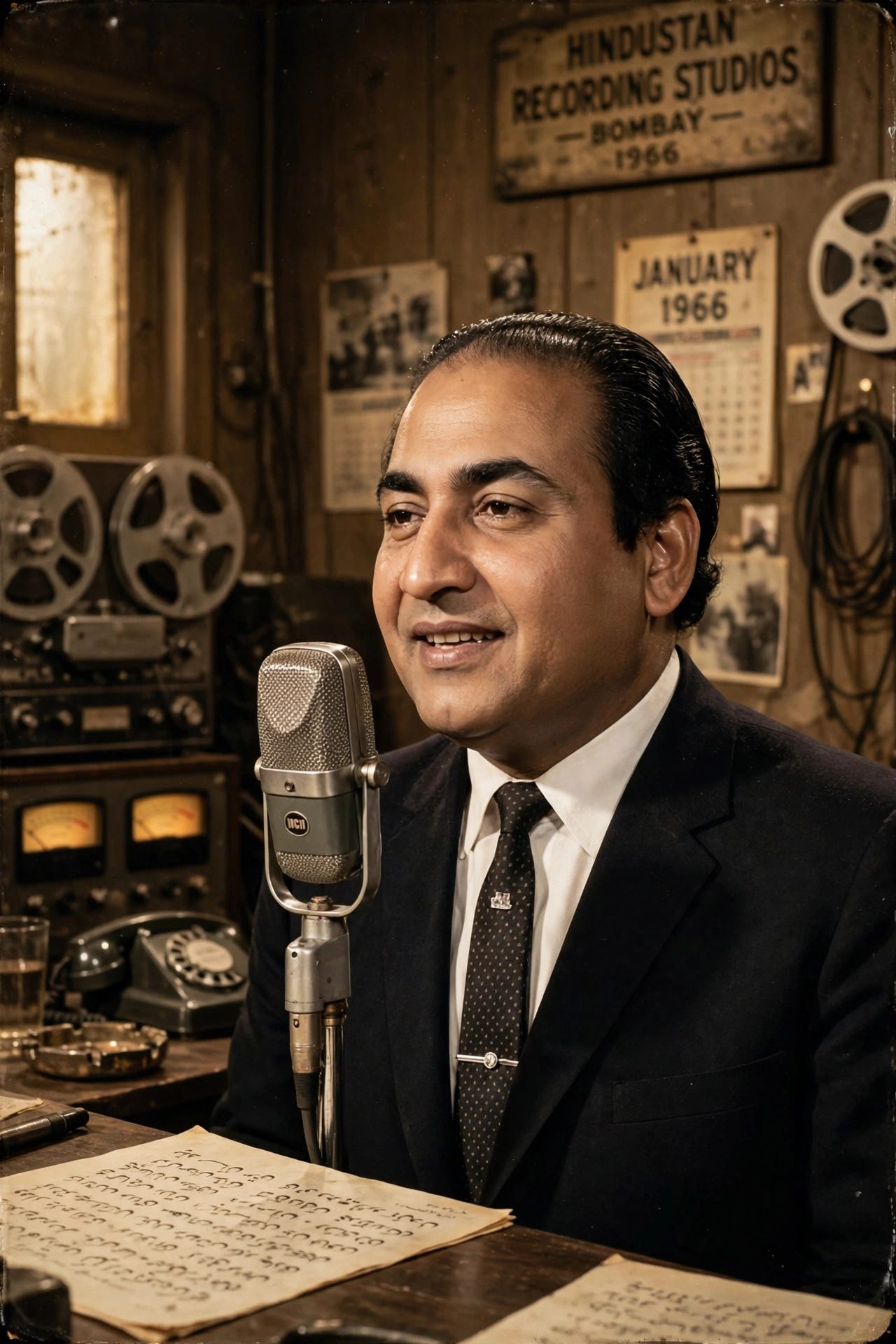
Kotla Sultan Singh: A Village Near Amritsar
Mohammed Rafi was born on 24 December 1924 in Kotla Sultan Singh, a village near Amritsar in Punjab. The geography matters, because Punjab in the 1920s was a land where music was not a separate profession practised behind closed doors but a living presence woven through ordinary days. Songs rose from fields and courtyards. Devotional singing filled places of worship. Wedding parties carried melodies across villages, and travelling singers moved from settlement to settlement with little more than their voices and the memory of older songs held carefully in the throat. A child growing up in such a landscape did not need to discover music as an abstraction; he breathed it in with the dust and the harvest air.
Kotla Sultan Singh was not a place that promised a recording career. There were no studios there, no film companies, no orchestras waiting for a young voice. What a village could give a gifted child was something more fundamental and, in Rafi’s case, more durable: an ear trained by listening, a memory stocked with folk cadence, and an instinctive understanding that a song is first of all an act of communication between one human being and another. Long before he understood the grammar of a raga in any formal sense, he understood that a voice could make people stop what they were doing. That lesson, learned in childhood, never left him. Even at the height of his fame, when he sang for the biggest stars in Bombay before the largest orchestras in the business, listeners felt that directness — the sense that the song was being offered to them personally, without a wall of technique in between.
Amritsar, the nearest great city, carried its own weight in the boy’s world. It was a centre of faith, trade and memory, a city whose very name evoked devotion. The Punjab of Rafi’s childhood was still undivided, and Lahore — where his musical education would properly begin — was its cultural capital, connected to Amritsar by road, by rail and by a shared language of poetry and song. The journey from Kotla Sultan Singh to Lahore, and later from Lahore to Bombay, traces the arc of his life in miniature: from village to city, from city to metropolis, from anonymity to a fame so complete that, decades after his death, his voice still pours from radios, phones and loudspeakers as if he had never left the room.
It is worth pausing on how unlikely the whole story was. Playback singing as a profession was young when Rafi was a boy. The idea that a child from a small Punjabi village would one day record thousands of songs, sing in language after language, and become the defining male voice of an entire cinema would have seemed fanciful to anyone in Kotla Sultan Singh in the 1920s. Yet the seeds were all present: the voice, unmistakably gifted from an early age; the appetite for learning; and the willingness, which everyone who knew him later remarked upon, to work without complaint and without rest. Villages produce many talented children. What they cannot produce is the discipline to carry talent across thirty-six years of recording sessions. That discipline Rafi built himself, lesson by lesson, city by city.
His birth date, 24 December, would acquire a particular resonance a century later, when his hundredth birth anniversary in December 2024 brought tributes from the highest offices in the country and a film festival honour in his name. But in 1924 it was simply the birthday of one more son in a Punjabi household — the second eldest of six brothers — in a village whose name most of India would learn only because he carried it with him, in every account of his life, to the end.
Haji Ali Mohammad and Allah Rakhi: The Household
Rafi was the second eldest of six brothers, the son of Haji Ali Mohammad and Allah Rakhi. A household of six sons in a Punjabi village of that era was a world unto itself: a hierarchy of age and affection, a constant negotiation of space and food and attention, and a training ground in the social arts that no school could replicate. Being second eldest placed the young Rafi in a particular position — old enough to be given responsibility, young enough to still be guided; close enough to the eldest to learn leadership by watching, and close enough to the younger boys to learn patience by practising it.
Biographical accounts of Rafi return again and again to the gentleness of the adult man, and it is reasonable to look for some of its roots in this early household. A boy who grows up among five brothers learns early that volume is not the same as strength, that the loudest voice in the room is rarely the one that settles anything. Those who worked with Rafi in the Bombay studios decades later described a man who raised his voice only in song. In negotiation, in disagreement, in the ordinary frictions of a competitive industry, he was remembered as soft-spoken to a fault. Temperaments are not simply inherited, of course, and a childhood cannot explain a whole character. But the household of Haji Ali Mohammad and Allah Rakhi gave him his first audience, his first critics, and his first experience of the thing his entire career would rest upon: singing for people who knew him, in a place where he belonged.
The family name he carried — Mohammed Rafi — would eventually be shortened by an adoring public to simply Rafi, or, with the honorific that attached itself naturally to him, Rafi Sahab. In the village, though, he was a son and a brother before he was anything else. The movement of his life away from Kotla Sultan Singh, first to Lahore and then to Bombay, followed a pattern familiar across the subcontinent in those decades: talent and ambition drew young men to the cities, and the cities either made them or sent them home. That Rafi was never sent home — that he conquered first one city and then another — should not obscure how much depended on those first steps being taken at all. Behind every great playback career stands a family that let a son leave, and a household whose songs he carried in his memory for the rest of his life.
There is also something fitting in the fact that so little of the family’s private life was ever turned into public spectacle. Rafi guarded his domestic world with the same quietness he brought to his professional one. He married — his first wife was Bashira Bibi and his second wife Bilquis Bano, as family accounts record — and he built a home in Bombay, but he never made his private life part of his publicity. In an industry that has always fed on personality, his reticence stood out. The public knew the voice intimately and the man hardly at all, and by every account that was exactly how he preferred it. The household in Kotla Sultan Singh had taught him where the boundary lay: the song was for everyone; the home was for the family.
Pheeko: The Boy Who Followed a Fakir
Every great singer’s biography contains one scene that later generations retell because it seems to contain the whole future in embryo. In Rafi’s life, that scene belongs to his boyhood, when the child known in the family by the nickname Pheeko — as widely reproduced biographical accounts report — encountered a travelling fakir singing as he passed through the village world around Kotla Sultan Singh. The boy followed the fakir, listening, absorbing, and, as the story is told, imitating. The image is irresistible: a small boy trailing a wandering singer through the lanes, drawn by a voice the way iron is drawn to a magnet, learning his first lessons in music not from a syllabus but from sheer enchanted attention.
Accounts of this episode, including the account carried by a Google Doodle honouring him, treat it as the beginning of his musical education, and it is easy to see why the story has endured. The fakir represents the oldest tradition of music in the subcontinent — music as devotion, music as livelihood earned coin by coin and meal by meal, music carried in the body rather than written in books. A boy who learned by following and imitating was learning the way folk musicians had always learned: by ear, by memory, by love. Formal training would come later, and it would be rigorous, but the foundation was this — a child’s conviction that a singing voice was the most interesting thing in the world, worth following down any lane.
The nickname Pheeko deserves a moment of its own. Family nicknames are the names of intimacy; they belong to courtyards and kitchens, not to record labels. That the world came to know this one at all is a measure of how completely Rafi’s admirers wanted to know the boy behind the voice. There is a tenderness in the survival of the name. The man who would be garlanded on a hundred stages, who would hold the highest civilian honours of his country, remained, in the telling of his own story, a village boy with a pet name, running after a fakir’s song. Biographers return to it because it keeps the legend human-sized.
It also tells us something true about how Rafi learned everything afterwards. His later teachers were masters of demanding classical disciplines, and he submitted to their rigour completely. But the method never changed at its core: listen first, imitate faithfully, then make the thing your own. Studio colleagues in Bombay would marvel at how quickly he grasped what a composer wanted — a phrase demonstrated once was a phrase learned. That quickness was not a parlour trick acquired in adulthood. It was the fakir’s lesson, practised from childhood: the ear leads, the voice follows, and understanding arrives through the act of singing itself.
One should be careful, as with all childhood stories of the famous, not to load a single episode with more meaning than it can bear. Boys followed singers in many villages; only one of them became Mohammed Rafi. Yet the episode survives in every serious account of his life because it captures the direction of his desire before ambition had a name. He did not begin by wanting fame, or Bombay, or awards. He began by wanting to hear the song properly, and then to sing it back. Fame, when it came, was almost an accident of that wanting — the world eventually noticed a man who had been following the music, single-mindedly, since he was small enough to be called Pheeko.
Lahore: Training and All India Radio
Lahore was where the village boy became a musician. In the Lahore of his youth — the cultural capital of undivided Punjab, a city of colleges, poets, musicians and broadcasting studios — Rafi received the formal training that transformed a gifted ear into a disciplined instrument. He trained under Ustad Abdul Waheed Khan, under Ustad Ghulam Ali Khan — named as Chhote Ghulam Ali Khan in Britannica’s account — and under Pandit Jivanlal Mattoo. To study under teachers of this stature was to enter a tradition in which music was a lifelong sadhana, a practice closer to prayer than to entertainment, and in which the student’s first duty was surrender to the discipline.
The names of his teachers map the breadth of what he was absorbing. The khayal tradition represented by his ustads demanded command of raga grammar, of slow unfolding and sudden flight, of the long arc of a performance built note by patient note. Alongside it stood the lighter forms — the ghazal, the thumri-inflected melody, the Punjabi folk idiom he already carried in his blood. Rafi’s mature singing would be famous precisely for refusing to choose between these worlds. The classical grounding gave his film songs their spine: the flawless intonation, the ease in difficult passages, the ability to hold a note steady as a plumb line. The folk and devotional grounding gave them their warmth. Lahore is where those two inheritances were fused into one voice.
The city gave him his first public platform as well. At the age of thirteen, he gave his first public performance in Lahore — a boy standing before an audience, delivering on the promise his family and teachers had heard in private. He also recorded at All India Radio Lahore as a teenager, as widely reproduced accounts record, which placed his voice inside the newest and most democratic musical institution of the age. Radio changed everything for singers of his generation. A voice on the radio belonged to no single room; it travelled into homes the singer would never see, and it was judged on sound alone. For a young vocalist without connections or wealth, that blindness of the medium was a gift. On radio, Pheeko from Kotla Sultan Singh was exactly as good as his voice, and no better and no worse — and his voice was very good indeed.
Lahore also taught him the professional habits that Bombay would later reward. Broadcasting and public performance impose a discipline of preparation: the song must be ready at the appointed hour, in the appointed key, at the appointed length. There is no waiting for inspiration when the red light is on. Colleagues in the film studios would later describe Rafi as the most prepared singer they knew — a man who arrived with the song already inside him, who rarely wasted a session, whose first takes were often usable and whose final takes were definitive. That professionalism was not a Bombay invention. It was formed in Lahore, in the years when a teenage singer learned that talent opens the door but punctuality, preparation and humility keep it open.
The Lahore years ended, as they ended for so many of his generation, with the approach of upheaval. The Punjab he had grown up in was about to be divided, and the cultural world that had nurtured him — one world, stretching from Amritsar to Lahore — was about to be cut in two. Rafi’s own decisive move came just before that storm: in 1944, still a teenager by the measure of his birth in December 1924, he left for Bombay. He carried with him a classical training, a radio singer’s discipline, a memory full of Punjabi melody, and one recorded film song already to his name. It was enough. It was, in fact, everything.
A First Song in Punjabi: Gul Baloch 1944
Rafi’s first recorded song was a Punjabi duet, “Soniye Ni Heeriye Ni”, sung with Zeenat Begum for the film Gul Baloch in 1944, with music by Shyam Sunder. Every element of that sentence deserves attention, because beginnings reveal what a career will be built on. It was a duet, which meant the young singer’s first appearance on a film soundtrack came not as a soloist demanding the spotlight but as a partner — listening, blending, answering another voice. It was in Punjabi, his mother tongue, the language of Kotla Sultan Singh and Lahore, which meant his recording life began at home before it travelled. And it was for a composer, Shyam Sunder, working in the Punjabi film world that served as a bridge between the Lahore music scene and the larger Bombay industry.
A first song is a small thing in the arithmetic of a career that would eventually be counted in thousands, but symbolically it is enormous. Until Gul Baloch, Rafi’s voice had lived in rooms and on radio waves — present, then gone. A recorded song was different: it fixed the voice in a medium that could outlast the moment of singing. The boy who had followed a fakir down village lanes had now done the one thing the fakir never could. He had made a song that would still exist after he left the room.
The duet form, too, proved prophetic. Rafi would become one of the greatest duet singers in film history, a partner of legendary generosity whose collaborations with Lata Mangeshkar and Asha Bhosle produced hundreds of songs that defined romance for generations of listeners. The qualities those duets required — the ability to leave space for another voice, to match a partner’s mood in an instant, to make two singers sound like one conversation — were present from the very first recording. Careers in playback are often described as ladders climbed alone. Rafi’s began, fittingly, as a conversation.
The year 1944 was a hinge in his life in more ways than one. In the same year as the Gul Baloch recording, he made the move to Bombay, the city where the Hindi film industry — the largest stage available to an Indian singer — was concentrated. Lahore had trained him and given him his start; Bombay would test him at an entirely different scale. He arrived as one of hundreds of hopefuls in a city that chewed through hopefuls without noticing. What he had that most of them did not was a finished musician’s training and a voice that composers, once they heard it in a room, tended to remember. The story of his Bombay years is the story of those composers hearing it, one by one, and finding larger and larger uses for it — beginning with the most demanding taskmaster of them all.
Bombay 1944: Naushad and Pehle Aap
Rafi arrived in Bombay in 1944, and his break came through Naushad — the composer whose name, for any singer of that era, was both an opportunity and an examination. Naushad was a classicist among film composers, a man who built film scores on raga foundations and who expected his singers to be musicians first and personalities second. For a young vocalist trained under ustads in Lahore, this was the ideal door to knock on, because it was a door that opened for exactly the qualities Rafi possessed in abundance: sur, discipline, and the stamina to rehearse a difficult composition until it sat perfectly in the voice.
His first work for Naushad was modest — a place in the chorus of Pehle Aap in 1944, singing “Hindustan Ke Hum Hain”. A chorus line is the least glamorous assignment in a recording studio, and it is also one of the most revealing. Chorus singers must blend, must subordinate their individual timbre to the collective sound, must be exact without being prominent. That the young Rafi accepted the assignment and executed it without fuss tells us how he intended to build his career: from wherever he was placed, by doing the work in front of him better than it needed to be done. Bombay was full of voices demanding solos. The voice content to begin in a chorus, and to sing that chorus as if it mattered, was rarer — and composers notice such things.
Then came Gaon Ki Gori in 1945, a further step, and the relationship with Naushad deepened into one of the defining partnerships of Indian film music. To understand what Naushad gave Rafi, one has to understand what Naushad demanded of everyone: compositions rooted in classical and folk sources, melodies that required genuine vocal technique, and an emotional directness that punished any hint of artifice. A singer who could satisfy Naushad could satisfy anyone. A singer whom Naushad trusted with his most ambitious melodies was being handed, piece by piece, the keys to the industry.
The Bombay Rafi entered in 1944 was a city of opportunity shadowed by war and approaching independence, its film industry growing in confidence and reach. Playback singing was coming into its own as the defining musical form of Indian cinema — the voice behind the actor’s face, supplying the emotion the scene could not speak. The great male voices of the era each had their territory and their champions. For a newcomer, the path ran through exactly the kind of apprenticeship Rafi served: chorus work, small assignments, the slow accumulation of trust. What distinguishes his story is the speed with which trust, once given, turned into dependence. Composers who used him once tended to build their next scores around him. Naushad was the first to do so, and the pattern he set — discover, test, then entrust completely — would repeat with composer after composer over the next three decades.
By the end of his first Bombay years, Rafi had done the hardest thing a playback singer has to do: he had become known inside the studios as a musician of the first rank. The public fame was still to come. It arrived, as it so often did in that era, attached to a face — the face of a young actor whose own stardom was rising in parallel, and whose tragic screen persona would find, in Rafi’s voice, its perfect musical expression.
Jugnu 1947: A Voice Finds Dilip Kumar
In 1947, Rafi sang in Jugnu for Dilip Kumar. The pairing that began there — Rafi’s voice, Dilip Kumar’s face — would become one of the most consequential collaborations in the history of Indian cinema, a fusion so complete that generations of listeners, hearing the songs, see the actor; and watching the actor’s great tragic scenes, hear the singer. Jugnu itself arrived in a year of earthquake: 1947, the year of independence and partition, when the subcontinent Rafi had been born into split apart and the Punjab of his childhood was divided by a border drawn through its heart. That a young singer from near Amritsar and a young actor from Peshawar should begin their defining partnership in that year gives the collaboration a historical weight beyond the studio walls. Both men carried the lost, undivided world in their memories. Both would spend their careers giving it a voice.
Playback singing rests on an act of ventriloquism so complete that audiences forget it is happening. The actor moves his lips; the emotion, the technique, the very soul of the moment comes from a man standing in a studio before a microphone. For that illusion to hold across a whole career, singer and actor must share an emotional register — a common understanding of how sorrow sounds, how dignity sounds, how a man breaks without making a spectacle of breaking. Between Rafi and Dilip Kumar, that understanding was present from the start. Dilip Kumar’s screen persona was built on restraint: grief held behind the eyes, love expressed in glances and silences. Rafi’s singing, for all its power, was built on the same restraint. He could pour feeling into a phrase without ever spilling it.
Jugnu was the beginning, not the summit. The summit would take five more years to reach, and it would come, once again, under Naushad’s baton. But the direction of travel was now set. Rafi was no longer merely a promising studio singer with a classical training and a growing list of credits. He was becoming the voice through which the Hindi cinema’s greatest tragic actor would sing — and in an industry where an actor’s singing voice could define his stardom as surely as his dialogue, that made Rafi something more than a singer. It made him a co-author of the performances India would remember longest.
The late 1940s were his years of consolidation. The industry was reorganising itself in a new nation; studios rose and fell; composers assembled their teams of trusted voices. Rafi’s name moved steadily up the list of the trusted. What he needed, to complete the ascent, was a single song so undeniable that no listener in the country could remain unaware of him — a song that would do for his public fame what Naushad’s trust had already done for his professional standing. In 1952, Naushad handed him exactly that song, in a film about a classical singer, no less. The boy from Kotla Sultan Singh was about to sing his way into the permanent memory of a civilisation.
Baiju Bawra 1952: O Duniya Ke Rakhwale
The breakthrough came with Baiju Bawra in 1952. Under Naushad’s direction, Rafi sang “O Duniya Ke Rakhwale”, and the song did what breakthrough songs do: it reorganised the landscape around it. Baiju Bawra told the story of a legendary classical singer, and its score demanded a vocalist who could carry classical weight inside a popular film without breaking either the raga or the audience’s heart. In Rafi, Naushad had a singer who could do both, and “O Duniya Ke Rakhwale” became the proof that travelled across the country — a cry of anguished devotion, addressed to the keeper of the world, that built from pleading to a climax of almost unbearable intensity.
Consider what the song asks of a singer. It is a prayer from a man at the edge of loss, and it must sound like one: not performed grief but enacted grief, rising through registers that would expose any weakness of breath, pitch or conviction. Rafi’s classical training is audible in every bar — in the control of the ascent, in the way the voice gathers force without ever coarsening, in the final heights where technique and feeling become indistinguishable. Listeners who knew nothing of raga grammar knew they were hearing something true. The song entered the permanent repertoire of Indian devotion-tinged film music, requested, replayed and imitated for decades, and it fixed Rafi’s public identity: here was a singer who could carry the heaviest emotional and classical loads the industry could devise.
Breakthroughs in playback careers are rarely single songs, but they are often remembered as such, because a single song is what the public can hold. Behind “O Duniya Ke Rakhwale” stood eight years of preparation — Lahore’s lessons, radio’s discipline, the chorus of Pehle Aap, the steady trust of Naushad. The song was less a lucky break than a debt coming due. Naushad had been building towards a vocalist who could realise his most ambitious classical conceptions on screen; Rafi had been building towards a composer who would ask everything of him. In Baiju Bawra, the two ambitions met, and the result announced the arrival of the dominant male playback voice of the coming two decades.
The film’s success also changed the terms on which Rafi worked. After 1952, he was no longer a singer composers tried out; he was a singer they planned around. The 1950s that followed would see him become, in quick succession, the voice of tragedy, of romance, of comedy and of exuberance — of virtually every leading man and every mood the Hindi film could imagine. All of that expansion traces back to the credibility won here. A singer who had carried Baiju Bawra could be trusted with anything, and the industry proceeded to trust him with everything.
There is a final resonance worth noting. “O Duniya Ke Rakhwale” is a song about a singer — about music as a man’s offering and his plea. Rafi, singing the anguish of the legendary Baiju, was in a sense singing the story of his own formation: the boy who followed a fakir, the student who submitted to his ustads, the musician for whom singing was never merely a job. The prayer in the song was addressed to the keeper of the world. In the decades since, listeners have returned the compliment, treating the singer’s own voice as a kind of keeping — a place where the world’s sorrows and joys are held safely, in tune, forever.
Naushad: The First Great Partnership (149 songs)
The numbers, before anything else: across their long association, Naushad and Rafi created 149 songs together, of which 81 were solos. In an industry where a singer might work with a composer a handful of times, a catalogue of 149 songs is not a collaboration; it is a shared life’s work. Naushad was the first great composer to build on Rafi, and the foundation he laid — classical, folk-rooted, emotionally direct — remained the bedrock of Rafi’s art even when the singer’s later work ranged into territory Naushad himself rarely visited.
What did Naushad hear in Rafi that made him invest so heavily? Partly it was the training: Naushad, a classicist, could compose at the full stretch of his knowledge knowing the singer would meet him there. Partly it was temperament. Naushad’s studio discipline was legendary, and Rafi’s willingness to rehearse, to refine, to sing a phrase twenty ways until the composer heard the right one, matched it exactly. And partly it was something harder to name — a shared understanding that a film song, however popular its destination, deserved to be built like a serious composition. Their sessions were working sessions between two musicians who believed the audience’s intelligence and feeling were worth respecting at full stretch.
The 81 solos in their catalogue mark the spine of Rafi’s classical reputation. These were the songs in which a single voice carried an entire emotional and musical architecture — the devotional heights of Baiju Bawra, the aching melodies that became synonymous with Dilip Kumar’s screen sorrow, the folk-tinged numbers rooted in the soil of Uttar Pradesh and Punjab that Naushad loved to draw upon. When later generations ask where Rafi’s authority came from — why his voice, among all the fine voices of his era, became the standard against which others were measured — a large part of the answer lies in this body of work. Naushad gave him the most demanding repertoire of the age, and he mastered it in public, film after film, until mastery itself became his signature.
Partnerships of this depth also shape a singer’s limitations, or rather, they define the home ground from which expeditions are launched. Rafi’s home ground, thanks to Naushad, was the classical-devotional-tragic register: the song as prayer, as lament, as moral address. Everything he later added — the romance, the comedy, the rock and roll abandon — was an addition to that ground, never a replacement for it. That is why his lighter songs never sound lightweight in the dismissive sense; beneath the playfulness, the plumb line of the training holds. And it is why, when the industry’s fashions turned in the 1970s, the voice could not be dismissed as a period piece. A foundation that deep does not date.
Their association belongs to the era when the composer was king of the film score and the singer his principal instrument. To be the principal instrument of Naushad — the composer of some of the most revered scores in Hindi cinema — across 149 songs is a distinction no summary of Rafi’s career can afford to treat lightly. Other partnerships would produce more songs, and still others would produce more famous individual hits. This one produced the singer himself.
The Classical Foundation: Madhuban Mein Radhika
If a single performance had to be chosen to demonstrate what Rafi’s classical training made possible inside a popular film song, the strongest candidate is “Madhuban Mein Radhika Nache Re” from Kohinoor in 1960 — again under Naushad, in a film that let Dilip Kumar show his lighter side. The song is a classical showpiece dressed as a film number: intricate, swift, demanding a command of rhythm and ornament that no amount of studio trickery can fake. Rafi navigates it with a joy that is itself a form of virtuosity. The voice dances — there is no other word — and the listener understands that the dance is possible only because the discipline underneath it is absolute.
Classical training in a playback singer is often discussed as a kind of credential, a line in a biography. In Rafi’s case it was something more practical: it was the engine of his versatility. A singer who has mastered the slow exposition of a raga has mastered breath, and breath is what allows a long ghazal phrase to land unbroken. A singer who has practised rapid taans has the agility for a comic number’s patter or a qawwali’s escalating exchanges. A singer who has internalised the emotional grammar of the ragas carries a map of moods — which is why Rafi could move between devotion, longing, mirth and majesty within a single working week and sound native to each. The ustads of Lahore had not been preparing him for film music; they had been preparing him for music, and film music turned out to be one of its provinces.
“Madhuban Mein Radhika” also marks a point about the audience of that era that is easy to forget. The song was a popular success, not a connoisseur’s indulgence. Millions of listeners with no formal knowledge of classical music delighted in a performance whose pleasures were inseparable from its classical substance. The golden age of Hindi film music rested on exactly this compact between artists and audience: the artists refused to condescend, and the audience rose to meet them. Rafi embodied the compact. He never sang down. Whether the assignment was a bhajan, a ghazal or a piece of pure entertainment, the full musician showed up, and listeners learned to expect — and to love — the sound of a voice that took them seriously.
The classical foundation had one more consequence, quieter but just as important: longevity of the instrument itself. Voices built on correct technique endure. Rafi recorded for thirty-six years, from 1944 to the last day of his life in 1980, and while the voice inevitably matured and darkened, it never lost its centre, its intonation or its extraordinary steadiness. Singers who rely on a natural gift alone often find the gift withdrawing early. Rafi’s gift was maintained like a temple — daily, methodically, with reverence. Kohinoor’s dancing Radhika number, arriving sixteen years into his recording career, is the sound of that maintenance paying its dividend: a master in full command, making the hardest thing he ever sang sound like play.
Chaudhvin Ka Chand 1960: The First Filmfare Award
In 1960, Rafi won the first of his six Filmfare Awards, for the title song of Chaudhvin Ka Chand — a ghazal of luminous tenderness, composed by Ravi, in which the beloved is compared to the full moon of the fourteenth night. The award mattered, but the song mattered more, because it demonstrated a register of Rafi’s art quite different from the classical thunder of Baiju Bawra or the dance of Kohinoor. Here the voice does not climb or conquer; it gazes. The singing is all softness and control, a lover’s wonder held at exactly the temperature of reverence, and it showed the industry — and the award voters — that the same throat that could shake a durbar hall could also whisper a ghazal as if confiding it to one person alone.
The ghazal form deserves a word of explanation for readers meeting it fresh. Rooted in Urdu poetry, the ghazal is a sequence of couplets bound by refrain and rhyme, each couplet a small complete world of longing, separation, praise or metaphysical ache. To sing a ghazal well, a vocalist must serve the poetry: the words must remain intelligible, their images intact, while the melody embroiders around them without ever smothering them. Rafi’s diction was famous among composers — Urdu, Hindi, Punjabi and the other languages of his vast output all emerged from his mouth with a clarity that poets themselves appreciated. In the Chaudhvin Ka Chand title song, that diction becomes the whole performance. Every image lands. The moon rises in the words because the singer refuses to get in their way.
The year 1960 finds Rafi at a summit of simultaneous achievements — the classical display of Kohinoor and the ghazal crown of Chaudhvin Ka Chand in the same season — and it is worth standing back to appreciate what that simultaneity meant. Singers specialise because voices and temperaments pull them towards one kind of excellence. Rafi’s career is a standing refutation of that logic. He did not have a kind. Or rather, his kind was completeness itself: the conviction, absorbed from his teachers, that a musician’s duty is to the composition in front of him, whatever its mood, and that the self must be flexible enough to disappear into each new song’s requirements. The first Filmfare Award recognised a ghazal. The five that followed would recognise romance, friendship, devotion and playful seduction. The list of his awards, read whole, is the shortest biography of his range ever written.
Awards in film music are imperfect instruments — they depend on voters, fashions and the accidents of a given year’s competition — and Rafi’s admirers have never needed trophies to make their case. Yet the 1960 win has a particular historical flavour. It came at the moment when playback singing was fully established as an art in its own right, judged separately from the films it served, and it honoured a performance of restraint at a time when restraint was not the obvious route to applause. The industry, in honouring the moonlit ghazal, was honouring the proposition that softness is a form of strength. Nobody in Indian music embodied that proposition more completely than the man who received the award.
The Voice of Dilip Kumar: Tragedy in Song
To speak of Rafi and Dilip Kumar is to speak of one of the great doublings in cinema history: two artists, one visible and one invisible, jointly creating a single screen soul. The partnership that began with Jugnu in 1947 deepened across the 1950s into the definitive musical expression of Dilip Kumar’s tragic persona — the lover undone by fate, the idealist crushed by a world too coarse for his fineness, the man whose suffering was always more articulate in song than it could ever be in dialogue. Under Naushad especially, Rafi’s voice became the interior monologue of that persona: what the character could not say to anyone in the film, he sang to the audience, and the audience understood that the singing was the truth of the scene.
The technical challenge of singing tragedy is the avoidance of melodrama. Grief, over-sung, becomes noise; the listener retreats. Rafi’s tragic singing works by the opposite route — by an almost severe economy, in which the emotion is carried by timbre, by the grain of a sustained note, by pauses that feel like a man gathering himself. His classical training supplied the control; his temperament supplied the dignity. Dilip Kumar’s acting was built on the same principles — the famous restraint, the refusal to beg the audience for tears — and the fit between the two men was so exact that it is difficult, watching the films now, to remember that the voice and the face belonged to different people. That difficulty is the measure of their achievement.
There is a cultural dimension, too. The tragic hero of 1950s Hindi cinema carried the emotional burdens of a young nation: partition’s wounds, poverty’s humiliations, the collision of tradition and modern aspiration. When Dilip Kumar’s characters suffered, audiences recognised their own histories. When Rafi sang that suffering, he gave it a form beautiful enough to be borne — grief organised into melody, which is one of the oldest functions of music in human society. The songs outlived the films’ plots in the public memory precisely because they had done this larger work. People who could not recount a storyline could still hum its sorrow, and in humming it, carried a piece of their own past in a form they could hold.
It is also worth noting what Rafi did not do in this partnership. He never imitated Dilip Kumar’s speaking voice, never chased a surface resemblance. Playback at its best is not impersonation but interpretation — the singer finds the character’s emotional frequency and broadcasts on it. Rafi found that frequency for actor after actor, changing it utterly from man to man, which is why the same voice could be Dilip Kumar’s tragedy in one film and, in the same year, another star’s swagger or clowning. The Dilip Kumar register remains the most revered of these incarnations because it was the first and because tragedy, handled at this level, leaves the deepest mark. But it was one room in a very large house, and the 1950s and 1960s were about to show how large the house was.
The Voice of Dev Anand: Romance in Song
If Dilip Kumar was tragedy, Dev Anand was romance in motion — the smiling, restless, eternally youthful charmer whose screen persona moved through the world as if life were a pleasant conspiracy arranged for his delight. Rafi became a principal voice of that persona too, and the adjustment he made is a small masterclass in what playback singing actually is. For Dev Anand, the voice lightens. The phrasing loosens, takes on a conversational swing, allows itself a smile you can hear. The lover here is not undone by love; he is delighted by it, and the singing must convey a man for whom romance is not fate but adventure.
The Dev Anand films of the era, with their modern settings, their jazz-tinged and rhythm-forward scores — S. D. Burman prominent among their composers — asked the singer to inhabit a different musical India from Naushad’s classical durbars: an urban, cosmopolitan India of nightclubs, hill stations, taxis and telephones. Rafi moved into that world without a trace of strain. His diction crisped; his ornamentation streamlined; the voice acquired a spring in its step. Listeners accepted the transformation instantly, because the transformation was total — he did not sing Dev Anand’s songs as Rafi-with-adjustments, but as the character, from inside.
Romance is the most common assignment in film music and the easiest to do adequately; thousands of pleasant romantic songs exist. What distinguishes Rafi’s romantic singing, for Dev Anand and across his work, is its sincerity of address. He sings to the beloved, never at the audience, and the microphone disappears. That quality — intimacy at scale, a private feeling somehow transmitted to millions without losing its privateness — is the rarest gift in popular singing. It cannot be taught directly, though training can prepare the ground for it. It depends on the singer’s willingness to be emotionally exposed while remaining technically armoured, and Rafi managed the paradox for thirty-six years.
Placed beside the Dilip Kumar work, the Dev Anand songs complete a picture of the singer as a company of actors in one throat. The tragic hero and the romantic charmer were, in the public mind, opposite poles of masculinity in that era’s cinema. That one voice supplied the singing soul of both — and would shortly supply a third pole more exuberant than either — is the central, still-startling fact of Rafi’s career. Versatility is a word that gets applied to singers who can handle several styles competently. What Rafi demonstrated was something else: incarnation, repeatedly, in incompatible persons, each one convincing. The industry had never seen it at this scale before. It has arguably never seen it since.
The Voice of Shammi Kapoor: Yahoo and Abandon
Then came Shammi Kapoor, and with him the most joyful noise in Hindi film history. Shammi’s screen persona — elastic, mischievous, physically explosive, a young man apparently powered by springs — required a singing voice that could match a level of energy no playback singer had previously been asked to supply. Rafi supplied it, and in doing so revealed yet another self: the shouter of “Yahoo! Chahe Koi Mujhe Junglee Kahe”, the title exclamation of Junglee, in which the voice abandons every classical decorum and simply erupts. The shout became a national catchphrase. More than that, it became a permission — for a generation of listeners, the sound of a respectable, classically trained, famously modest man cutting completely loose was a liberation in itself.
The Shammi Kapoor songs, many of them composed by Shankar-Jaikishan, are feats of controlled abandon. This is the paradox at their centre: to sound that free, a singer must be that disciplined. The leaps, the whoops, the rhythmic games, the sudden drops from a yell to a croon — all of it is executed with the intonation and breath control of the Lahore training, deployed now in the service of mischief. Rafi reportedly delighted in these assignments, and one can hear the delight. There is no sense of a serious artist slumming. There is, instead, the unmistakable sound of a musician discovering that his technique has bought him the right to play, and playing with his whole heart.
Shammi Kapoor himself understood what he owed. The persona that made him a star was a duet between his body and Rafi’s voice — the leaps on screen answered by leaps in the soundtrack, the comic timing doubled by a singer who could time a vocal gag to the frame. Their collaboration stands as the clearest proof that playback singing, at its highest level, is acting. Rafi was not accompanying Shammi’s performances; he was co-performing them, from a studio the audience never saw, with an instrument the audience never mistook for anyone else’s.
Consider the distance travelled. The boy who learned by following a fakir; the student of ustads; the voice of Dilip Kumar’s tragedies and Dev Anand’s romances — this same singer was now the voice of a star vaulting through the snow shouting Yahoo. Each incarnation was complete, and none cancelled the others. By the early 1960s, Rafi had achieved something without precedent in Indian popular music: he was simultaneously the voice of the cinema’s past — its classical and tragic gravitas — and of its exuberant, modern, youthful present. Composers understood that in hiring Rafi they were not hiring a style. They were hiring the whole spectrum, and the next phase of his career would be defined by the composers who exploited that spectrum most fully.
Shankar-Jaikishan: 341 Numbers
The partnership with Shankar-Jaikishan produced 341 numbers, of which 216 were solos — a catalogue more than double the Naushad total, and the largest sustained collaboration of Rafi’s career until Laxmikant-Pyarelal surpassed it. Shankar-Jaikishan, the twin kings of the popular film score, built their music on melody of immediate memorability, orchestration of increasing richness, and an instinct for what a mass audience would carry out of the theatre humming. For such composers, Rafi was the ideal instrument: a voice the public already loved, capable of anything they could write, and — crucially for their prodigious output — fast, accurate and tireless in the studio.
The 216 solos in this catalogue testify to the trust involved. A solo is a composer’s confession that one voice can carry a film’s emotional centre unassisted. Shankar-Jaikishan made that confession hundreds of times. Their Rafi solos range across the full map of feeling — soaring romance, folk-flavoured celebration, patriotic address, melancholy reflection — and they formed, for the listening public of the 1950s and 1960s, a kind of continuous national songbook. The radio era amplified their reach: a hit from this partnership did not merely succeed in its film; it entered the air, and from the air into weddings, festivals, tea stalls and courtyards, until it belonged to everyone.
Working at this volume changes the nature of the singer-composer relationship. With Naushad, the keynote had been depth — fewer songs, each built like a monument. With Shankar-Jaikishan, the keynote was abundance: the monument-building continued, but alongside it ran a river of melody in which Rafi had to be excellent at speed, film after film, without the luxury of treating any assignment as minor. His consistency across this flood of work is one of the least dramatic and most remarkable facts about him. Listen across the catalogue and the standard does not waver. The intonation does not slip, the commitment does not thin, the hundredth song receives the same care as the first. In an industry built on deadlines, that reliability was itself a form of genius, and composers built their schedules on it.
Shankar-Jaikishan’s music also pushed Rafi’s voice towards the modern — towards orchestras with violins in massed ranks, towards rhythms drawn from across the world, towards the big, bright sound of a confident young nation’s popular culture. The classical foundation held, as it always held, but the surface gleamed with newness. If Naushad had made Rafi the voice of India’s musical inheritance, Shankar-Jaikishan made him the voice of its present tense. A singer needs both tenses to become immortal. By the mid-1960s, Rafi had them, and the one partnership that would produce even more songs than this was already taking shape in the studios of Bombay.
Laxmikant-Pyarelal: 369 Numbers
The largest collaboration of Rafi’s career was with Laxmikant-Pyarelal: 369 numbers, 186 of them solos — more songs than with any other composer or team. The statistic carries a story inside it, because Laxmikant-Pyarelal were of a younger generation than Naushad or Shankar-Jaikishan. They rose in the 1960s, when Rafi was already the established king of male playback, and they built their ascent substantially on his voice. The relationship thus ran in both directions: the young composers gave the mature singer a repertoire that kept him contemporary into the 1970s, and the singer gave the young composers the authority and popularity that turned promising talents into the dominant hit-makers of their era.
Their music was famous for its melodic sweetness, its folk and classical infusions, and its shrewd sense of the mass audience — and Rafi was its perfect vehicle, able to deliver a tune so that it lodged instantly in the public ear while losing none of its musical substance. The 186 solos include some of the most beloved recordings of his later prime, among them award-winning work: “Chahoonga Main Tujhe” from Dosti in 1964, a hymn to friendship that won him a Filmfare Award, and “Baharon Phool Barsao” from Suraj in 1966, another Filmfare winner, in which the voice seems to shower the beloved with flowers exactly as the words promise. Dosti deserves special mention: a film carried overwhelmingly by its music, in which Rafi’s singing did not support the drama so much as constitute it. When a low-budget film becomes a phenomenon because its songs conquer the country, the singer is not an employee of the production. He is its star.
The Laxmikant-Pyarelal association also illustrates the economics of trust in the golden age. Composers worked with favoured singers the way theatre companies work with resident actors — the shorthand of long collaboration allowed risks that strangers could not take. A melody could be written at the edge of Rafi’s range because everyone in the room knew the edge was safe. A difficult phrase could be left uncut because the singer would solve it in the take. Across 369 numbers, that accumulated trust became an artistic instrument in its own right, audible in the catalogue’s freedom: this is music written for a specific voice by men who knew exactly what that voice could do, and delighted in finding out what else it could do.
By the time this partnership reached its full flood, Rafi’s position in the industry was beyond challenge — the first-choice male voice for composers of every generation and school. Yet the catalogue of his collaborations still had breadth to add. Around the central partnerships stood a circle of other major composers, each drawing a different colour from the voice, and it is in that circle — Ravi’s ghazals, Madan Mohan’s melancholy, O. P. Nayyar’s swagger — that the portrait of the complete singer comes fully into focus.
Ravi, Madan Mohan and O. P. Nayyar
A singer’s range is best measured not by his greatest partnership but by the variety of strong partnerships he could sustain at once, and by that measure Rafi’s middle career is astonishing. Ravi gave him the ghazal crown of Chaudhvin Ka Chand and a stream of melodies whose simplicity was deceptive — songs that seemed to sing themselves, and that only a master could sing that simply. Madan Mohan, the composer of some of the most refined and melancholic music in Hindi film, found in Rafi a voice for his lighter and folk-touched compositions as well as his sorrows; their work together carries a particular intimacy, the sense of two perfectionists recognising each other. O. P. Nayyar, whose rhythmic, flamboyant scores defined a whole strain of Bombay stylishness, used Rafi’s voice for romance and verve in films where the music had to strut — and the voice of the fakir-following village boy strutted as if born to it.
Each of these composers demanded a different Rafi, and the differences are the point. Ravi’s clarity, Madan Mohan’s ache, Nayyar’s bounce: a lesser singer would have imposed one personality on all three and flattened them into sameness. Rafi did the opposite. He functioned as the ideal interpreter — the musician through whom each composer’s distinct imagination reached the public undistorted. This is a rarer gift than virtuosity. Virtuosos bend repertoire towards themselves; interpreters disappear into it, and are paradoxically remembered longer, because every composer’s best work ends up bearing their voice.
S. D. Burman belongs in this company as well — the senior composer whose scores for Dev Anand’s films and Guru Dutt’s masterpieces drew from Rafi performances of sly humour, romantic ease and, in Pyaasa, something close to social prophecy. The full circle of his major collaborators — Naushad, Shankar-Jaikishan, Laxmikant-Pyarelal, S. D. Burman, Ravi, Madan Mohan, O. P. Nayyar — amounts to a roll call of the golden age itself. There is no major school of Hindi film composition in those decades in which Rafi was not a central voice. Music directors disagreed with each other about tempo, about orchestration, about the future of the film song. About Rafi, the record suggests, they did not disagree at all.
For the listener today, this breadth has a practical consequence: Rafi’s recorded legacy is not one catalogue but many, each keyed to a composer’s world, and exploring it is less like listening to a singer than like touring a civilisation’s musical provinces with a single, endlessly adaptable guide. The provinces differ in language of feeling — devotion here, urbanity there, heartbreak in a third — and the guide is native to all of them. That nativeness, repeated across decades and hundreds of films, is what the word versatility means when it is used carefully. In Rafi’s case, it may still be too small a word.
Pyaasa and C.I.D.: The Comic and the Wry
Guru Dutt’s films gave Rafi two of his most distinctive assignments, and together they reveal the register of his art that admirers sometimes undervalue: his wit. In Pyaasa, the great lament for a poet destroyed by a materialistic world, Rafi sang “Sar Jo Tera Chakraye” — a comic number, a masseur’s patter-song performed on screen by Johnny Walker, in which the singer must be funny in rhythm, in diction and in sheer cheek, while the film around the song is steeped in bitterness. The number is a beloved classic of screen comedy, and its humour is inseparable from the singing: the bounce, the timing, the relish of a master vocalist playing the fool with total precision. In C.I.D., likewise, his songs carry the film’s wry, urban knowingness — romance and comedy delivered with a raised eyebrow.
Comedy is the sternest test of a serious singer, because it cannot be faked by technique alone; the singer must actually possess timing, which is a form of intelligence, and lightness, which is a form of grace. Rafi’s comic singing — the Johnny Walker numbers above all — shows both in abundance. He understood that a comic song is a small dramatic performance: a character is being created, with a voice, a gait and a philosophy of life compressed into three minutes. The masseur of “Sar Jo Tera Chakraye” is as fully realised a character as any tragic hero Rafi voiced, and considerably harder to dismiss from the memory once heard.
The wry register mattered for another reason. It kept Rafi’s art connected to the street — to the Bombay of taxi drivers, masseurs, pickpockets and clerks that Guru Dutt and the era’s best filmmakers loved to portray. A singer who only voiced kings, lovers and saints would have floated free of ordinary life. Rafi’s comic and character songs anchored him in it. They also demonstrated, to any composer watching, that there was no assignment beneath or beyond him: the man who had sung Baiju Bawra’s prayer would sing a masseur’s sales pitch with the same total commitment, and make both immortal. Studios run on such demonstrations. Each one widened the circle of what Rafi would be asked to do, until the circle included, quite literally, every kind of song the Indian cinema had invented.
There is a lesson in these performances about the relationship between dignity and play. Rafi’s personal dignity was proverbial — no colleague ever reported him diminished by vanity, drink or scandal. Yet on record he could be gloriously undignified whenever a character required it, because his dignity was never the brittle kind that play threatens. It rested on the work. A singer secure in his craft can afford any role, and the laughter in “Sar Jo Tera Chakraye” is the sound of that security. The tragic voice and the comic voice were never rivals in him. They were two hands of the same musician, and the films of Guru Dutt — where tragedy and comedy share the same reel — remain the perfect showcase of their unity.
Qawwali, Bhajan, Ghazal: Singing Every Faith of Song
No account of Rafi can go far without confronting the fact that seems, to many listeners, the most moving of his whole career: a Muslim singer from Punjab became the beloved voice of Hindu bhajans, of qawwalis rooted in Sufi devotion, of ghazals carrying the metaphysics of Urdu poetry — of, in short, every faith of song that India possesses. He sang devotional music with a conviction that listeners of the faiths concerned accepted as their own. Hindu audiences folded their hands to his bhajans without a thought for the singer’s religion. Audiences for qawwali felt the authentic escalation, the gathering spiritual intoxication, that the form demands. In a subcontinent where sacred music is guarded jealously by tradition, Rafi crossed every border as if borders did not exist, because for the duration of a song, in his voice, they did not.
The qawwali tested his stamina and his sense of architecture: the form builds by repetition and intensification, the lead voice riding waves of chorus and handclap towards ecstasy, and a playback qawwali must compress that long arc into film length without losing the climb. Rafi’s qawwalis have the climb. The bhajan tested something subtler — purity of tone and of intention, since devotional singing fails the moment it sounds performed rather than offered. His bhajans pass that test so completely that they are played in temples and homes as devotion, not merely as film music. And the ghazal, as Chaudhvin Ka Chand had shown, tested his service to poetry, his diction, his restraint. Three forms, three different spiritual and technical disciplines, one voice equal to all: this is the core of the claim that Rafi was not merely a film singer but a vessel through which India’s many musical souls could speak.
There is a practical, archival side to this legacy that today’s listeners and researchers know well. Rafi’s devotional and classical recordings are scattered across decades of films, record catalogues and reissues, in language after language, and scholars who try to catalogue them face a mountain of listings. A modern researcher assembling a complete spreadsheet of his recordings across languages — film by film, form by form, bhajan beside qawwali beside ghazal — will eventually want that catalogue in a form that can be shared with fellow devotees and students, and it is exactly at that unglamorous moment that a tool likeCSV to PDF earns its place in the story, turning a working catalogue of a life’s singing into a clean document others can read. The devotion is Rafi’s; the documentation is ours, and it matters, because a legacy this dispersed survives only if ordinary listeners keep gathering it.
What Rafi’s sacred singing finally demonstrates is that technique, in him, was never separable from reverence. He approached a bhajan and a qawwali with the same preparation he brought to a classical showpiece, and with something more that preparation cannot explain: an evident belief that the song’s addressee — God, the beloved, the saint, the divine presence under whatever name — deserved the best of his voice. Listeners heard that belief, across every communal line the subcontinent contains, and answered it with a trust that has never been withdrawn. Singers since have been compared to him in range, in sweetness, in power. In this — the ability to be, for millions, a voice of prayer itself — the comparison usually ends in silence.
Patriotic Songs: Jahan Daal Daal Par
Rafi’s patriotic singing, crowned by “Jahan Daal Daal Par” from Sikandar-e-Azam in 1965, forms a distinct and honoured shelf in his catalogue. The patriotic song is a treacherous genre: it must stir without shrillness, praise the land without falsifying it, and carry a melody strong enough to survive the weight of its theme. “Jahan Daal Daal Par” — a vision of the golden land, bird by bird and branch by branch — succeeds on all counts, and Rafi’s singing is the reason. He delivers the praise as a lover delivers it, not as a herald proclaims it: the voice moves through the imagery with tenderness first and majesty second, so that the nation appears in the song as something cherished before it is something defended.
The timing mattered. The song arrived in 1965, in a decade when the young republic had fought wars and was defining itself to itself, and when film music served as one of the principal languages in which India spoke about India. A voice trusted across every region, language and faith was the natural instrument for such speaking, and Rafi’s was the most trusted voice in the country. When he sang the land’s praises, no listener felt excluded from the anthem by the singer’s name, region or religion — a fact whose significance in that decade, and in every decade since, needs no underlining.
Patriotic songs also reveal the public dimension of his art that the love songs can obscure. Rafi was, among other things, a national institution while he was still alive — a shared possession of a vast and various people, like a river or a festival. His patriotic recordings were the formal expression of that status: occasions when the private emotions his voice usually carried — longing, devotion, joy — were gathered up and offered to the collective. That he could make the gathering sound intimate, as if the nation were one listener being sung to in a courtyard, was the same gift that animated his love songs, turned outward. The scale changed; the address did not.
These songs have had a long afterlife in school assemblies, national celebrations and broadcast commemorations, where they continue to do the work they were made for. And they complete a triad in his catalogue that few singers anywhere can match: he sang his civilisation’s gods, its lovers and its homeland with equal authority. The patriotic shelf is smaller than the romantic one, as it is in every singer’s work, but in Rafi’s hands its songs acquired the permanence of folk memory — which is to say, they stopped belonging to their films and started belonging to the country. It is the fate his best work always met, and no singer has ever deserved it more.
Teesri Manzil 1966: Rock and Roll in Hindi
Every long career contains a moment that tests whether the artist can survive the future. For Rafi, one such moment arrived in 1966 with Teesri Manzil and the song “Aaja Aaja Main Hoon Pyaar Tera” — a rock-and-roll number, composed by R. D. Burman, in a film whose whole musical design announced that a new generation had arrived in the Bombay studios with electric energy and no intention of asking permission. Rafi was forty-one, the established king, the voice of classical gravitas and ghazal refinement. The song asked him to be none of those things. It asked him to be young, loud, rhythm-drunk and irresistible. He was all of them, completely, from the first bar.
The performance is worth studying for what it says about his musicianship. Rock and roll in Hindi film form demanded a rhythmic attack quite foreign to the classical and ghazal idioms — phrases bitten off, beats ridden rather than floated over, an exuberance that had to sound spontaneous while landing precisely on the arrangement’s every accent. Rafi’s attack is exact and his joy is audible, and the duet energy of the number made it one of the defining sounds of its moment. Audiences who associated him with Dilip Kumar’s tears discovered he could also soundtrack a party without losing a particle of authority. Composers of the rising generation learned the lesson that would shape the next decade: Rafi was not a monument to be honoured from a distance. He was a contemporary, ready for whatever the new music required.
Teesri Manzil also marks a generational crossing that gives the song its poignancy in retrospect. R. D. Burman represented the future of film composition — restless, omnivorous, global in its appetites. That the future, arriving, chose to announce itself through the voice of the past’s greatest singer tells us how the industry itself understood Rafi: not as a relic of the golden age but as its living bridge. When the musical weather changed again at the end of the decade, the change would not be so kind to him, and the reasons had less to do with his abilities than with the persona a new star required. But in 1966, in Teesri Manzil, the record is unambiguous. Given the new music, the old master mastered it on contact.
There is a temptation, in telling singers’ stories, to treat each stylistic conquest as a surprise. With Rafi the surprises accumulate into a pattern that should retire the word. Bhajan, qawwali, ghazal, classical showpiece, tragedy, romance, comedy, patriotism, rock and roll — the list is not a series of lucky escapes from his home territory. It is evidence that his home territory was music itself, and that every genre he entered was entered as a native. “Aaja Aaja” remains the most exhilarating proof, because its distance from “O Duniya Ke Rakhwale” is the greatest distance his catalogue contains, and he covers it without a visible seam. Fourteen years separate the prayer from the party. In his voice, they are neighbours.
Duets with Lata Mangeshkar
The duets of Rafi and Lata Mangeshkar — about 344 of them, by Cinemaazi’s count — constitute one of the supreme collaborations in recorded music anywhere. Two voices, each sovereign in its own realm, met across hundreds of songs to create the standard against which all film romance would be measured. The male voice warm, ardent, classically grounded; the female voice luminous, precise, capable of a sweetness that never cloyed — together they did not merely sing love songs. They defined, for several generations of listeners across the subcontinent and its diaspora, what love was supposed to sound like.
A great duet is a drama in miniature, and its first requirement is listening. Each singer must shape their phrases around the other’s — entering, answering, yielding, returning — so that the song becomes a conversation rather than two solos sharing a track. Rafi and Lata were masters of this reciprocity. Their exchanges have the give and take of real feeling: teasing answered by tenderness, longing answered by promise, separation answered across the song’s divide by hope. Composers wrote for the pair knowing that the writing would be honoured at a level beyond their imagining, and the catalogue they built together spans every romantic weather — first love, married love, parted love, love remembered, love renounced.
The number itself, roughly 344, deserves contemplation. It represents hundreds of recording sessions across more than three decades, through changes of technology, fashion, personnel and the singers’ own lives, and the standard never visibly dips. Sustaining excellence with a partner over that span requires more than talent; it requires professional generosity, the willingness to make the other voice shine, session after session. Everything recorded about Rafi’s studio character — his courtesy, his preparation, his freedom from ego — finds its confirmation in this catalogue. Duet singing exposes selfishness instantly. Three hundred and forty-four duets expose, instead, a partnership.
For listeners, the Rafi-Lata songs have become a kind of emotional archive of the culture. Families mark their own histories by them: the song that played at a wedding, the song a father sang to a mother, the song that returns unbidden in old age carrying a whole vanished world with it. This is what the golden age of film music actually was — not a style or a period, but a shared inner life, sung into being by voices the whole society trusted with its feelings. At the centre of that trust stood these two, answering each other across the decades, and the answering has never really stopped. The recordings remain, and in them the conversation continues, fresh as the day it was sung.
Duets with Asha Bhosle
If the Lata duets are the cathedral of Rafi’s collaborative work, the Asha Bhosle duets — about 806 by Cinemaazi’s count, a staggering figure — are its festival: brighter, quicker, more playful, and in their sheer abundance a phenomenon without parallel. Eight hundred duets is not a collaboration; it is a second career running alongside the first, and it reveals the side of Rafi that the tragic and devotional catalogues keep in shadow — his delight in rhythm, in flirtation, in the sheer athletic pleasure of two virtuoso voices sparring and swooning together.
Asha Bhosle’s versatility was the female counterpart of Rafi’s own: a voice equally at home in the cabaret and the ghazal, the folk number and the love song. Pairing two such omnivores produced duets of unusual range and mischief. Their exchanges crackle with competitive joy — each singer answering the other’s flourish with a flourish of their own, the composer and arranger riding behind them like a band that knows it is accompanying something special. In the O. P. Nayyar world especially, where rhythm was king and romance wore sunglasses, the Rafi-Asha combination became a signature sound of Bombay modernity: urban, witty, unmistakably alive.
The count of roughly 806 also tells a story about the industry’s working methods. Duets were the bread and butter of film scores, and the Rafi-Asha pairing was, for a long stretch of the 1950s, 1960s and 1970s, the industry’s first resort across an enormous range of films and composers. To be first resort at that volume, a singer must be fast, reliable, adaptable to every actor and situation, and capable of chemistry on demand with a partner doing the same. Both singers were all of these things, relentlessly, and the catalogue they amassed is the documentary record of two professionals at the absolute summit of a demanding craft, enjoying themselves in public.
Heard together, the two duet catalogues — Lata’s 344, Asha’s 806 — map the emotional range of an era’s cinema almost completely. Between the reverence of the one and the sparkle of the other lies nearly everything Hindi film romance ever wanted to say, and Rafi is the common voice in both, adjusting his ardour to each partner as a great actor adjusts to a co-star. It is one more form of the same gift: the self, disciplined into flexibility, placed wholly at the service of the song and the singer beside him. Posterity, which tends to rank and compare, has sometimes tried to set the two partnerships against each other. The wiser response is gratitude that both exist, and that one man stands at the centre of each, holding the whole architecture of an era’s love songs together with a single voice.
Padma Shri: The State Honours Its Singer
The Republic of India honoured Rafi with the Padma Shri, and on the year of the award the record requires honesty: the Ministry of Home Affairs’ Padma directory gives 1967, while Britannica and Cinemaazi give 1965 — this article follows the Ministry of Home Affairs directory, 1967, and notes the discrepancy plainly, because a singer who never falsified a note deserves biographers who never falsify a date. The award itself, one of the nation’s highest civilian honours, placed the playback singer from Kotla Sultan Singh formally among the citizens the republic chose to celebrate — an acknowledgement, by the state, of what the public had known for fifteen years.
Civilian honours for film musicians carried a particular significance in those decades. Cinema was the young nation’s most popular art, yet its practitioners were not always granted the cultural respect accorded to classical artists, writers and statesmen. A Padma Shri for a playback singer asserted that the distinction between high and popular art was not the republic’s official view — that a voice which had sung the nation’s joys and sorrows to itself, in film after film, had performed a service worthy of the same honour roll as any other. Rafi, with his classical training worn lightly inside popular song, was the perfect recipient of that assertion. In his person, the two Indias of art — the durbar and the cinema hall — were already one.
By every account, he received the honour the way he received everything: quietly, without self-congratulation, and with the credit deflected towards his teachers, his composers and God. The humility was not a performance for the occasion; it was the consistent testimony of decades of colleagues. In an industry where honours are campaigned for and celebrated loudly, Rafi’s indifference to self-promotion became its own legend. He let the work accumulate and the recognition follow at its own pace, and if the record books cannot quite agree on the year of his Padma Shri, they agree on everything that matters: the honour was given, it was deserved many times over, and the man who received it remained, before and after, exactly who he had been in the Lahore radio studios — a singer who considered the song more important than the singer.
The Padma Shri also invites reflection on what a state can and cannot honour. It can decorate the citizen; it cannot create the relationship between the artist and the people, which in Rafi’s case preceded the honour and would long outlast the ceremony. Millions who never heard of the award loved the voice; the award merely ratified the love in the republic’s formal language. Yet ratification has its value. It wrote Rafi’s name into the permanent record of the nation’s gratitude, in a directory maintained by the Ministry of Home Affairs — the same record that, in giving 1967, gently corrects the reference books. Even in the archives, his story rewards those who check their sources.
The Six Filmfare Awards
Six Filmfare Awards stand in Rafi’s record, and the list of winning songs, read in sequence, is a miniature history of his range. The first, for “Chaudhvin Ka Chand Ho” from Chaudhvin Ka Chand in 1960, honoured the ghazal — the moonlit whisper. The second, for “Teri Pyari Pyari Soorat Ko” from Sasural in 1961, honoured romantic praise, the lover’s delighted gaze. The third, for “Chahoonga Main Tujhe” from Dosti in 1964, honoured friendship — that hymn to loyalty between two poor boys that carried an entire film on its melody. The fourth, for “Baharon Phool Barsao” from Suraj in 1966, honoured romantic ardour at full bloom. The fifth, for “Dil Ke Jharoke Mein” from Brahmachari in 1968, honoured yet another shade of longing. And the sixth, for “Kya Hua Tera Wada” from Hum Kisise Kum Naheen in 1977, honoured the comeback — the veteran, written off by fashion, returning to take the industry’s top singing prize a full seventeen years after his first.
No two of these songs occupy the same emotional territory, and that is precisely their collective meaning. Award lists usually reveal a performer’s speciality — the thing voters reward them for repeating. Rafi’s list reveals the opposite: a restlessness of incarnation, recognised afresh each time in a different register. The ghazal singer, the romantic, the friend, the ardent lover, the yearning heart, the betrayed man demanding an accounting of a promise — the industry kept honouring him because he kept arriving as someone new, and each arrival was complete.
The seventeen-year span between the first and sixth awards carries its own weight. Playback careers are notoriously brief; voices fade, fashions rotate, new stars demand new sounds. Rafi’s award span covers the entire golden age and reaches into the era that had supposedly replaced him, which makes the list less a record of a peak than of a permanence. The 1977 win, coupled with the National Film Award for the same song, forms the emotional climax of his later story, and it will be treated in its own place below. Here it is enough to note the shape of the whole: six statuettes, six different men sung into being, one voice.
It is also honest to note what the awards do not capture. They do not capture the classical summit of Baiju Bawra or Kohinoor, the comedy of Pyaasa, the devotion of the bhajans, the hundreds of duets — the vast majority of his greatness, which needed no jury. Awards are the foam on a deep sea. But foam marks where the sea has been, and Rafi’s six Filmfare Awards mark, for the record books, the decades during which Indian film music had a king — elected not by the industry alone, but by the listening millions whose verdict the industry, six times, formally seconded.
Aradhana 1969 and the Kishore Wave: The Eclipse Years
In 1969, Aradhana arrived, and with it the tide turned. The film’s music, and above all the voice of Kishore Kumar singing for Rajesh Khanna, the new phenomenon of Hindi cinema, redrew the map of male playback almost overnight. The 1970s belonged, in their first half, to a different sound — looser, more conversational, keyed to a new star persona and a new audience mood — and Rafi, the sovereign of two decades, found his assignments thinning as composers and producers followed the fashion. The eclipse years had begun, and they form the most instructive chapter of his story, because they show what the man was made of when the industry stopped calling as often.
It is important to describe this honestly, as he deserves. The eclipse was not a collapse of ability. The voice that recorded through the early 1970s had lost none of its training, sweetness or power; what had changed was the market’s desire, which is a weather system no singer controls. Nor was the eclipse total — he continued to record, and fine songs continued to appear — but the centrality was gone, and everyone in the industry knew it. Lesser artists have responded to such seasons with bitterness, with public complaint, with the slow poisoning of their own gift. The testimony about Rafi is uniform and striking: he responded with patience, with dignity, and with undiminished care for whatever work came. He sang the smaller assignments as if they were Baiju Bawra. He waited, without rancour, for the wheel to turn.
There is a deeper point here about the nature of the fame he had enjoyed. Rafi’s supremacy had never rested on a single star’s face or a single fashion; it rested on being the complete musician of his field. Fashions, by definition, favour the partial — the voice that fits this moment’s persona exactly. When the moment changed, the complete musician was, paradoxically, at a disadvantage: too associated with the old completeness, too grand for the new casualness. But completeness has one advantage that fashion cannot match. It does not expire. The voice that could do everything could wait for the industry to remember that it needed everything done again — and in the late 1970s, with new films and old masters reasserting themselves, the industry remembered.
The eclipse years also refined his legend among colleagues. Anyone can be gracious at a summit; the studios watched Rafi be gracious in the valley, and they did not forget it. When the comeback came, it was powered not only by public affection but by the goodwill of an industry that owed him a debt of conduct as well as of art. His story is often told as a sequence of triumphs. The eclipse is the chapter that makes the triumphs believable, because it proves the character underneath them was real — tested, in the only way character can be tested, by loss.
The Man Himself: Humility, Generosity, a Simple Life
Strip away the catalogue, the awards and the partnerships, and the testimony about Mohammed Rafi converges on a single portrait: a man of extraordinary humility, famous generosity, and simple personal habits — a teetotaller and non-smoker in an industry not known for abstinence, soft-spoken in a business of loud self-assertion, and remembered by colleague after colleague, across every rivalry and generation, with a warmth reserved for almost no one else. The documentary record assembled in later years, including the many interviews gathered for Dastaan-E-Rafi, returns to this portrait so consistently that it must be accepted as the man himself, not a publicist’s varnish. There was no publicist. There was barely a persona. There was a singer who arrived, sang beautifully, helped where he could, and went home.
His generosity is the stuff of studio folklore, reported widely and in many forms: help extended quietly to struggling musicians and colleagues, fees treated flexibly when a producer was in difficulty, encouragement given to newcomers who might, in a colder calculation, have been rivals. Such stories attach themselves to many famous men, but in Rafi’s case they are corroborated by the sheer range of the witnesses — composers, fellow singers, actors, technicians — and by the absence of any counter-testimony. In decades at the summit of a competitive industry, he appears to have made no enemies. That is not a small achievement. It may, in its way, be as rare as the voice.
His personal simplicity completes the picture. He lived without flamboyance, kept his family life private — his marriages, to Bashira Bibi first and then to Bilquis Bano, were matters of record rather than publicity — and organised his days around the work and the practice that sustained it. The voice was maintained like an instrument of worship, because for him it was one: singing was his sadhana, and the habits that protected it — rest, abstinence, discipline — were observed without exception or complaint. The boy who had submitted to his ustads’ discipline in Lahore simply never stopped submitting. Fame changed his circumstances completely and his routines hardly at all.
Why does this matter to the music? Because listeners, over decades, come to sense the person inside a voice. Rafi’s singing carries a moral quality that audiences recognised long before they could name it — a lack of cruelty in the teasing songs, a lack of vanity in the great ones, a sincerity in the devotional repertoire that no technique can counterfeit. The humility was not separate from the art; it was audible in it. When India called his voice divine, as it often did, it was responding to this fusion: a supreme instrument governed by a selfless temperament. The man and the music were one thing, and the thing was good.
Languages: A Voice for All India
Rafi sang in a procession of languages that reads like a map of the subcontinent: Hindi and Urdu at the centre, and around them Punjabi, Bengali, Marathi, Gujarati, Tamil, Telugu, Kannada, Assamese, Bhojpuri, Odia, Sindhi, Konkani and more. He sang for over a thousand Hindi films alone, and his work across languages made him one of the very few playback singers who belonged, genuinely, to the whole country rather than to one region or one industry. A listener in Punjab claimed him as a son of the soil; a listener in Bengal or Maharashtra or the South encountered him in their own tongue, pronouncing it with the care that was his signature, and claimed him too.
Multilingual singing at this scale is a formidable discipline. Each language carries its own phonetics, its own relationship between word-stress and melody, its own emotional conventions, and a singer who treats them as interchangeable produces the vocal equivalent of a tourist’s phrasebook. Rafi’s reputation across these industries rests on the opposite quality: preparation. The same man who rehearsed a Naushad composition until it was perfect applied himself to the diction and feeling of each new language’s songs, respecting the audience enough to meet them properly in their own house. In a country where language is identity, that respect was noticed, and repaid with adoption.
The all-India character of his voice had a historical significance beyond the musical. In the decades after independence, the new nation was knitting itself together culturally — through radio, through cinema, through the shared songs that crossed every internal border without a passport. Rafi was one of the principal threads in that knitting. His voice in a Bengali song or a Marathi one was not an import; it was a reminder that the country’s cultures, for all their glorious differences, could hold a single singer in common affection. Long before the phrase became a slogan, his career was a working demonstration of unity in diversity, sung rather than spoken.
For the diaspora, in time, the multilingual catalogue acquired yet another meaning. Emigrants carried his records and cassettes across the world, and the voice that had sung in all their languages became a portable homeland — the one possession that weighed nothing and contained everything. It is no accident that his memory is tended as devotedly in London, Toronto and New Jersey as in Mumbai and Amritsar. He had sung to all of India, in India’s own tongues, and so all of India, wherever it went, took him along.
How Many Songs? The Honest Count
How many songs did Mohammed Rafi sing? The question sounds simple, and the honest answer is that nobody knows exactly — and that the uncertainty itself is part of his story. Britannica gives a figure of more than 25,000 songs. Folk claims run higher still, to 26,000 or even 28,000. These numbers must be handled carefully: the largest of them are unverified, and the Guinness record entry that once supported a vast total was deleted in 1984. Against the legend stand the documented tallies assembled by patient research — roughly 4,425 Hindi film songs, and about 7,405 songs in total across languages, in research published in 2015. This article presents the honest range and asserts none of the folk figures as fact, because Rafi’s real achievement needs no inflation.
Consider the arithmetic of the documented count alone. Some seven thousand four hundred songs, recorded across thirty-six years, amounts to a new song roughly every day and a half for an entire working lifetime — through changes of technology from shellac to stereo, through the rise and fall of studios and stars, through his own eclipse and comeback. Even the most conservative tally describes one of the most productive recording careers in the history of popular music. The Hindi film tally of roughly 4,425 songs, in over a thousand films, means that for decades the average Hindi filmgoer’s musical memory was, to a remarkable degree, furnished by this one voice.
Why, then, did the numbers swell in the telling? Partly because his admirers loved him and love exaggerates. Partly because the true count is genuinely difficult: recordings for regional industries, private and devotional recordings, unreleased and lost tracks, and the imperfect documentation of the early decades all leave gaps that legend happily fills. And partly because the vast numbers express a felt truth that statistics miss — the sense, universal among his listeners, that Rafi was everywhere, that no occasion, mood or decade lacked his voice. The figure of 28,000 is best understood not as a count but as a metaphor his public invented for ubiquity. Metaphors, however, belong in the appreciation of his art, not in the record of it, and the record is glorious enough: thousands upon thousands of documented songs, each one findable, listable and singable, constituting an archive no other male playback singer of his era can match.
The Guinness deletion of 1984, four years after his death, closes the matter with a certain poetic justice. The record books withdrew their certification, but the songs themselves — the only record that ever really mattered — remained exactly where they had always been: in the films, on the radio, in the memory of a civilisation. Rafi does not need a number. He has a catalogue, and the catalogue, honestly counted, is beyond praise.
The Comeback: Amar Akbar Anthony and Hum Kisise Kum Naheen
The wheel turned in the late 1970s, and it turned with a completeness that felt, to his admirers, like justice. Amar Akbar Anthony, Hum Kisise Kum Naheen and Sargam led a run of successes in which Rafi’s voice — the voice fashion had pensioned off at the decade’s start — was once again at the centre of the industry’s biggest films. The comeback was not a nostalgia act. The songs were hits in the present tense, embraced by audiences who included a generation that had grown up during the eclipse and now discovered, in real time, what their parents had meant about this singer. A voice written off as belonging to the past proved to belong, as it always had, to the music itself.
Amar Akbar Anthony, Manmohan Desai’s exuberant tale of three separated brothers, gave him material worthy of the return — including a qawwali setting in which the veteran’s command of the form blazed undimmed. Hum Kisise Kum Naheen, Nasir Hussain’s musical spectacle, gave him the song that would define the comeback and close his career’s great circle of honours. What made these successes decisive was their scale: these were not charity assignments for a beloved elder but the musical spines of blockbuster entertainments, entrusted to him because the filmmakers — several of them masters who had worked with him across decades — knew that when the biggest songs of a big film needed a voice, the safest and most inspired choice remained the same as it had been in 1955.
Comebacks in popular music usually run on sentiment: the audience applauds the survivor. Rafi’s ran on merit so conspicuous that sentiment was almost superfluous. The singing in these films is not the singing of a man conserving a diminished instrument; it is full-voiced, playful, rhythmically alive, equal in every audible respect to the work of his prime, and in emotional authority beyond it — for now the voice carried, in addition to everything else, the dignity of endurance. Listeners who had doubted heard the evidence. The industry, which respects hits above all arguments, rendered its verdict in the only currency that settles such questions: the songs conquered the charts, the films conquered the box office, and the king resumed his throne as if the interregnum had been a rumour.
There is a human satisfaction in this chapter that no reader should begrudge. He had borne the eclipse without complaint, without disparaging the singer who eclipsed him or the star who carried the new wave, without a single recorded act of bitterness. The comeback was the reward the story owed him, and it arrived in time — in time for him to enjoy it, to be honoured for it at the highest level, and to leave the stage, when the end came with shocking suddenness in 1980, not as a survivor of a vanished era but as a reigning master in full possession of his kingdom.
Kya Hua Tera Wada: The National Award
The emblem of the comeback, and the crowning official honour of his career, is “Kya Hua Tera Wada” from Hum Kisise Kum Naheen in 1977. The song — a betrayed man’s demand to know what became of a promise — won Rafi both the Filmfare Award and the National Film Award for Best Male Playback Singer for 1977, the latter being the highest honour the Indian state bestows on film achievement. The Directorate of Film Festivals, in the catalogue of the 25th National Film Awards, gave its citation “for a golden voice, with resonant timbre and charm” — a few words of official prose that happen to be a perfect description, as if the state, for once, had simply written down what every listener already knew.
The song itself repays close attention, because it is not an obvious award vehicle. It is not a classical showpiece or a devotional ascent; it is a dramatic confrontation, carried almost entirely by the singer’s ability to act — to move within one performance from wounded disbelief to a controlled, devastating accusation, keeping the melody intact while the emotion hardens. This is the mature Rafi, the complete musician of sixty years of accumulated craft compressed into a single number: the diction crystal clear, every word of the reproach landing like a sentence in a judgement; the voice golden, yes, but with an iron core the early romances never needed. That the National Award came for this song, rather than for one of the famous summits of the 1950s, feels right in retrospect. It honoured not a moment of his art but its totality — the acting, the musicianship, the endurance — gathered into one performance the whole nation was humming.
National Awards for playback singing occupy a special place in Indian cultural life, because they represent the judgement of the republic’s own film establishment, given across the whole breadth of the country’s cinemas. For Rafi to receive it in 1977, thirty-three years after his first recording, placed a formal seal on the story the public had long since written: the boy from Kotla Sultan Singh had become one of the defining artists of the nation. The citation’s phrase — golden voice, resonant timbre, charm — is quoted in every serious account of his life, and it earns its repetition. Bureaucracies are not supposed to write poetry. Confronted with Rafi, this one did.
The double victory of 1977 — Filmfare and National Award for the same song — also settled, permanently, the question the eclipse had raised. Voices do not win national honours at fifty-two, in a new musical era, on the strength of nostalgia. They win them by being, demonstrably, the best available. Rafi in 1977 was the best available, as he had been in 1957, and the two decades between the two dates are spanned by that single, unbroken standard. The promise in the song’s title had been broken by its fictional beloved. The promise of the singer’s own career — made in a Lahore studio to no one in particular, that the work would always be done at the highest level he could reach — was kept to the very end.
Sargam and the Last Years
Sargam, arriving at the end of the 1970s, confirmed that the comeback was a restoration and not a farewell tour. Its music returned Rafi to the centre of a major production, in partnership once more with Laxmikant-Pyarelal, the composers with whom he had recorded more than with anyone else — a fitting final chapter for the largest collaboration of his life. The voice in these last years is a study in what mastery means when youth has gone: the top of the range burnished rather than forced, the phrasing deepened by experience, the emotional directness undiluted. Singers who survive into their sixth decade in popular music usually do so as institutions. Rafi survived as an artist, still interpreting, still surprising, still the first name on the biggest films’ music credits.
The last years were, by all accounts, happy ones in professional terms — the industry restored to him, honours in hand, a younger generation of listeners joining the old. He worked at the pace he had always worked, which is to say relentlessly, because the habit of the studio was the habit of his life. There was no suggestion of retirement, no farewell concert, no valedictory summing-up; men who have sung every day since boyhood do not plan endings, and nothing in his health or his manner warned those around him that the end was not merely near but measured in days. The final chapter, when it came, came as such chapters should never come and so often do: in the middle of the work, with the next session still in the diary.
It is tempting, looking back, to load these last recordings with a significance their maker never intended. Resist the temptation, and a truer picture emerges: an artist who, having conquered his field, been eclipsed by fashion, and conquered it again, simply continued — singing for Amar Akbar Anthony’s audiences and Sargam’s with the same care he had brought to a Lahore radio microphone forty years earlier. The continuity is the meaning. From the chorus of Pehle Aap to the sessions of 1980, the standard never moved, the courtesy never failed, the preparation never slackened. Careers are usually arcs. His, in its final years, looks more like a straight line drawn at the highest possible level, from the first day to the last — and the last day, when it arrived, found him exactly where the line had always run: in a recording studio, at work.
31 July 1980: The Last Session for Aas Paas
On 31 July 1980, Mohammed Rafi recorded for the last time. His final recording session was for the film Aas Paas, as AllMusic’s account records — a working day like thousands before it, a singer doing his job at the standard he had maintained for thirty-six years. That same day, at 10:50 p.m. in Bombay, he died of a massive heart attack. He was fifty-five years old. The symmetry is almost too much for narrative: the voice that had begun recording in 1944 fell silent on a day it had been used, professionally, to the end — as if the instrument and the life had been wound on the same spring, and stopped together.
Fifty-five is not old, and in 1980 it felt younger than it does now; he was a man in his working prime, restored to the summit of his profession, with every reason to expect another decade of singing. The suddenness of the death multiplied the shock. There had been no farewell, no decline, no period in which the public could rehearse its grief. One day the voice was recording new songs for a new film; the next, the newspapers carried the news that it would record no more. India has mourned many artists, but the mourning for Rafi had a particular quality — the feeling of a presence withdrawn from the middle of ordinary life, like a radio station going silent mid-song. For millions, he had not been a celebrity at a distance. He had been a daily companion, and companions are not supposed to die at fifty-five on an ordinary July night.
The detail of the last session has been preserved because it matters to his devotees, and it should be stated plainly, without embroidery: he worked on the day he died. In that fact, the whole character of the man is summarised more exactly than any tribute could manage. The ustads’ discipline, the radio singer’s punctuality, the professional who never kept a studio waiting — all of it held to the final day. He did not know it was the final day, and that is the point. He had lived as if every session mattered, so when the last one came, it found him ready in the only way that counts: doing the work, at full standard, without fuss.
Aas Paas was released to a world that had lost its singer, and its songs acquired the aura that last works always acquire. But the truer memorial is not any single film. It is the catalogue entire — the thousands of songs, in all those languages and moods, that did not stop when he did. Recording had been his medium from the age of nineteen, and recording is a pact with the future: the voice stays. On the night of 31 July 1980, the man died in Bombay. The voice, as the next forty years would prove, had other plans.
A Nation Mourns: Funeral and After
The mourning that followed his death was of the kind reserved for figures who belong to the whole people. Bombay, the city he had arrived in as a hopeful teenager thirty-six years before, turned out for him; the film industry he had served without a day of scandal closed around his memory like a family; and across the country, listeners who had never seen his face grieved for the voice that had sung their weddings, their festivals, their heartbreaks and their prayers. He was buried in the Juhu Muslim cemetery in Bombay, and the tributes that poured in carried a distinctive note that obituaries of entertainers rarely achieve: gratitude, not merely for the art, but for the man.
To understand the scale of that grief, one must understand what his voice had been in the daily texture of Indian life. It was in the cinema hall and the radio set, the wedding band and the temple loudspeaker, the long-distance bus and the neighbour’s window. A death in such a presence is not experienced as the loss of a performer but as a change in the weather of the world. The songs, of course, did not stop — radio played them in tribute, and has never really stopped playing them since — and this produced the strange, consoling paradox of his afterlife: the mourner and the consolation were the same voice. India grieved for Rafi by listening to Rafi, and found, in the listening, that the essential thing had not been taken.
The years immediately after 1980 tested the permanence of his reputation, as the industry moved on to new voices and new sounds, and for a while the centre of film music shifted decisively elsewhere. But the catalogue worked quietly in his favour. Every reissue, every radio retrospective, every young singer’s tribute performance recruited new listeners, and the judgement of time — the only judgement he had ever really courted — settled steadily in his favour. By the time of his centenary, the question was no longer whether he would be remembered. It was how a civilisation adequately honours a voice it has decided is immortal. The biography, the documentary and the centenary celebrations of the following decades are the record of that question being answered, piece by piece.
He had asked, in his life, for very little: to be allowed to sing, and to sing well. The nation, in its grief, discovered how much it owed for that modest request — and discovered, too, that the debt could never be discharged, only acknowledged, generation after generation, each time a song of his rises out of a speaker and a roomful of people, without deciding to, falls quiet to listen.
The Grave at Juhu and the Memory Wars
One sombre postscript must be handled with care. Rafi was buried in the Juhu Muslim cemetery, and in later years it was reported that his grave, like others in that crowded ground, was disturbed in the course of later burials — a controversy that periodically resurfaces in reporting about the cemetery, where space is scarce and old graves have not always been treated with the permanence devotees expect. The reports have caused real pain to his admirers, and they are mentioned here only because they are part of the documented afterlife of his memory, and because the emotion they provoke is itself evidence: decades after his death, the physical resting place of this singer remains a matter of public feeling, tended in the imagination of millions who will never see it.
The deeper truth the controversy touches is that graves are for the convenience of the living, and Rafi’s living devotees never needed one. His monument was never going to be a plot in Juhu. It is the catalogue — the thousands of recordings, each one a small, indestructible plot of ground in the culture, immune to disturbance. Cemeteries run out of space; memory, in his case, has done the opposite, expanding with every decade, every reissue, every new listener who discovers the voice and goes looking, astonished, for the rest of it. If there are memory wars over Mohammed Rafi, they are fought not over his grave but over rankings, counts and titles — greatest singer, most songs, best voice — and in those wars his position has only consolidated with time.
There is something fitting, too, in the modesty of the physical facts. He had lived without ostentation, in an industry of display; he was buried without a mausoleum, in a working city’s crowded cemetery. The grandeur was always elsewhere — in the work, which is where he had always insisted it lived. Those who wish to visit Mohammed Rafi do not need a map of Juhu. They need a song, any song, and three unhurried minutes. He is there, at full voice, exactly as he left himself: which is to say, everywhere, and entirely undisturbed.
Sujata Dev and Dastaan-E-Rafi: The Biography and the Film
The work of preserving his story in durable form has been taken up by devoted hands. Sujata Dev’s official biography, “Mohammed Rafi – Golden Voice of the Silver Screen”, was launched on his 91st birthday, giving the life its authorised, book-length telling — the village, the training, the partnerships, the eclipse and the return, assembled between covers where a reader can hold the whole arc at once. A biography matters for a figure like Rafi precisely because his own reticence left so much unsaid; the man who never promoted himself required others, after him, to do the work of record, and the official biography stands as the foundation of that record.
The film of the life, Dastaan-E-Rafi, made by Rajni Acharya and Vinay Patel, represents an even more ambitious act of preservation: five years of research and some sixty interviews with the colleagues, collaborators and witnesses of his career — among them figures such as Shammi Kapoor, Manoj Kumar, Lata Mangeshkar and Shamshad Begum, voices from inside the golden age testifying about the man they had worked beside. The documentary’s method is the right one for its subject. Rafi’s story is best told not by a narrator’s assertion but by the chorus of those who knew him, and their testimony, gathered while it still could be, converges — as the makers found, and as the film’s trailer and feature material convey — on the twin themes of this entire article: a range without parallel, and a humility without exception.
Between the book and the film, and the continuing stream of broadcast tributes — including the Films Division’s 59-minute documentary Rafi — We Remember You, made in Hindi in 2010 under Kuldeep Sinha’s direction — the documentary record of his life is now substantial enough to instruct generations who never heard him in his lifetime. This matters because playback singers, however beloved, leave a peculiarly vulnerable legacy: their faces are other men’s faces, their images borrowed from the stars they voiced. Books and documentaries restore the singer to his own story, give the voice back its biography, and let a new listener understand that the miracle had a method — training, discipline, character — and that the method can be studied even if the miracle cannot be repeated.
Preservation, in the end, is a form of gratitude with a practical streak. India has understood, in Rafi’s case, that gratitude must be organised — archived, filmed, written, catalogued — if it is to outlast the generation that felt it first. The biography and the documentary are that organisation at its best, and their existence, decades after his death, measures the distance between a celebrity’s afterglow and what Rafi has: a permanent place in the national memory, maintained like the voice itself was maintained, deliberately and with love.
The Centenary 2024: IFFI, the Coin and a Prime Minister’s Tribute
In December 2024, India marked the hundredth anniversary of Rafi’s birth, and the centenary showed how completely his reputation had been absorbed into the nation’s official memory. The International Film Festival of India paid tribute to him among the centenaries it honoured that year — he stood in the festival’s remembrance alongside Raj Kapoor, Akkineni Nageswara Rao and Tapan Sinha, a singer among the giants of the screen, which is exactly where his career had always placed him. Broadcast remembrance followed, including praise in the Prime Minister’s Mann Ki Baat that December, and the tributes of the season converged on the register his devotees had used for decades: reverence for a voice treated as a national inheritance.
The Prime Minister, Narendra Modi, marked the anniversary publicly on X on 24 December 2024, in words preserved verbatim by the Press Information Bureau: “Remembering the legendary Mohammed Rafi Sahab on his 100th birth anniversary. He was a musical genius whose cultural influence and impact transcends generations. Rafi Sahab’s songs are admired for their ability to capture different emotions and sentiments. His versatility was extensive as well. May his music keep adding joy in the lives of people!” Every element of that tribute earns its place — the acknowledgement of genius, the recognition that the influence crosses generations, the emphasis on emotional range and versatility — and its official preservation means that the republic’s regard for its singer is now a matter of permanent public record, quotable by the schoolchildren of the next century.
The centenary’s honours extended beyond words. In February 2025, the announcement of a Rs 100 commemorative coin in his honour, reported by Hindu BusinessLine, carried the tribute into the most literal currency of national memory: the state minting its gratitude, so that the singer’s name would pass from hand to hand in the marketplace he had soundtracked all his life. Coins are how nations declare that a figure belongs to everyone and to always. Rafi, who had begun as a boy following a singing fakir who earned his coins one song at a time, received his own — a symmetry no novelist would dare invent, and no reader of his story will fail to feel.
Taken together — the festival tribute, the Prime Minister’s words, the radio remembrance, the coin — the centenary amounted to a formal verdict on the question his career had posed since 1952: was this merely a great playback singer, or something more? The nation’s answer, delivered a hundred years after his birth in Kotla Sultan Singh, was unambiguous. He was entered, officially and affectionately, among the makers of the culture itself — an artist whose work the state treats as heritage, whose birthdays it keeps, and whose songs it expects, confidently, to outlive everyone who celebrated him.
Legacy — The Voice That Became a Prayer
What remains, when the dates and counts and awards are all recorded, is the thing his listeners have always said in simpler language than critics manage. The Times of India, summarising him in July 2010, called him “a singer for every season and every reason”, and the phrase has lasted because it is exactly right: there is no weather of the human heart, no occasion in the calendar of an Indian life, for which his catalogue does not hold the appropriate song, sung as if it had been written for that listener alone. Monsoon and wedding, festival and farewell, first love and last rites — the voice attends them all, and attends them still, forty-five years after its owner was laid in the ground at Juhu.
His legacy works at several levels at once. For musicians, it is a standard: the demonstration that technique and feeling, classical depth and popular reach, dignity and play, can coexist in one artist at the highest level — a standard against which every subsequent playback singer has been measured, usually by the public’s simple verdict of whether a new voice can do what Rafi did. For the culture, it is a bridge: between classical and film music, between the faiths whose songs he sang, between the regions whose languages he honoured, between the India of 1944 and the India of today, which finds his voice waiting for it in every new medium as if he had recorded for the smartphone all along. And for ordinary listeners, generation after generation, it is something more intimate — a companion of the inner life, the singer who seems to have known their particular sorrow and their particular joy before they had words for either.
Keeping faith with a legacy this dispersed is, in the end, personal work done by millions of people in small ways. It is the grandparent teaching a grandchild the words of a favourite song; the young singer spending a year on one of his classical numbers; the listener building, patiently, a personal research archive of notes on Rafi’s songs and sessions — the films, the composers, the stories behind the recordings — kept safe in a private library such as VaultBook, where a lifetime of listening can be organised and returned to. Empires of memory are built from such small devotions. His is among the largest on earth, and it is still growing, because the raw material of it — the songs — loses nothing with age. Played today, in a kitchen in Amritsar or a taxi in Toronto, the voice arrives undiminished: in tune, in feeling, in that uncanny sense of address that made a nation feel sung to, personally, for thirty-six years.
The title of this article calls his voice a prayer, and the claim should be understood precisely. A prayer is not merely a beautiful utterance; it is an utterance directed beyond the self, in faith that it will be heard, by a speaker who has set vanity aside. Rafi sang that way — beyond the self, in every genre, with vanity set so completely aside that colleagues searched his character in vain for any. His bhajans prayed literally. His love songs prayed after their fashion, and his patriotic songs, and even his comic numbers, carried prayer’s opposite of ego: total absorption in the thing being offered. That is why the devotional register attached itself to his memory so naturally, why his birthday and death anniversary are kept like holy days by listeners who never met him, and why the most accurate sentence ever written about him may be the simplest one his public coined long ago — that in his voice, for the length of a song, the world was put right.
Assessment: Versatility as a Moral Quality
It remains to say, as plainly as the evidence allows, what Mohammed Rafi was. He was the most complete playback singer Indian cinema has produced: the finest classical grounding of any major film vocalist of his era, placed at the service of every genre the industry possessed; the defining voice of its greatest tragic actor, its most beloved romantic, and its most exuberant comic star; the partner, in hundreds of duets, of both of the era’s supreme female voices; the collaborator of every major composer of the golden age, in catalogues that run to hundreds of songs each; a singer in more than a dozen languages, across more than a thousand Hindi films; the holder of six Filmfare Awards and a National Film Award; a Padma Shri of the republic; and a man whose humility, generosity and personal simplicity were attested, without contradiction, by everyone who ever worked with him. Any three of those distinctions would make a major career. He held them all at once, for thirty-six years, without scandal, without decline of standard, and without ever mistaking himself for the point of the exercise.
The word that attaches to him most often is versatility, and this article has used it throughout — but it should be understood, in his case, as something more than a technical description. Versatility in Rafi was a moral quality before it was a musical one. It rested on the conviction that no song, no composer, no actor, no language and no listener was beneath his best effort; that the masseur’s comic patter deserved the same preparation as the classical prayer; that the small producer’s duet deserved the same care as the blockbuster’s anthem. A singer who believes that will become versatile, because he will submit himself, wholly, to every assignment’s demands — and submission, practised for thirty-six years at the highest level, is indistinguishable from mastery. His range was his character, heard.
His limitations, honestly assessed, are the limitations of his medium and era rather than of his art. He was a playback singer, which meant his face is absent from his own legend and his image must always be reconstructed from the stars he voiced. The exact size of his catalogue remains unsettled, and some of the numbers attached to it are legend rather than record. The industry that crowned him also eclipsed him for the better part of a decade on fashion’s whim. None of this diminishes the achievement; all of it defines its shape. He worked inside a system that treated singers as voices behind other men’s faces, and he became, within that anonymity, one of the most recognisable artists who ever lived — recognisable in three seconds of audio, anywhere on earth where his songs have travelled.
The final assessment belongs, fittingly, to the long run. Singers are judged by time more severely than any other artists, because recordings do not age in private; they are re-heard, constantly, against every new voice that arrives. Forty-five years after his death, and a century after his birth, Rafi’s recordings are not surviving as antiques. They are competing — on the radio, in the streaming charts of memory, in the practice rooms of young singers — and winning, because the standard they set has not been met since. He was, in the end, what the fakir’s small follower could never have imagined and what the ustads’ diligent student was always, recognisably, becoming: the voice of his civilisation’s inner life, complete in every register, humble in every dealing, and permanent in a way that only song, among the arts, can be. India has produced greater classical musicians and greater stars. It has produced one Mohammed Rafi.
Sources and Acknowledgements
This article is based on the Encyclopaedia Britannica biography “Mohammad Rafi” (revised by Gitanjali Roy), cross-checked against Wikipedia and Cinemaazi-derived song counts; the Press Information Bureau release PRID 2087680, preserving the Prime Minister’s tribute of 24 December 2024 verbatim; the Press Information Bureau release PRID 1642466 of 30 July 2020, concerning the Films Division documentary; the Directorate of Film Festivals’ catalogue for the 25th National Film Awards, source of the 1977 citation; the Ministry of Home Affairs Padma Awards directory, followed here for the Padma Shri year of 1967; Hindu BusinessLine’s report of the Rs 100 commemorative coin announced in February 2025; Sujata Dev’s official biography “Mohammed Rafi – Golden Voice of the Silver Screen”; and AllMusic’s account of the final recording session. Video sources consulted, paraphrased and attributed: the Dastaan-e-Rafi special feature (trailer/feature) at
; “Working with Mohd Rafi Sahab”, the documentary conceived and executed by Arshad Ahmed, at
; and the Films Division documentary Rafi — We Remember You (59 minutes, Hindi, 2010, directed by Kuldeep Sinha), streamed on the Films Division YouTube channel as recorded in PIB release PRID 1642466. X research drew on the Prime Minister’s post of 24 December 2024 (preserved in PIB PRID 2087680) as a primary source, and on the centenary tribute season of December 2024 — including the IFFI honours and Mann Ki Baat remembrance — as signal only, paraphrased and never quoted. Where sources disagree, the article says so and follows the stronger authority, as with the Padma Shri year. No lyrics are quoted; song titles are named only. Errors that remain are the author’s own, offered in the spirit of the subject: checked twice, and sung as carefully as possible.