

There are film stars who belong to a country, and there are a very few who, without ever intending to become ambassadors, carry a country with them wherever their work travels. Raj Kapoor was the second kind. Born in Peshawar in 1924, a clapper boy before he was a leading man, a director at twenty-four, a bankrupt at forty-six and a legend long before his death in New Delhi in 1988, he built from a two-acre studio in Chembur a cinema that spoke, in the same breath, to a mill worker in Bombay, a collective farmer in the Soviet Union, a shopkeeper in Cairo and a schoolboy in Beijing. He did it with a shabby suit, a battered hat, a small moustache and an unshakeable belief that the poorest man in the audience deserved a story told as if his life mattered — because to Kapoor, it did. This is the story of how that belief was formed, tested, nearly destroyed and finally vindicated, and of the
family, the music, the studio and the tramp who made it endure.
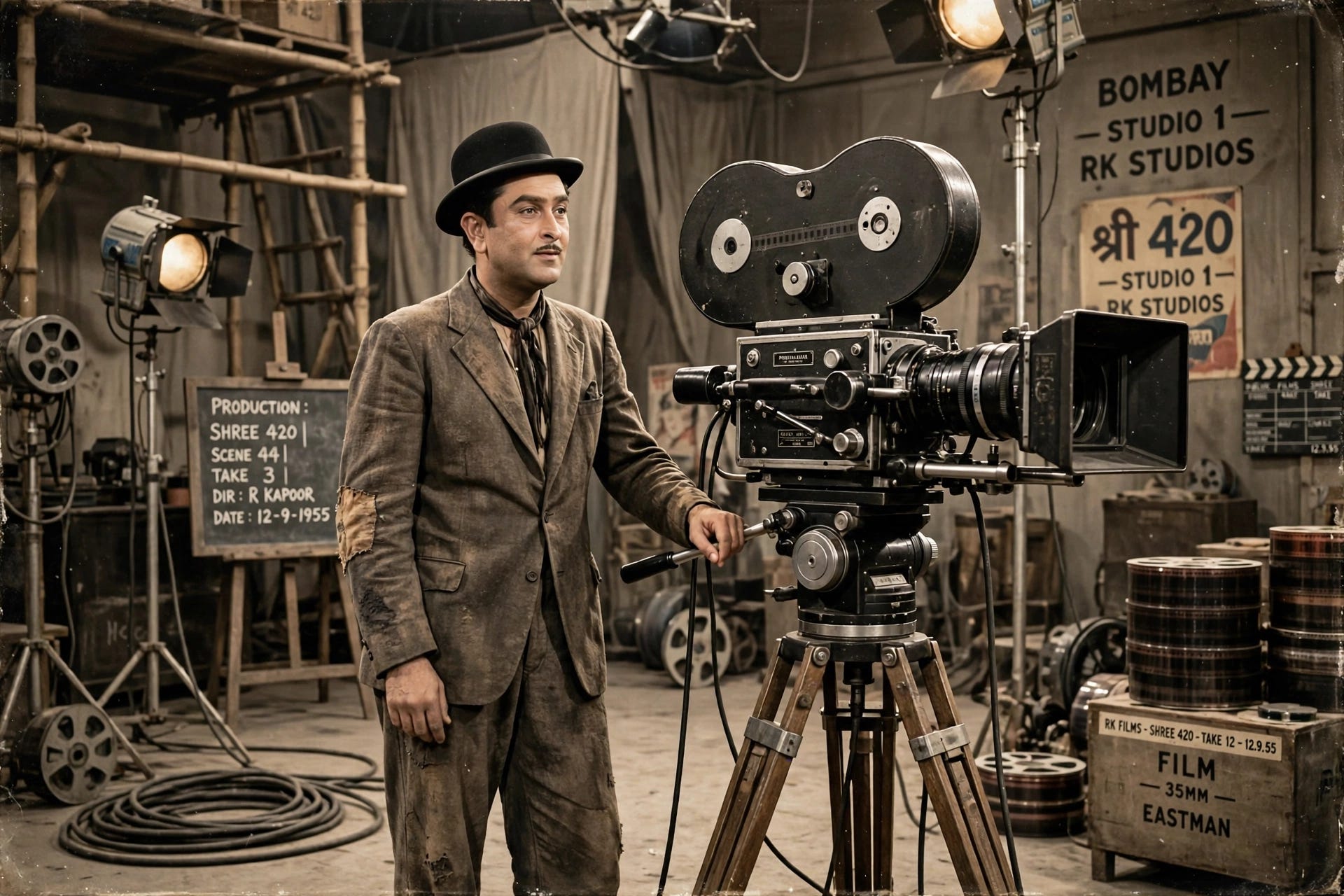
The Showman: A Name the World Learned
The title by which India remembers him — the Showman — was not a publicity invention. It described a method. Raj Kapoor understood, earlier and more completely than almost any Indian filmmaker of his generation, that cinema is not only the film on the screen. It is the poster that stops a passer-by, the song that leaves the theatre humming in the street, the premiere that becomes a civic occasion, the star who arrives in a foreign capital and is received less as an entertainer than as a familiar friend. He staged all of it, instinctively, from the beginning of his career to the end of his life.
Yet showmanship, in his case, was never a substitute for substance. The films that made his name — Awaara, Shree 420, Jagte Raho, Sangam, Mera Naam Joker, Bobby, Prem Rog — were popular entertainments built on serious questions. Who owns a child, the father who begets him or the world that raises him? Can a man stay honest in a city that rewards cheating? What does a society owe its widows, its street children, its fallen women, its clowns? Kapoor asked those questions in the language of song, melodrama and spectacle, which is why they travelled. A thesis stays in a lecture hall. A melody crosses a border without a passport.
His reach was, by any measure, extraordinary for a filmmaker working in Hindi, in a newly independent country, with modest budgets by Hollywood standards. In the Soviet Union he became, in the 1950s, emblematic of the cultural exchange between India and the USSR, and immensely popular besides — not as an exotic curiosity but as a beloved popular star whose vagabond hero audiences took to their hearts as one of their own. In China, in the Middle East and across Southeast Asia, the same films that were blockbusters at home were blockbusters abroad. That double success — domestic and foreign, critical and popular — is the central fact of his career, and the thread that runs through everything that follows.
He was also, inseparably, a Kapoor. The eldest son of Prithviraj Kapoor, he founded a dynasty as surely as he founded a studio. His brothers Shammi and Shashi became leading stars in their own right. His sons acted and directed. His granddaughters and his grandson carried the name into a new century. To tell his story properly is therefore to tell several stories at once: the story of a boy from Peshawar, of a father who built a stage, of a studio that rose and burned and was sold, of a partnership with an actress that defined an era, of a team of musicians who gave his tramp a voice, and of a single film that took six years to make, ruined him, and was redeemed by audiences on another continent who never stopped loving him.
What follows traces that arc in order — the childhood, the apprenticeship, the early triumphs, the tramp, the music, the fall, the rescue, the late masterpieces, the honours, the death that came cruelly close to his greatest honour, and the centenary year, a full century after his birth, when India stopped again to watch his films in darkened halls and remember why they had never really been forgotten.
Peshawar 1924: Kapoor Haveli
Raj Kapoor was born on 14 December 1924 at Kapoor Haveli, in Qissa Khwani Bazaar, Peshawar, in what was then British India and is now Pakistan. His birth name was Shrishti Nath Kapoor; he is also recorded as Ranbir Raj Kapoor. He was the eldest of six children of Prithviraj Kapoor and Ramsarni Kapoor, born into a Punjabi Hindu Khatri family.
Peshawar matters in this story for more than the accident of birth. It was a frontier city of storytellers — Qissa Khwani Bazaar means, in effect, the bazaar of the storytellers — and the Kapoor household stood in a neighbourhood that would produce more than one giant of Indian cinema. Kapoor grew up in the same Peshawar neighbourhood as Dilip Kumar, who would become his contemporary, his co-star in Andaz and his lifelong friend. That two boys from the same streets of a north-western frontier city should grow up to define, between them, much of the emotional vocabulary of Hindi cinema — Kumar the tragedian, Kapoor the tramp — is one of those coincidences that later generations understandably treat as fate.
Kapoor Haveli itself became, in time, a place of pilgrimage and of argument about preservation, a physical reminder that the roots of Bombay cinema ran deep into cities that Partition would place across a new border. Kapoor’s own beginnings were thus, from the first day, transnational in a way his later career would mirror. The boy born in Peshawar would be claimed, in his lifetime, by audiences in Moscow and Beijing who knew nothing of Peshawar at all — and yet something of the frontier city’s warmth, its hospitality to strangers and its love of a well-told tale, stayed in the persona he built. The vagabond Raju, after all, is a man perpetually arriving in a new place and asking to be taken in.
His mother, Ramsarni Kapoor, presided over a household that would grow to six children even as its circumstances shifted with his father’s fortunes. The Kapoor family of that generation was not yet the dynasty of popular imagination. It was a theatrical family, respectable but itinerant, whose wealth was talent and reputation rather than property. Everything the son later built — the studio, the cottage behind it where friends gathered, the almost feudal loyalty of his unit — can be read as an attempt to give that itinerant childhood a permanent address.
Prithviraj: The Father Who Built a Stage
No account of Raj Kapoor can begin anywhere but with his father. Prithviraj Kapoor was, when Raj was born, a touring stage actor — a man who carried his art from town to town, performing for audiences who might see a travelling company once in a season and remember it for years. He would go on to become one of the foundational figures of Indian theatre and cinema, founder of Prithvi Theatres, and to leave an indelible mark on the screen himself, most famously for later generations in Mughal-e-Azam in 1960.
The father’s influence on the son was both practical and philosophical. Practically, Prithvi Theatres gave the young Raj a stage to grow up on. He acted on stage with his father’s company, learning in the most direct way possible how a live audience breathes, where it laughs, where it falls silent and where it must be won back. Filmmakers who begin in theatre often carry a particular gift into cinema: they shoot for the last row. Kapoor always did. His scenes are built on clear, large emotions, played without embarrassment, because he had learned as a boy that a feeling stated timidly in a large hall simply disappears.
Philosophically, Prithviraj embodied a seriousness about popular art that his son never abandoned. The touring stage was not, in the father’s world, a lesser form awaiting rescue by high culture. It was a calling, with its own discipline, its own repertoire and its own obligations to the audience who had paid and travelled to be there. When Raj Kapoor later spent six years and his entire fortune on a film about a clown, baffling his financiers, he was behaving exactly as a Prithvi man would: the work demanded it, therefore the money would be found, and if the money could not be found, the assets would be mortgaged. That stubbornness came from Peshawar and from the touring stage as surely as his talent did.
The father-son relationship would also become, remarkably, material for the son’s greatest film. In Awaara, Prithviraj played Judge Raghunath, the stern father who believes that a criminal’s son must inevitably become a criminal, opposite Raj as Raju, the son raised in poverty who becomes a thief. The confrontation between them on screen — real father and real son, arguing through fiction the oldest question about heredity and environment — gave the film a charge that no casting director could have manufactured. Audiences who knew the relationship felt it. Audiences who did not, felt it anyway.
Prithvi Theatres, meanwhile, left Bombay a permanent institution and the family a permanent standard. To be Prithviraj’s son was an inheritance and, inevitably, a burden: doors opened, and expectations waited behind every one of them. The documentary treatments of the family, following the line from Prithviraj through Raj to the generations after, return again and again to that double edge — the name as capital, and the name as a debt each generation must repay in its own coin.
A Travelling Childhood, an Unfinished Education
Because Prithviraj was a touring actor, his children led a peripatetic life. Raj was schooled in Dehradun, at Colonel Brown Cambridge School, in Calcutta at St Xavier’s Collegiate, and in Bombay at Campion School — a map of schools that is really a map of his father’s engagements and the family’s gradual settling toward the film capital.
This fragmented education is sometimes told as a deficit, and in formal terms it was one: Raj Kapoor did not proceed to a university career, and he belonged to a generation of film people whose real university was the studio floor. But the travelling childhood gave him other kinds of knowledge that no settled schooling could have supplied. He saw India at ground level, from trains and theatre lodgings, in several languages and several climates of feeling. He learned early that a story must work for audiences who share neither a city nor a dialect with its teller — a lesson the Soviet and Chinese triumphs of his films would later confirm on a world scale.
He also learned the household economics of art. A touring family knows the difference between a full house and an empty one in the most literal way: it is the difference between eating well and not. The adult Kapoor’s famous extravagance — the lavish productions, the studio preserved like a palace, the hospitality of the R.K. cottage — coexisted with an equally famous instinct for what an audience would pay to see. Both instincts were formed in those years. He knew what insecurity felt like, so he built empires against it. He knew what audiences loved, because he had watched his father’s livelihood depend on it nightly.
The schools themselves left their mark in smaller ways. The convent and collegiate classrooms of Calcutta and Bombay gave him English, polish and a familiarity with the manners of the classes his tramp character would later charm, deceive and gently mock. The tramp works, as a character, precisely because the man playing him understands both worlds: the pavement he sleeps on and the drawing room he is excluded from. That doubleness began here, in a childhood spent moving between the stage door and the school gate.
By the time the family was settled in Bombay, the boy’s direction was set. The question was never really whether Raj Kapoor would enter films and theatre. The question was whether he would enter them as his father’s son, in his father’s shadow, or as something the industry had not seen before. The apprenticeship that followed answered that question slowly — and, characteristically, from the very bottom.
The Clapper Boy: Bombay Talkies and Kidar Sharma
Before the lead roles, before the banner, before the tramp, there was the clapper board. Raj Kapoor worked as a clapper boy at Bombay Talkies, one of the great early studios of Indian cinema, and assisted director Kidar Sharma. The detail is small in the record and enormous in its meaning. The clapper boy stands at the edge of every shot, announces the scene, snaps the board and steps out of frame. He sees everything and is credited with nothing. It is the best seat in film school, if the boy in it is paying attention.
Kapoor was paying attention. At Bombay Talkies he could watch a working studio as a system: how a set is lit, how a director composes a frame and coaxes a performance, how an editor’s decisions are prepared long before the cutting room, how a production holds together or falls apart. Assisting Kidar Sharma — a director, writer and lyricist of formidable learning — added the literary dimension. Sharma believed in dialogue, in poetry, in the written architecture beneath the spectacle. The Kapoor who later surrounded himself with writers of the calibre of Khwaja Ahmad Abbas, and lyricists of the calibre of Shailendra, was formed in part by having served, young, under a man who treated film writing as literature.
Popular retellings of his life, including the Hindi biographical treatments that circulate widely today, return to this clapper-boy phase for a reason: it makes the later showmanship legible. The man who mortgaged everything for Mera Naam Joker had begun by carrying the board. Nothing in a studio was beneath him because, at the start, nothing in a studio was above him — he had done the lowest job in the room, and he never forgot what the room looked like from there. His later sets were famous for their hierarchy and their warmth at once, and both qualities trace back to an apprenticeship served at floor level.
There is also a plainer lesson in the apprenticeship. Indian cinema in the 1940s had no film schools of consequence. It had studios, and it had masters, and a young man learned by attaching himself to both. Kapoor attached himself well. Bombay Talkies gave him craft; Kidar Sharma gave him a break — and, in time, the lead role that would end the apprenticeship for good.
Inquilab to Neel Kamal: The Child Actor Grows Up
Raj Kapoor’s first screen appearance came at the age of ten, in Inquilab in 1935. Through his father’s world he continued to appear as a child and young actor, with roles in films including Gauri in 1943 and Valmiki in 1946, alongside his stage work with Prithvi Theatres. These early appearances are best understood as a continuation of the family trade: the son of the company played the sons in the plays and films, and learned his timing before audiences who had not come to see him at all.
The break, when it came, came from his master. In 1947, Kidar Sharma cast him in the lead in Neel Kamal, opposite Madhubala and Begum Para. It was his first role as a leading man, and it announced the qualities the next decade would refine: the romantic softness, the expressive face, the willingness to appear vulnerable in a heroic culture that usually asked its leading men to be invulnerable. The same year brought other releases — Chittor Vijay, Dil Ki Rani and Jail Yatra — which failed. The contrast is instructive. Talent alone, in 1947, guaranteed nothing. The industry was crowded, the country was in the upheaval of independence and Partition, and a young actor with a famous surname could still disappear into the mass of hopefuls.
He did not disappear, for two reasons. The first was that Neel Kamal had shown directors what he could carry. The second was his own decision, taken with a speed that still startles: rather than wait for the industry to build him a vehicle, he would build the vehicle himself. Within a year of his first lead role, at an age when most actors are begging for a second chance, Raj Kapoor founded his own production company and directed his first film. The child actor who had grown up in other men’s companies became, at twenty-four, the youngest filmmaker in India.
The Partition context deserves a word, because it shaped the audience he would serve. The India that emerged in 1947 was a nation of displaced persons, divided families and new cities rising out of refugee colonies. Kapoor’s own family roots lay in Peshawar, now across the border. When his tramp hero later sang his way through Bombay’s streets — rootless, cheerful, claiming the whole world as his wardrobe and India as his heart — he was playing, whether consciously or not, to millions who had themselves arrived in a strange city with nothing but what they stood up in.
Marriage and the Making of a Household
In 1946, before the lead roles and the banner, Raj Kapoor married Krishna Kapoor, née Malhotra. The marriage endured for the whole of his life, and the household it created — five children: Randhir, Ritu, Rishi, Rima and Rajiv — became the private foundation on which the very public career was built.
It is easy, in a film biography, to treat a marriage as a paragraph of dates. In Kapoor’s case the household deserves more attention, because so much of his later story runs through it. The studio was a family enterprise in the literal sense: sons grew up on its sets, made their debuts under its banner and, in Rishi’s case, first as the child Raju of Mera Naam Joker and then as the young hero of Bobby, twice carried the banner’s fortunes on his shoulders. The house that the family finally bought — after Bobby, as his son Rishi later recalled, when friends and uncles insisted on it — was bought late precisely because for decades every spare rupee had gone back into the studio and the films. The household lived, for much of Kapoor’s career, inside the economics of his ambition.
Krishna Kapoor’s role in that household was, by all family accounts woven through the dynasty’s public memory, one of steadiness: the centre that held while productions expanded, debts mounted and fame made its ordinary depredations. The Kapoor family’s public gatherings — later generations would see them at festivals and family occasions, a clan photographed together across four generations — projected an unity that began in this marriage. When, in the centenary year, the family travelled together to meet the Prime Minister in New Delhi ahead of the Raj Kapoor 100 festival, the line of descent they represented ran straight back to 1946.
The children, meanwhile, inherited both the stage and the scrutiny. Randhir, Rishi and Rajiv all entered films; Ritu and Rima built lives partly outside the screen while remaining part of the family’s public story. Rishi, in particular, would become his father’s most vivid memorialist — the source, decades later, of the clearest account of what Mera Naam Joker’s failure actually cost the family, told in his own words. That account appears later in
1948: R.K. Films and Aag
In 1948, Raj Kapoor founded R.K. Films. Its first production, Aag, released that year, was his debut as both director and producer. He was twenty-four years old, and he was the youngest filmmaker in India. The audacity of that fact deserves to be sat with. A twenty-four-year-old with one successful lead role behind him persuaded the world to let him direct, produce and star — and, more than that, to let him do it under his own banner, with his own initials over the door.
Aag co-starred Nargis, the actress who would become his defining screen partner. The film was praised by critics but was not a commercial success. In the long view, that pattern — critical admiration running ahead of the box office — would recur at the most important moments of his career, most painfully with Mera Naam Joker. But in 1948 it taught the young producer-director the essential arithmetic of survival: praise does not pay the laboratory bills. The next film would have to be built to succeed, and it was.
What Aag established, beyond its reviews, was a working method and a working family. Under the R.K. banner, Kapoor began assembling the collaborators who would stay with him, in some cases, for decades: writers, composers, lyricists, cameramen and actors who understood that an R.K. film was not a job but a court, with its own rituals, its own standards and its own generous, demanding king. The banner’s films would become famous for their polish — for songs staged as set pieces, for photography that lingered, for a completeness of vision that came from one man supervising everything and a loyal team executing it.
The founding of R.K. Films also fixed the geography of the story. In time the banner would settle at Chembur, in a studio of nearly two acres that became one of the landmarks of Indian cinema. But in 1948 the empire was an idea and a letterhead. The idea was simple and, for its time, radical: that an Indian popular film could be made with the care of a work of art and the reach of a work of showmanship, by a company that answered to the man whose face was on the poster.
Barsaat 1949: The First Hit and a Logo
Barsaat, in 1949, was the banner’s first hit, and it gave R.K. Films the two things a young studio needs most: money in the bank and an image the public could carry away with it. The film’s success established Kapoor and Nargis as a pair the audience wanted to see again, and its music carried the film far beyond the theatres, into the streets and courtyards where film songs live their second, longer life.
The image endures literally. The famous still of Kapoor holding Nargis in his arms became the logo of R.K. Films — the emblem that would precede every film the banner made, for half a century. Logos are usually abstractions. This one was a love scene. It told every audience, before a single frame of the new film had run, what an R.K. picture promised: romance, music, longing, and a hero who held the heroine — and the world — in a particular, tender way. Few production companies in the world have been so fortunate in their trademark, or so wise in choosing it from their own work rather than from a designer’s board.
Barsaat also confirmed the commercial logic of the Kapoor method. Songs were not interruptions to an R.K. film; they were its ambassadors, sent ahead of it into the public ear. A hit song created an audience before the film opened and sustained it after the film closed. The young producer who had watched his father’s houses fill and empty understood that a melody is a full house that travels. From Barsaat onward, the music of an R.K. film was planned with the same seriousness as its story — a seriousness that would soon produce one of the great musical partnerships in Indian cinema.
For Kapoor the actor, Barsaat fixed the romantic image that the tramp would shortly complicate. He could play the ardent lover, rain-soaked and yearning, as convincingly as any leading man of his day. The achievement of the next three years was to fuse that lover with a vagabond, a thief and a clown, without losing the audience’s love in the process.
Andaz: Superstardom Beside Dilip Kumar
Also in 1949, Kapoor acted for another director in a film that changed his standing overnight. Andaz, directed by Mehboob Khan, starred Nargis with both Kapoor and Dilip Kumar — the friend from the Peshawar neighbourhood, now his great contemporary. The film broke box-office records and made superstars of Kapoor and Kumar.
A modern reader, accustomed to opening-weekend arithmetic, may need help feeling what a record-breaking hit meant in 1949: longer runs, fuller houses, songs and dialogues passing into common speech, and two young actors elevated, in a single release, into the small company of performers whose names alone could open a film. Andaz placed Kapoor in that company by merit, under another director’s command, in a story where he shared the heroine, the frame and the honours with the most formidable actor of the age. It is the indispensable counterweight to the auteur story. Kapoor the director built R.K. Films; Kapoor the actor could walk onto Mehboob Khan’s set and hold his own opposite Dilip Kumar.
For readers who want to trace how those record-breaking collections actually accumulated — film by film, territory by territory — the modern habit is to reach for a structured explorer of historical figures rather than a single remembered number, and the Bollywood Box Office Explorer is the kind of tool that lets a curious viewer follow a career like Kapoor’s through its commercial peaks and valleys alongside its artistic ones. The two curves, in his case, rarely moved together, which is precisely what makes the tracing worthwhile.
Andaz also completed a triangle that the public never tired of: Kapoor, Kumar and Nargis. The two men represented, for a generation of viewers, two poles of screen masculinity — Kumar inward, smouldering, tragic; Kapoor open, musical, resilient — and the friendly rivalry between the Peshawar boys became one of the sustaining narratives of Bombay cinema. That both men remained lifelong friends, their rivalry a professional spur rather than a feud, says something about the generation that built the industry: they competed for the same audience and never mistook the competition for war.
The Tramp: Chaplin’s Shadow, India’s Everyman
Kapoor’s best-known screen persona was modelled on Charlie Chaplin’s Little Tramp: poor but honest, moustached, dressed in a shabby suit and hat. The debt was open and acknowledged in the figure itself — the gait, the cane-swinging jauntiness, the pathos that arrives a beat after the laugh. What matters is what Kapoor did with the inheritance.
Chaplin’s tramp was a figure of the industrial West: a little man processed by factories, lodging houses and police courts, whose dignity survived his circumstances. Kapoor transplanted him to a newly independent India and discovered that the soil was, if anything, richer. His Raju — the name recurs across the great films — is the migrant in the metropolis, the village boy in the cheating city, the honest man in the dishonest bazaar. Where Chaplin’s tramp confronted the machine age, Kapoor’s confronted the moral economy of a poor, rapidly urbanising nation: the moneylender, the smuggler, the respectable judge, the dance hall and the pavement. The shabby suit in Bombay carried a different charge than in London or Los Angeles. It said: this is us, the clerks and coolies and cart-pushers, and our hearts are better than our clothes.
The persona was also a piece of strategic genius. A star who plays kings ages out of kingship; a star who plays the everyman can play him at twenty-seven and at forty, in romance and in tragedy, because the character is not a youth but a condition. The tramp let Kapoor grow older on screen without breaking faith with his audience. It let him sing — the tramp in India sings, because in India the poor sing — and it let him weep, openly, in an era when screen masculinity elsewhere was tightening its jaw.
Critics of the time and since have debated the Chaplin debt, some treating it as imitation. The fairer judgement is that Kapoor did with the tramp what every strong artist does with a master: he learned the grammar and then wrote his own sentences. The test is the foreign triumph. Soviet audiences did not embrace Raju as a copy of a figure they also loved; they embraced him as a fellow everyman, a brother in shabby clothes whose sorrows and songs were theirs. A copy does not travel like that. A translation does.
In the films themselves — Awaara and Shree 420 above all — the persona reached its perfection: the wide eyes registering wonder and hurt in the same instant, the smile that asks the world’s pardon while quietly indicting it, the walk that is half dance. The tramp became, in the end, less a character Kapoor played than a lens through which India examined itself for two decades. Every later section of this story is, in some way, about what that lens revealed.
Awaara 1951: The Vagabond Conquers the World
Awaara, released in 1951, is the film on which everything else in this story rests. Kapoor directed it and starred as Raju, the vagabond; Nargis played Rita, the woman who believes in him; and Prithviraj Kapoor played Judge Raghunath, Raju’s father, whose rigid conviction — that a bad man’s son must grow up bad — sets the tragedy in motion. The judge casts out his wife, the child grows up in poverty under the influence of the very criminal the judge had convicted, and the son becomes a thief. The film then asks its question in the form of a courtroom drama and a love story at once: is Raju a criminal by birth, or a man made by the world that refused him?
The film competed for the Grand Prize at Cannes in the early 1950s — Awaara and Boot Polish competed at Cannes in 1953 and 1955 respectively in Britannica’s account of his legacy — which placed a Bombay popular film, with songs, in the company of the world’s art cinema. Time magazine ranked Kapoor’s performance in Awaara among the ten greatest screen performances of all time. For a twenty-seven-year-old actor-director from a touring theatre family, these were not ordinary honours. They were a declaration that the popular cinema of India had produced a figure the world had to reckon with.
Watching the film itself — it circulates today in full, a primary source more eloquent than any summary — what strikes a modern viewer first is the completeness of the tramp’s physical life: the costume, the gait, the courtroom framing in which the vagabond’s story is told to the very establishment that condemned him, and the father-son confrontation in which Prithviraj’s granite authority meets Raj’s wounded bewilderment. The melodrama is large, but it is never vague. Every emotion is attached to a social fact: the slum, the jail, the judge’s bungalow, the law that protects one world from the other.
Awaara also fixed the pattern of the R.K. film at its best. There is a thesis, but it arrives wearing a love story. There is social criticism, but it sings. There is a star performance, but it is surrounded by a company — above all by Nargis, whose Rita is not a decoration on Raju’s story but its moral intelligence: the educated, privileged woman who sees the man the court cannot. And beneath everything runs the music, carrying the film’s feelings into the streets in a form that even those who never bought a ticket would absorb. The vagabond conquered the world because the film built him a vehicle in which every part — story, star, song, spectacle — pulled in the same direction.
At home, Awaara made Kapoor the defining popular filmmaker of the young republic. Abroad, it began the phenomenon that the next section describes: an embrace, in the Soviet Union and China and far beyond, so warm and so durable that it reshaped what the Indian film industry believed its audience to be.
Awaara Hoon: The Soviet Union and China Fall in Love
The title song of Awaara — “Awaara Hoon”, I am a vagabond — became famous across the Soviet Union and China, and with it, its singer’s face and its star’s shabby silhouette became part of the popular culture of countries that shared no language with the film. Kapoor became a superstar in the Soviet Union, emblematic of the cultural exchange between India and the USSR in the 1950s, and immensely popular in the Middle East, China and Southeast Asia. Awaara and Shree 420 were blockbusters abroad as well as at home.
The scale of this deserves emphasis, because it is easy to file under trivia. The Soviet Union was a closed and enormous market in which foreign films were few and therefore mighty: a film admitted there played to a continent. Indian films, and Kapoor’s above all, were admitted and adored. The reasons repay thought. Soviet audiences, emerging from war and hardship into a rigid official culture, met in Raju a hero who was poor without being pitiful, funny without being cruel, and in love with life without being naive about it. The tramp’s critique was aimed at judges, moneylenders and hypocrites — targets a Soviet audience could applaud — while his warmth, his music and his romance offered pleasures that official art often rationed. Popular memory in India, retold in biographical treatments ever since, delights in the scale of it: the songs on Soviet lips, the star mobbed by affection on his visits, the vagabond as an unofficial ambassador between two young states.
China’s embrace had its own logic. A vast, poor, newly revolutionary country recognised the world of Awaara — its pavements, its hungry children, its corrupt respectability — as a version of its own recent past, and its hero’s refusal to be embittered as a version of its hopes. The song travelled there as songs do, by radio, by street singers, by sheer memorability, until the vagabond’s refrain belonged to people who had never seen Bombay.
For Indian cinema, the lesson was permanent. Kapoor proved that a Hindi film, made without compromise for its home audience, could be a world film — not by imitating Hollywood, but by being so completely itself that foreign audiences recognised their own lives in it. Every later Indian star with a following in Moscow, Beijing, Cairo or Jakarta walked a road that Awaara opened. And for Kapoor personally, the foreign love created a reservoir of goodwill that would matter, decades later, in the most unexpected way: when his most personal film failed at home, it was the Soviet audience that redeemed it.
There is a further dimension to the Soviet and Chinese embrace that is easy to miss from India, where Kapoor’s fame needs no explanation. Abroad, he was not merely a foreign star who had succeeded; he was, for hundreds of millions of viewers, their primary knowledge of India itself. The India they carried in their imaginations — its cities, its poverty, its music, its moral warmth — was substantially the India of his films, because his films were the India that reached them. A Soviet schoolchild of the 1950s humming the vagabond’s song was humming a tune composed in Chembur, and the Bombay street she pictured while humming it was a set built on two acres in a suburb she would never see. This is the mechanism that the language of a later century would call soft power, and Kapoor achieved it without a single official commission, simply by making films for his own people so honestly that other peoples recognised themselves in them. The foreign triumph also fed back into the work. A filmmaker who knows his audience includes Moscow and Beijing begins, consciously or not, to build stories whose emotional architecture needs no translation: the lost child, the stern father, the faithful beloved, the song that says what dialogue cannot. The universality critics praise in the tramp films was not an abstract aesthetic choice. It was the craft of a man whose public, by 1955, spanned half the earth, and who had learned to speak to all of it at once without thinning what he said to any part of it. When the clown’s testament later needed a foreign audience to redeem it, it was collecting a debt this decade had created — loyalty banked, song by song, in the 1950s, and honoured, with interest, in 1972.
Boot Polish and the Children of the Street
Boot Polish, released in 1954, turned the camera from the vagabond to the children who shined shoes on the same pavements. The film belongs to the great sequence of R.K. productions of the 1950s — Awaara, Boot Polish, Shree 420, Jagte Raho — in which Kapoor, as producer and presiding spirit, used popular form to look steadily at the people Indian respectability preferred not to see: thieves, orphans, pavement dwellers, the night population of the city.
The choice of subject was itself a statement. Street children were not, in 1954, a recognised subject for a major commercial banner. Kapoor’s cinema insisted that they were — that the boy with the boot-polish box had an inner life as worthy of a feature film as any prince’s, and that the audience which had wept for Raju would weep, and laugh, for the children who inherited Raju’s streets. Boot Polish competed at Cannes in 1955, in Britannica’s account, extending the banner’s festival presence and confirming that these were not merely domestic successes: the children of Bombay’s streets could hold a screen on the Riviera.
Within the arc of Kapoor’s work, the film matters for another reason. It shows the showman learning to step back. The R.K. banner was never only a vehicle for its founder’s face; it was a house style, a moral outlook and a production standard that could carry a film centred on child performers. That institutional quality — the banner as author, not only the man — is what later allowed R.K. Films to survive its founder’s retreat from acting, to launch his sons, and to remain a name audiences trusted for fifty years, until its last film in 1999.
Boot Polish also deepened the social world of the tramp films. If Awaara asks what society does to a child it abandons, Boot Polish asks the question in the present tense, without the courtroom’s retrospective comfort. Together they form the compassionate core of Kapoor’s 1950s: a cinema that believed the measure of the new nation was its treatment of its smallest citizens, and that said so in songs the whole nation could sing.
Shree 420: The Honest Man in a Cheating City
Shree 420, released in 1955, is the tramp’s second great monument. The title itself is an argument: “420” refers to Section 420 of the Indian Penal Code, the provision on cheating — a number so embedded in Indian slang that to call a man a “420” is to call him a fraud. Kapoor’s hero arrives in the city as an honest, educated innocent and is drawn, by hunger and by love and by the glittering machinery of Bombay, toward the very crime the title names. The film won a National Film Award in 1955.
The film contains the two passages of published song lyric that have become, in effect, Kapoor’s public epitaphs, quoted in Britannica and sung ever since. The first is the great duet of Shree 420: “Pyaar hua, ikraar hua hai, pyaar se phir kyun darta hai dil?” (“We fell in love, we accepted it. Why does the heart still fear love?”) It is the tramp in love — the umbrella, the rain, the two figures negotiating, in melody, the distance between feeling and confession. The second is the tramp’s own anthem of identity: “Mera joota hai Japani, yeh patloon Englishtani, sar pe lal topi Roosi, phir bhi dil hai Hindustani” (“My shoes are Japanese, my trousers English, a red Russian cap on my head — yet my heart is Indian”). No four lines in Indian cinema state a national philosophy more economically. The wardrobe is the whole world — Japan, England, Russia, the very map of the film’s foreign triumphs — and the heart is Hindustani. Cosmopolitan in dress, rooted in allegiance: it was Kapoor’s own biography set to music, and it became a young nation’s favourite description of itself.
As a film, Shree 420 sharpens Awaara’s questions for a richer, more corrupt city. The vagabond of 1951 was made a thief by rejection; the hero of 1955 is tempted into fraud by seduction — by the city’s promise that honesty is a luxury the poor cannot afford. His fall and redemption give the tramp his most complete moral arc, and the film’s success, at home and abroad, confirmed that the persona could sustain not just sympathy but sustained ethical storytelling. The honest man in the cheating city became the definitive Kapoor figure: the little man whose heart, tried by every inducement, remains Hindustani in the song’s deeper sense — uncorrupted.
Jagte Raho and the Festival Circuit
Jagte Raho, released in 1956, extended the R.K. canvas in a new direction: a single night in the city, in which a poor villager, searching for water, wanders through an apartment building and discovers, floor by floor, the hidden corruptions of its respectable residents. The film won the Crystal Globe at the Karlovy Vary film festival in 1957 — a major European festival honour for a Bombay production, and evidence that the banner’s festival presence, begun at Cannes, was a pattern rather than an accident.
The film’s structure is a piece of quiet daring. Where Awaara and Shree 420 are built around the star’s journey, Jagte Raho is built around his gaze: the tramp as witness, moving through the city’s compartments while the city, unaware, confesses itself. The respectable world that judged Raju in Awaara is here caught in its own thefts, hypocrisies and cruelties, while the intruder from the village — the supposed criminal of the piece — remains its only innocent. The reversal completes the trilogy’s argument. The tramp films, taken together, conduct a sustained cross-examination of respectability, and Jagte Raho is the cross-examination conducted at night, by torchlight, in whispers.
The festival honours mattered at home as well as abroad. In the 1950s, Indian popular cinema was routinely condescended to by cultural establishments, Indian and foreign alike, as a bazaar art beneath serious notice. Kapoor’s films kept returning from Cannes and Karlovy Vary with competition slots and crystal globes, and each return made the condescension harder to sustain. He did not make festival films instead of popular ones. He made popular films that festivals could not ignore — which is the harder trick, and the one that changed his industry’s sense of its own possibilities.
By the end of the 1950s, then, the position was this: Kapoor was a superstar at home, a beloved figure across half the world, a festival-honoured director, and the head of a banner whose logo was a love scene. The next phase of the story is about the two collaborations that made all of it sing — literally — and about the acting he continued to do, with undiminished distinction, for other directors.
The Music: Shankar–Jaikishan, Mukesh, Shailendra
Britannica’s judgement is plain: music was crucial to the success of Kapoor’s films, and many of their songs became hits. Behind that plain sentence stands one of the great creative teams in cinema history. Kapoor’s core collaborators were the composers Shankar–Jaikishan, the playback singer Mukesh — his signature voice — the lyricists Shailendra and Hasrat Jaipuri, and the writer Khwaja Ahmad Abbas. Together they did not merely supply songs to R.K. films. They built the emotional language in which the tramp thought aloud.
Shankar–Jaikishan gave the films their melodic abundance: tunes of an almost folk-like simplicity on the surface, orchestrated with a richness that let a street song swell, a moment later, into something symphonic. Their partnership with the banner began in the Barsaat era and ran through the great decades, and its sound — the accordion’s sigh, the violins in flood, the rhythm that walks at the tramp’s pace — became so identified with Kapoor that it is difficult, now, to hear the melodies without seeing the shabby suit.
Mukesh was the voice. Playback singing allows a cinema to choose, for each face, the voice that face would have in a better world, and Kapoor’s choice was definitive: Mukesh’s grainy, tender, slightly wounded baritone became the sound of Raju’s heart. The identification grew so complete that the singer was known, simply, as Kapoor’s voice — when Mukesh sang, audiences heard the tramp thinking. It is one of the purest star-voice fusions in world cinema, and it meant that the songs could leave the film and carry the character with them, into radio sets and tea stalls where the face had never been seen.
Shailendra, the poet among the lyricists, gave the tramp his philosophy in lines a child could memorise and a philosopher could ponder — the Hindustani heart beneath the foreign wardrobe is his kind of sentence, a whole worldview in a rhyming couplet. Hasrat Jaipuri supplied the romantic ardour, the lover’s register of the same universe. And Khwaja Ahmad Abbas, the writer whose association with Kapoor runs from the tramp films to Mera Naam Joker, gave the stories their social spine: the slum and the courtroom, the judge and the thief, rendered by a writer who had spent his life reporting on exactly that India.
Kapoor’s own role in this team was that of the impresario with perfect pitch for other men’s gifts. He chose collaborators the way he cast actors, for life rather than for a project, and he created the conditions — the studio, the cottage, the long musical sittings — in which a team could become a school. The R.K. sound was not a style imposed on the films. It was the films, thinking in music.
The durability of that sound deserves a moment’s wonder. The songs of the tramp films did not merely accompany hits; they outlived the films’ first runs, the banner’s crises, the studio itself and every participant in their making, passing from radio to record to cassette to streaming without ever leaving the public ear. A melody by Shankar–Jaikishan, a lyric by Shailendra, a phrase in Mukesh’s voice: these became part of the emotional furniture of Indian life, the tunes a nation reaches for at weddings, partings and rainy-season evenings without remembering that it is quoting a film at all. Kapoor understood this afterlife earlier than anyone. He treated every song as a small film with its own staging, its own dramatic necessity and its own poster image — the duet under the umbrella, the tramp’s walk through the city, the clown’s song behind the mask — so that when the song detached itself from the film and travelled, it carried a picture with it. That is why the music of R.K. Films conquered countries the films reached late or never: the song arrived first, as an emissary, with the tramp’s face already printed on it. Directors since have chased that synthesis with bigger orchestras and costlier picturisations. Few have matched it, because the synthesis was never really about resources. It was about a producer who believed that a film’s music was its soul’s native language, and who hired, for life, the men who could speak it.
Nargis: The Great Screen Partnership
From Aag in 1948 through the great films of the 1950s, Nargis was Kapoor’s defining screen partner, and their partnership remains the standard against which Indian screen couples are measured. She was the face in the logo — the woman held in the hero’s arms in the Barsaat still that preceded every R.K. film — and she was, in Awaara and Shree 420 and the films around them, the moral and emotional intelligence of the tramp’s world.
The partnership worked because it was a partnership of equals in talent. Nargis brought to the R.K. films a gravity and modernity that balanced Kapoor’s sentiment: her Rita in Awaara is a lawyer’s daughter who argues the tramp’s case to the world and to herself; her heroines are never merely the prize at the end of the hero’s journey but the standard by which the journey is judged. When the tramp sings his fear of confessing love in Shree 420, it is her answering presence that gives the fear its stakes. Popular fascination with the pair — mined by every retelling of Kapoor’s life since — rested on something the films themselves supply: an on-screen intimacy of rhythm, two performers who seem to be listening to each other even in song.
Their films together trace the whole arc of the banner’s first decade: the praised failure of Aag, the first hit of Barsaat, the record-breaking Andaz — where she stood between Kapoor and Dilip Kumar at the summit of the industry — and the world-conquering tramp films. That one actress should be present at every stage of a studio’s founding decade is rare in any cinema. That the studio should then choose her image, in its founder’s arms, as its permanent emblem is rarer still. The logo was an acknowledgement, renewed before every film the banner ever made, of where the house had come from.
When the partnership ended, as partnerships do, the tramp continued — but the classic period of R.K. Films, the black-and-white world of Raju and Rita, had reached its natural close. The 1960s would demand a new Kapoor: in colour, in Europe, and eventually behind the camera more than before it.
Acting for Others: Anari, Chhalia, Teesri Kasam
Kapoor’s career was never confined to his own banner. Among his notable performances for other directors, Britannica singles out Anari in 1959, Chhalia in 1960 and Teesri Kasam in the 1960s — a sequence that shows the actor, at the height of his own directorial fame, still submitting himself to other men’s visions and finding, in them, registers his own films did not use.
Anari — the simpleton, the innocent — is the tramp’s cousin: the honest fool in a world of sharpers, a role that let Kapoor refine the persona toward pure guilelessness. Chhalia, in 1960, placed him amid the wounds of Partition, the national trauma of his own generation and his own family’s displacement from Peshawar; the film’s emotional landscape of separated families and lost homes drew on sorrows its audience had lived. Teesri Kasam, in the 1960s, is the jewel of the three: Kapoor as a humble cart-driver, carrying a passenger whose story unfolds across a journey, in a film of a lyricism and restraint quite unlike the R.K. spectaculars. It proved, late and definitively, that the showman could also be a minimalist — that the face which could hold a stadium-sized melodrama could hold, just as surely, a silence.
These outside performances matter to the assessment of Kapoor because they correct the auteur myth. The founder of R.K. Films was not a director who acted in his own films for want of offers. He was one of the most sought-after actors in the country, whose services other major directors competed for, and who kept returning to their sets even when his own banner could have consumed all his years. Acting, for Kapoor, was the first craft — learned on his father’s stage, before the clapper board, before the camera — and he honoured it by practising it under other men’s direction to the end of his leading-man career.
They also widened his audience’s sense of him. The public that knew Raju the tramp met, in these films, the innocent, the Partition refugee and the cart-driver, and recognised in each the same moral signature: the little man’s dignity, asserted against a world arranged to deny it. It is the signature of the whole career, whether the camera was his or another’s.
Sangam 1964: Colour, Europe and the Last Leading-Man Triumph
Sangam, released in 1964, was Kapoor’s first colour film, partly shot in Europe, co-starring Vyjayanthimala and Rajendra Kumar, and built on the grand scale: a blockbuster with two intervals, a running time that announced itself as an event. It was a triumph — and, as Britannica notes, it was the last film in which Kapoor found success as a leading man.
The move to colour and to European locations was the showman’s answer to a changing decade. Indian audiences of the 1960s were asking for spectacle their parents’ cinema had not offered: foreign cities, modern romance, the world beyond the studio wall. Sangam gave them Europe through Kapoor’s eyes — the tramp grown into a prosperous, passionate hero, the love triangle staged among the landmarks of a continent that most of his audience would never see except through him. The two-interval scale declared that an R.K. film was not an evening’s entertainment but an occasion, and the public responded as he had taught it to: by turning out in numbers that made the film a blockbuster.
Yet Sangam’s triumph carried its own ending inside it. Kapoor was forty in 1964. The romantic lead he played opposite younger co-stars belonged, increasingly, to the generation rising behind him — a generation that included, soon enough, his own younger brothers and, in time, his sons. The film’s success proved he could still command the summit as a star. Its status as his last such success proved something else: that the summit, for an actor, is a lease, not a freehold. The wisdom of Kapoor’s later career — and it is wisdom, however painfully learned — was to convert stardom into authorship: to become, fully, the director whose name could open a film even when his face no longer filled its posters.
Sangam also stands as a hinge in the banner’s history for its scale of ambition. The film that shot in Europe with two intervals taught Kapoor that he could think at epic length and be rewarded for it. Six years later, he applied that lesson to the most personal story he had — a clown’s autobiography, six years in the making, with two intervals of its own. Sangam’s success had shown the reward of scale. Mera Naam Joker would show its price.
The Sixties Falter: Around the World
The later 1960s were, for Kapoor the actor, a season of ebbing. Around the World, in 1967, failed, and acting success faded as the decade closed. The industry was changing around him: new stars, new styles, a new audience impatience with the moral universes of the 1950s. The tramp, who had seemed eternal in 1955, could seem, by 1968, like a figure from a vanished India — the India of the first Five-Year Plans and the first general elections, whose hopes he had sung.
It is worth pausing on the honesty of the record here, because the Kapoor legend is sometimes told as an unbroken ascent, and it was nothing of the kind. Between Sangam and Bobby stretches nearly a decade in which the greatest showman in Indian cinema could not reliably sell a ticket with his own face. He was in his forties, carrying a studio,
The gamble’s name was Mera Naam Joker. To understand it, one must first understand that for Kapoor it was not a comeback vehicle. It was a testament — the film in which the tramp would finally step forward, remove the mask the audience had loved for twenty years, and show them the man underneath: the showman himself, whose private sorrows had been converted, performance by performance, into the public’s joy. He had been preparing it, in a sense, since the clapper board. He would spend six years making it. And when it came, India would break his heart with it — and Moscow would mend it.
The Dream That Grew for Six Years: Conceiving Mera Naam Joker
Mera Naam Joker took six years to make. Kapoor directed it, produced it, edited it and starred in it as the clown Raju; Khwaja Ahmad Abbas, his collaborator since the tramp films, wrote it. It was partly shot in Moscow, with Soviet performers including the ballerina Kseniya Ryabinkina. It became one of the longest Indian films of its era, with two intervals. And it gave a screen debut, as the young Raju, to Kapoor’s son Rishi — who won the National Film Award for Best Child Artist for the performance, a laurel that arrived, poignantly, attached to the film that nearly destroyed his father.
The conception explains the scale. Every Kapoor hero had been, in some measure, a clown: the tramp’s comedy was always a performance staged over pain. In Mera Naam Joker, Kapoor proposed to make that structure explicit and autobiographical. His Raju is a circus clown whose life unfolds in chapters, each centred on a woman he loves and loses — the teacher of his boyhood, the trapeze artist of his youth, the love of his maturity — and whose profession is the film’s thesis: the show must go on, the audience must laugh, whatever the performer’s heart is doing backstage. It was the story of Raj Kapoor told as the story of Raju the clown, and Kapoor, who had mortgaged his feelings to his art for thirty years, intended it as his testament.
The Moscow dimension was no ornament. Kapoor’s Soviet audience was the largest foreign audience any Indian star had ever possessed, and the film honoured it in the work itself: Soviet performers, a Russian ballerina woven into the clown’s story, a production that crossed the world his songs had conquered and filmed there. In an era when Indian productions rarely left the studio, let alone the country, the Moscow shoot announced that this was to be a world film about the world’s clown.
Six years of production meant six years of cost without income — of a studio’s resources flowing into a single, ever-lengthening film while the industry moved on around it. Sets stood, schedules stretched, the film grew chapters the way its hero gathered sorrows. Around Kapoor, the faithful unit held; behind the production, the finances thinned toward transparency. Everyone in Bombay knew the scale of the wager. The showman had bet the studio, the assets and the name on the proposition that India was ready to watch its beloved tramp weep for the length of an epic — and to understand, at last, that the weeping had always been the point.
The film also carried, in the young Raju, the dynasty’s future inside its own frame. Rishi Kapoor’s debut as the boy clown — awkward, yearning, already performing feeling for an audience of one beloved teacher — is the film’s first chapter and its most prophetic. The son literally played the father young, in the film that consumed the father’s fortune. Three years later, the same son would restore that fortune, as the hero of Bobby. No novelist would dare the symmetry. The Kapoors simply lived it.
1970: The Joker Weeps — Failure and Debt
Mera Naam Joker was released in 1970, and in India it failed — critically and commercially. The failure put Kapoor into financial crisis and nearly bankrupted R.K. Films. The length defeated exhibitors, the sorrow defeated the audience that had come for the tramp’s resilience, and the autobiographical nakedness of the film — a superstar asking the public to contemplate his own heartbreak at epic length — met a public that was not ready, in 1970, to grant him that hearing. The clown wept, and India, for once, looked away.
The human cost of that failure is best told in the family’s own words. His son Rishi Kapoor, speaking in 2018, recalled the release and its aftermath in an account that has become the definitive record of what the film cost: “When Mera Naam Joker was about to release, our studio and all our assets were mortgaged to release that film, and the picture bombed. We were in severe problems. Then he made a film called Bobby with new boy and new girl, which was a huge risk after seeing the failure of Mera Naam Joker. But it became super hit and that is when his friends and my uncles insisted that he should to buy a house.”
Read that testimony slowly. The studio and all the family’s assets were mortgaged to release the film. Not to make it — to release it: by the end, the Kapoor fortune was pledged merely to put the finished work before the public. When it bombed, the family of the greatest showman in Indian cinema was, in his son’s words, in severe problems — and, as the end of the account reveals, did not yet even own the house that Bobby’s success would finally oblige them to buy. The empire of two acres at Chembur, the cottage, the costumes, the name: all of it had been staked on a clown’s tears.
What Kapoor did in that crisis defines him as much as any triumph. He did not sell the studio. He did not retreat into character roles in other men’s films, though offers and dignity alike were available there. He did what his father’s touring company would have done after a disastrous town: he looked at his resources — a son of film age, a instinct for youth, a banner whose credit with the public was dented but not dead — and he mounted a new show. The next section but one tells that story. First, the Joker itself must have its revenge, because the film that India rejected in 1970 was, at that very moment, being carried to triumph by the audience that had loved its maker longest.
In time, India came round. Mera Naam Joker later became a cult classic, regarded among Kapoor’s finest films — the judgement of a later generation that met it without 1970’s expectations, on its own terms, as the most personal work of a major artist. The rehabilitation is now so complete that the original failure reads as the anomaly. But rehabilitation came too late to pay the mortgages of 1970. For those, Kapoor needed Moscow — and a love story about two teenagers.
Moscow’s Revenge: The Joker in the Soviet Union
In the Soviet Union, Mera Naam Joker, released there in 1972 in three parts, was a blockbuster, selling 73.1 million tickets. The figure deserves to stand alone for a moment: seventy-three million tickets, in a single foreign market, for the film that had nearly bankrupted its maker at home.
The three-part release suited the film as India’s single marathon release had not. Presented in instalments, the clown’s life could be absorbed chapter by chapter, the way its audience had absorbed the tramp’s earlier adventures — and Soviet audiences brought to it two decades of accumulated love. They had sung “Awaara Hoon” since the 1950s. They had taken Raju to their hearts as a fellow everyman, a brother in the shabby suit whose sorrows were a working man’s sorrows in any language. For that audience, the clown’s testament was not an indulgence. It was a letter from an old friend, longer and sadder than expected, and they read it to the end, seventy-three million times.
The episode completes the deepest theme of Kapoor’s career: that his true constituency was never a single nation. The tramp belonged to the world’s poor, and the world’s poor, given the chance, were loyal in a way that fashion-bound metropolitan audiences rarely are. India’s rejection wounded Kapoor; the Soviet embrace did not merely console him — it vindicated the film’s wager that the story of a clown’s heart was universal property. When later generations of Indians reclaimed Mera Naam Joker as a classic, they were, in a sense, catching up with Moscow.
There is a lesson here for how reputations actually work. A film’s first reception is a vote, not a verdict. Kapoor lived long enough to see the vote reversed in both directions — the Soviet verdict immediate, the Indian verdict delayed — and the double experience marked his later work with a particular patience. The director of Prem Rog and Ram Teri Ganga Maili no longer needed the opening weekend to love him. He had learned, at ruinous cost and then at glorious profit, that a film true to its maker finds its audience somewhere, sometime — and that the showman’s duty is only, and entirely, to make it true.
Bobby 1973: The Rescue
Bobby, released in 1973, directed by Raj Kapoor and starring his son Rishi Kapoor with newcomer Dimple Kapadia, was a huge blockbuster — and it rescued the studio. Britannica’s account and the family’s own testimony agree on the essentials: after the mortgaged assets and the severe problems of the Joker years, Bobby’s success restored R.K. Films, and it was then, as his son Rishi Kapoor, speaking in 2018, recalled, that friends and uncles insisted Kapoor should buy a house.
The film itself was a deliberate act of renewal. Kapoor, who had just spent six years on an epic about his own sorrows, turned and made a swift, sunlit film about first love — two teenagers from different worlds, played by two new faces, in a story whose freshness was its argument. The showman who had failed by asking the audience to grow old with him succeeded by giving the audience its own youth back. Bobby did not merely make money. It reset the banner’s relationship with a new generation of viewers, for whom Raj Kapoor was no longer the tramp of their parents’ devotion but the director who understood their own first loves better than any younger man in the industry.
Casting his son was both the risk and the masterstroke. Rishi Kapoor had already won a National Film Award as the child Raju; as Bobby’s hero he carried his father’s banner into a new decade with a face the audience could adopt as its own contemporary. Dimple Kapadia, the newcomer opposite him, became an overnight phenomenon in the film’s glow. Together they embodied the film’s promise: that R.K. Films, which had seemed in 1970 to be ending with its founder’s testament, was in fact beginning again.
For readers following the commercial arc of the career, Bobby is the great inflection point — the valley of Mera Naam Joker and the peak of Bobby separated by only three years and one man’s refusal to stop. The rescue also freed the director. With the studio solvent and a house finally bought, Kapoor entered the last and freest phase of his career: a decade in which he directed, almost exclusively, the films he chose, on the themes that compelled him, with his acting career honourably wound down and his authorship complete. The films of that phase — Satyam Shivam Sundaram, Prem Rog, Ram Teri Ganga Maili — are the work of a man who had been ruined and rescued and no longer feared either outcome.
Consider, too, what Bobby proved about its maker’s reading of the public. The industry wisdom after a disaster of the Joker’s scale is retrenchment: smaller budgets, safer stories, stars already proven. Kapoor did the opposite in every particular except cost. He chose the newest possible faces, the lightest possible subject and the youngest possible audience, and he staked the rescued banner’s future on teenagers’ first love while he was still, himself, the most famous romantic hero in the country. It was the decision of a man who had spent the faltering sixties watching the audience change and had drawn the correct conclusion — not that his kind of cinema was finished, but that its centre of gravity had moved to a generation that wanted its own feelings, not its parents’, on the screen. The showman’s deepest skill was never spectacle. It was this: knowing, before the figures proved it, what the audience’s heart had begun to want, and being willing to serve that want even when it required the humbling of his own persona. Bobby’s teenagers were the tramp’s grandchildren in spirit — innocents entering a world arranged by their elders’ compromises, insisting on the heart’s Hindustani honesty against the whole cheating city of adult arrangement. The continuity is the point. Kapoor did not abandon his lifelong theme to survive. He found its next generation, cast his own son to embody it, and survived by fidelity rather than by surrender. That is why the rescue reads, in retrospect, less like a comeback than like a succession — the moment the banner passed, in plain sight, from the father’s testament to the son’s dawn, without the lights ever going out.
The Director Ascendant: Letting Go of the Lead
The transition Kapoor accomplished in the 1970s — from leading man to director, from the face on the poster to the name above the title — is one that defeats most stars. The camera’s love is addictive, and the industry conspires to keep an ageing star in roles that shrink beneath him. Kapoor’s escape from that trap was Bobby’s true gift to him. By launching his son, he gave his own audience a new Kapoor to love, and gave himself permission to step behind the camera without the public feeling abandoned.
The director who emerged in that decade was, in important ways, a new artist. The tramp films had argued with society through a beloved persona; the late films argue directly, through stories chosen for their provocations. A woman whose face is disfigured and whose body is desired. A widow assaulted and then denied remarriage by the village that pities her. A village girl carried to the city and corrupted by it, returning as a river returns — polluted and purifying at once. These are not the subjects of a man playing safe with a rescued fortune. They are the subjects of the Prithvi stage at its most serious, translated into the popular cinema Kapoor had spent thirty years mastering.
Letting go of the lead also changed his relationship with his actors. The director who had been the most directed of stars — who had served under Kidar Sharma and Mehboob Khan and learned what a performer needs — now dispensed that understanding to a new generation: his brother Shashi in Satyam Shivam Sundaram, his son Rishi again in Prem Rog, newcomers entrusted with films on which the banner’s honour rode. The R.K. set in those years was a school as much as a production, and its graduates carried the Kapoor standard — preparation, musicality, emotional directness — into the wider industry.
None of this required him to renounce the tramp. Raju remained the banner’s soul and the public’s memory of its founder. But from Bobby onward, Kapoor’s own appearances receded and his direction took the foreground, until the final filmography reads as two careers in sequence: the actor who conquered the world in a shabby suit, and the director who spent his last decade asking India the hardest questions he could frame in song.
Satyam Shivam Sundaram: Beauty, Desire and Controversy
Satyam Shivam Sundaram, released in 1978, starred Kapoor’s brother Shashi Kapoor and Zeenat Aman, and it remains the most debated of his late films. Its very title — Truth, God, Beauty — announces its provocation: a story of a man who falls in love with a woman’s voice and beauty while recoiling from her disfigured face, made by a director determined to examine how desire actually behaves when it meets imperfection.
The film belonged to the strain in Kapoor’s work that Britannica describes directly: his films tackled complex and controversial themes and were often erotically charged and ahead of their time, and contemporary commentators have debated whether the imagery was empowering or exploitative. Satyam Shivam Sundaram is where that debate burns hottest. One reading honours the film’s intention: to expose the hypocrisy of a society — and a hero — that worships beauty while preaching the soul, and to grant its heroine a longing and a dignity that Hindi cinema rarely granted women marked by difference. The other reading indicts its method: that the camera’s lingering on its heroine’s body repeats, for the audience’s pleasure, the very gaze the story condemns. Both readings have serious defenders, and the honest account of Kapoor must hold them together, because the tension between them is not an accident of this film. It is the central tension of his late work.
What can be said without controversy is that the film was, in 1978, an extraordinary subject for a major commercial banner to choose, and that only a director of Kapoor’s standing could have carried it. The rescued studio of Bobby might have been husbanded with safe romances. Instead its founder spent its credit on a meditation on beauty and deformity, desire and disgust — cast, daringly, with his own brother as the man whose love fails its test. The family firm had become, by then, an instrument its founder trusted with his most uncomfortable questions.
The film’s music and imagery entered the permanent popular memory, as R.K. music and imagery always did, outliving the controversy of its release. And the debate it started — about the erotic eye of the male auteur, about intention and effect — would follow Kapoor through the rest of his career and into his posthumous reputation, where a later section of this account takes it up directly.
Prem Rog: The Widow and the Village
Prem Rog, released in 1982, examined sexual assault and a widow’s remarriage through the lens of social conservatism. Of all Kapoor’s late films, it is the one whose social argument is most explicit and most humane: a young widow, violated and then condemned by custom to a living death, and the man whose love insists that her life is not over — against the whole weight of a village that calls its cruelty tradition.
The subject placed Kapoor, at fifty-eight, at the head of a conversation Indian society was still conducting in whispers. Widow remarriage had been a reformist cause since the nineteenth century, yet in the villages of the film’s world — and in much of the audience’s world — a widow’s remarriage remained a scandal, and a violated woman’s suffering was compounded by a shame that attached to her rather than to her attacker. Prem Rog took the side of the widow without hedging, and it did so in the full R.K. manner: not as a pamphlet but as a romance, with songs, with spectacle, with a star performance at its centre, so that audiences who would never have bought a ticket to a lecture found themselves weeping for a cause.
This was the mature form of the method the tramp films had pioneered. In Awaara, the thesis wore a love story; in Prem Rog, the thesis is a love story, indistinguishable from it. Kapoor had spent thirty years learning how to make an audience feel a social fact in its chest, and the late films are that knowledge spent on the subjects he judged most urgent. The village of Prem Rog is Shree 420’s cheating city grown older and more rural: a community whose respectable surfaces conceal an arrangement for sacrificing its weakest members, confronted by a love that refuses the arrangement.
The film’s success with audiences and its standing since confirm that the director ascendant had lost none of the showman’s instinct for the public pulse. He had simply redirected it — from the tramp’s sorrows to the sorrows of women his earlier cinema had loved, pitied and, in the judgement of his critics, sometimes displayed. Prem Rog reads, in the sequence of his work, as an answer: the ageing auteur turning his camera, at last, to the inner life of the fallen woman his young tramp had so often rescued, and finding there a heroine who rescues herself.
Ram Teri Ganga Maili: The Last Film
Ram Teri Ganga Maili, released in 1985, was Raj Kapoor’s last film as director. Its governing metaphor is announced in its title: the Ganga, the sacred river, made dirty — a village girl’s journey from the purity of the mountains to the corruption of the city and back, told as the story of the river itself, holy in its source and polluted by everything it is made to carry.
The film gathers the whole career into itself. The innocent arriving in the cheating city is Raju’s journey, retold through a woman. The city’s appetite for purity it then defiles is the hypocrisy Jagte Raho caught in the night. The river’s endurance — its refusal, finally, to be only what men have made of it — is the tramp’s resilience translated into a sacred key. Kapoor, directing at sixty, made a film that a young industry of new stars and new styles received as both a popular success and a valediction: the showman’s last bow, taken on the largest of his lifelong themes.
It also carried forward the controversies of the late work — the erotic charge, the debate between empowerment and exploitation — into his final statement, so that his career ends, fittingly, not in consensus but in argument. The last R.K. film of his lifetime asked its audience to decide what purity and pollution, sanctity and shame, really mean, and audiences argued then and argue still. A lesser showman would have ended with a summation everyone could applaud. Kapoor ended with a river that forced his public to think about what it had poured into her.
Three years after its release, he was dead. The banner he founded continued without him — its last film, Aa Ab Laut Chalen, came in 1999 — but the directorial filmography closes with the Ganga. There is a completeness to that ending which the sections that follow, on his themes, his method, his studio and his family, will fill in: the river was the right last word for a man whose first great hero had been a vagabond the world kept trying to wash away.
Themes: The Underdog, the City and the Fallen Woman
Three subjects recur across Kapoor’s work with a persistence that amounts to a worldview. The first is the underdog: Raju the thief, the boot-polish children, the clown, the cart-driver of Teesri Kasam, the simpleton of Anari. Kapoor’s camera instinctively seeks the person the story’s world values least, and builds the story until the audience values him most. This was not sentimentality — or not only sentimentality. It was the politics of the touring stage, where the audience was itself the underdog class, and of a young nation that had promised its poorest citizen a republic. The tramp’s India is judged, in film after film, by a single standard: what it does to the man in the shabby suit.
The second subject is the city. Bombay, in Kapoor, is a character with two faces: the city of opportunity that draws the village boy across the country, and the cheating city — Section 420’s city — that prices his honesty and buys his soul in instalments. Sangam’s Europe extends the city theme to the world; Ram Teri Ganga Maili completes it by sending the corrupted innocent home along the river. Kapoor, who arrived in Bombay as a theatre family’s son and built his empire in its suburbs, never resolved the city into simple love or simple condemnation. His films hold both, because his audience lived both: the migrants who cursed Bombay’s cruelty in the morning and would not have left it for any village on earth by night.
The third subject is the woman the world calls fallen — and Kapoor’s treatment of her is the most argued-over element of his legacy. From Nargis’s heroines, granted moral intelligence beyond the era’s norm, through the disfigured singer of Satyam Shivam Sundaram, the violated widow of Prem Rog and the river-girl of Ram Teri Ganga Maili, his late cinema returns obsessively to women whom society has marked, and insists on their inner lives. Whether the insistence redeems the camera’s gaze or merely dignifies it is the debate the next sections keep open. What is certain is the persistence: no major Indian director of his generation returned so often, or so sympathetically, to the woman respectability had discarded.
Underdog, city, fallen woman: the triangle defines a cinema that was popular because it was moral, and moral because it had chosen its side early — on his father’s stage, in the bazaars of Peshawar, at the clapper board — and never changed it.
These themes also explain the peculiar emotional temperature of Kapoor’s cinema, which audiences feel even when they cannot name it. His films are warm — not merely sentimental, but warm in the structural sense: the world of an R.K. film is arranged so that kindness, however defeated in the middle reels, is the force the ending vindicates. The judge’s doctrine of inherited criminality is refuted; the cheating city fails to keep the honest man’s soul; the clown’s audience, in Moscow at least, refuses to let him weep alone. Critics raised on irony sometimes mistake this warmth for naivety. It is better understood as a wager, renewed in film after film, about what popular art is for. Kapoor had watched his father’s company play to towns that saw a troupe once a season. He knew that for most of his audience, the cinema was not one entertainment among many but the republic of feeling itself — the one place where the underdog’s inner life was treated as the main event. A cinema with that responsibility, he believed, owed its audience hope that had been earned by honesty about sorrow, rather than despair dressed as sophistication. The tramp’s smile is not ignorance of the world’s cruelty; every film catalogues that cruelty in detail. The smile is the argument that cruelty does not get the final word. Seventy years of audiences, across more countries than any Indian filmmaker of his era reached, have voted for that argument with a consistency that suggests it answers something permanent in the people who buy tickets in the dark and hope, for two hours, to be told that their hearts are better than their circumstances. Kapoor told them exactly that, and he told it so well that they are still listening.
Method: The Showman’s Set and the R.K. Cottage
Kapoor’s method as a director grew from the completeness of his control: he directed, produced and, on Mera Naam Joker, even edited, and the R.K. production was organised as an extension of one man’s taste. Sets were built to be lived in by the camera; songs were staged as the film’s summits rather than its intermissions; costumes and properties were preserved by the banner with a curator’s care — the studio kept its films’ costumes, an archive of its own history hanging in its wardrobes. The standard was theatrical in the best sense: nothing reached the audience that had not been rehearsed into inevitability.
At the centre of the method stood a place: the cottage behind R.K. Studio, Kapoor’s cottage, which hosted intimate gatherings. The cottage was the court’s inner room — where music sittings ran long, where scripts were argued over, where the team that made the films was bound together by hospitality into something nearer a family than a unit. Indian cinema runs on such rooms; every great banner had one, but Kapoor’s was famous because the work that emerged from it bore its mark: the sense, in an R.K. film, of a company that had eaten together, sung together and believed together before it ever performed together.
His direction of actors followed the same principle of total immersion. He was an actor’s director because he was an actor — one who had been directed by masters and who knew that a performer gives his best when the set’s emotional weather is set to the scene. The famous Kapoor intensity, the retakes and the meticulous staging, served a single end that audiences could feel without naming: in an R.K. film, nobody is marking time. The tramp’s world is inhabited at full pressure, from the star to the child with the boot-polish box.
The method had its costs — six years for the Joker is a cost stated as a schedule — and its disciplines could harden, in weaker productions, into mannerism. But at its best it produced the most recognisable house style in Indian popular cinema: musical, pictorial, emotionally maximal, morally earnest. A viewer dropped into any five minutes of a major R.K. film knows whose house he is in. Few directors in any country can say as much.
R.K. Studio, Chembur: An Empire of Two Acres
R.K. Studio was established at Chembur, in Mumbai, on nearly two acres, its main building built in the early 1950s. Kapoor’s cottage stood behind it. The banner’s films preserved their costumes there. For half a century, that modest acreage was one of the capitals of Indian cinema — the place where Awaara’s world and Bobby’s world and the Ganga’s world were manufactured, and where generations of technicians, musicians and stars passed through the gate beneath the memory of the logo.
Two acres is not, by the standards of Hollywood’s backlots, an empire. Kapoor made it one by intensity of use and force of personality. The studio was a factory, a court, a school and a home at once: productions overlapped, the cottage gathered the faithful, the wardrobe held the past in trust for a future that might need it — as, in the centenary year, restorations and retrospectives gratefully did. To walk its floors in its prime was to walk through the material memory of Indian popular film, accumulated by a founder who threw nothing of his work away.
The studio also embodied the family’s economics, for good and ill. It was the asset mortgaged, with everything else, to release Mera Naam Joker. It was the asset Bobby rescued. It was the place his sons grew up and the place his banner, after his death, slowly wound down, until its last film in 1999. And it was the place whose fate, in the next generation’s hands — fire, loss and sale — would become the most painful chapter of the legacy, told in full in a later section.
An empire of two acres, then, in the most literal sense: a small piece of Chembur from which a shabby-suited vagabond walked out, in 1951, to conquer audiences on three continents. The geography is the biography. Kapoor needed a permanent address for the peripatetic childhood, a stage his father’s company could never own, a house for the household that lived for decades without one. He built it in Chembur, and for fifty years Indian cinema came to him there.
Family: Brothers, Sons and the Dynasty
The Kapoor dynasty is the most famous family story in Indian cinema, and Raj Kapoor stands at its centre — not at its head, for that place belongs to his father, but at the point where the line turns from theatre into film history and multiplies. Prithviraj Kapoor, the touring actor who founded Prithvi Theatres and stamped himself on the screen in films including Mughal-e-Azam in 1960, had three sons who became stars. Raj, the eldest, built the banner. Shammi Kapoor brought a wild, elastic, rock-and-roll energy to the screen and became a leading star of the 1960s. Shashi Kapoor, the youngest brother, combined matinee-idol looks with an actor’s seriousness, a leading star through the 1960s, 1970s and 1980s — and, in 1978, the leading man of his brother’s Satyam Shivam Sundaram, in a piece of family casting that only the Kapoors could have made seem natural.
The second generation of Raj’s line extended the story in every direction. Randhir Kapoor, the eldest son, acted and directed under the banner and beyond it. Rishi Kapoor’s arc — child artist of genius in Mera Naam Joker, romantic phenomenon in Bobby, and a long, decorated career thereafter — made him, for many viewers, the dynasty’s most beloved modern face, and his voice, in interviews across the decades, became the family’s chronicle of itself: it is his testimony that preserves the mortgage, the bombing of the Joker and the house that Bobby bought. Rajiv Kapoor, the youngest son, acted under the banner his father built. Ritu and Rima, the daughters, remained part of the family’s public fabric while building lives at a greater distance from the camera.
The third generation carried the name into a new century and a new industry. Karisma Kapoor and Kareena Kapoor Khan, Randhir’s daughters, became leading stars — Kareena among the defining actresses of her era — and Ranbir Kapoor, Rishi’s son, became a leading star of the twenty-first century, an actor whose craft is routinely discussed in the same breath as the great-grandfather who founded the line. Four generations of performers from one Peshawar household: documentary treatments of the family, tracing a hundred years of Bollywood stardom from Prithviraj through Raj to the present, frame the story as both a legacy and an argument — the talent-versus-privilege debate that now attends every famous surname in the industry. The Kapoor record complicates that debate in the most useful way. The name demonstrably opened doors: Rishi debuted in his father’s film, Ranbir grew up inside the profession’s inner rooms. And the record also shows what the name demanded: a child artist winning a National Film Award under his father’s direction, a teenage hero carrying a mortgaged studio on his first leading role, a fourth-generation actor measured, in every review, against a great-grandfather he never met. Inheritance and burden, in this family, were never separable. Raj Kapoor, who had lived both halves of that equation as Prithviraj’s son before imposing it on his own children, understood the bargain better than anyone. The dynasty was his creation and his apology at once: he gave his descendants a stage, knowing exactly what a stage costs.
For the centenary, the family’s unity became the public face of remembrance — the clan gathering in New Delhi, the daughters and granddaughters posting their gratitude, the festival presented not by a corporation but by R.K. Films itself, the family’s own house. That, too, is a Kapoor inheritance: the understanding that a legacy is not a catalogue of films but a household that keeps showing up for them.
The Erotic Eye: Ahead of His Time or Exploiting It?
Britannica’s summary is carefully balanced: Kapoor’s films tackled complex and controversial themes, were often erotically charged and ahead of their time, and contemporary commentators have debated whether the imagery was empowering or exploitative. That debate deserves a section of its own, because it is the one argument about Kapoor that has grown, rather than faded, since his death — and because both sides of it can point to the films and be right about what they see.
The case for the defence begins with intention and context. Kapoor worked in a cinema governed by a strict censorship regime and a stricter public morality, in which desire — especially women’s desire — was conventionally punished or erased. His heroines long, choose, err and survive. His late films place women’s inner lives at the centre of major commercial productions: a disfigured woman’s longing in Satyam Shivam Sundaram, a violated widow’s right to love again in Prem Rog, a village girl’s odyssey through a corrupting world in Ram Teri Ganga Maili. Against the standards of his industry and era, the argument runs, this was a cinema that granted women a subjectivity its peers denied them, and the erotic charge of the films was part of that grant: desire acknowledged, on screen, as a woman’s own.
The case for the prosecution begins with the camera. Intention, it argues, is not what an audience receives; the audience receives images, and Kapoor’s images of women — rain-soaked, river-bathed, displayed in set pieces of celebrated pictorial beauty — were consumed, and marketed, as spectacle for the male gaze. That the same director could make Prem Rog’s humane argument and stage its heroine’s beauty for the gallery is not, on this reading, a paradox to be resolved but the definition of the problem: a patriarchal cinema humanising women with one hand and exhibiting them with the other, and profiting from both.
The mature assessment holds the tension rather than dissolving it. Kapoor was a man of his time and his industry who pushed, harder and further than his contemporaries, at the boundaries of what could be shown and said about desire — and who pushed from inside the assumptions of his time, not from outside them. His films are simultaneously documents of liberation and of limitation, which is precisely why they remain alive in argument while safer films have faded into respectability. The debate is not an embarrassment to his legacy. It is evidence that the work still touches the nerve it always aimed at: the place where a society’s professed morality meets its actual desires. Jagte Raho’s respectable householders, caught in the night, would have recognised the territory.
Soft Power Before the Word Existed
Long before governments employed consultants to manufacture it, Raj Kapoor was exercising what a later vocabulary calls soft power: the ability of a country’s culture to make strangers love it. His films did for India’s image in the Soviet Union, China, the Middle East and Southeast Asia what no diplomatic mission could have purchased — they attached the name of India, in the minds of hundreds of millions, to a face, a song and a moral warmth. The vagabond with the Japanese shoes and the Russian cap and the Hindustani heart was, functionally, India’s most effective ambassador of the 1950s, accredited to no ministry and received everywhere.
The centenary year gave that achievement its official phrasing. When the Kapoor family met Prime Minister Narendra Modi in New Delhi on 10 December 2024, ahead of the Raj Kapoor 100 festival, the Prime Minister paid tribute to Kapoor’s global work, observing that Raj Kapoor “had established the soft power of India at a time when the term itself was not coined” — the words are Prime Minister Narendra Modi’s, spoken in December 2024 and recorded in the Press Information Bureau’s release of the meeting. The tribute matters less as flattery than as recognition of a mechanism: a head of government, seventy years after Awaara, formally crediting a film star with a form of national influence that the state itself had not yet learned to name while he was exercising it.
The Prime Minister’s tribute on X on 14 December 2024, the centenary day itself, carried the same themes into the public square — the eternal showman, a genius whose artistry, emotion and social commentary transcended generations — and the day’s flood of tributes, like the annual surge of remembrance every 14 December and 2 June, showed the soft power still compounding. But the deeper point is historical. In the 1950s, India was a poor, new, largely illiterate nation with a modest diplomatic service and an enormous need to be known on its own terms rather than through empire’s old caricatures. Kapoor’s cinema met that need from below. It told the world’s poor that India was a place where a vagabond’s heart mattered, where judges could be wrong and thieves could be innocent, where the songs were beautiful and the feelings were large. Nations spend fortunes to be thought of that way. India got it from a two-acre studio in Chembur, because one showman understood that a melody crosses borders that armies and arguments cannot.
Honours: Padma Bhushan and the National Awards
The honours of Kapoor’s career, gathered across four decades, trace the arc of an artist whom both the state and his own industry learned, gradually, to value at his true weight. Across his career he received three National Film Awards and eleven Filmfare Awards — the industry’s own laurels, accumulated from the tramp films onward. Shree 420 won a National Film Award in 1955. Jagte Raho carried the Crystal Globe home from Karlovy Vary in 1957. His son’s performance in his film won the National Film Award for Best Child Artist. The festival honours at Cannes and Karlovy Vary placed his popular cinema, repeatedly, in the world’s most serious company.
The state’s recognition culminated in the Padma Bhushan in 1971 — awarded, with a certain irony, in the immediate aftermath of Mera Naam Joker’s failure, when the industry’s commercial judgement and the nation’s cultural judgement of the same man pointed in opposite directions. The Padma Bhushan said what the box office of 1970 would not: that Raj Kapoor’s contribution to Indian life exceeded any single film’s receipts. It remains one of the more perceptive honours of its decade, a reminder that a republic’s honours list exists precisely to correct the market’s short memory.
Above even that stood the honour that closes his story: the Dadasaheb Phalke Award, Indian cinema’s highest recognition, named for the father of Indian film. Kapoor was to receive it in the spring of 1988. The award’s meaning in his filmography is doubled by what happened at its ceremony — told in the next section — and by a grace note from the industry itself: the Filmfare Lifetime Achievement Award is named after him, so that every year, when Indian cinema honours a lifetime, it speaks his name to do it. Few artists are so thoroughly woven into their country’s machinery of remembrance. The tramp who began as a clapper boy became, in the end, the name on the prize.
Taken together, the honours correct a possible misreading of the career. Kapoor was not a popular artist whom posterity rescued from contemporary neglect; nor was he a critical darling the public endured. He was, across forty years, decorated by audiences, festivals, his industry and his state in turn — with the single, famous exception of the film he loved most, which the audiences of two nations spent twenty years arguing into its proper place at the head of his work.
2 May 1988: The Ceremony and the Collapse
On 2 May 1988, Raj Kapoor attended the ceremony at which he was to receive the Dadasaheb Phalke Award. There, in the moment of his profession’s highest honour, he collapsed, suffering an acute asthma attack. He was sixty-three years old, and he had lived at the pace his work demanded for four decades — the pace of the touring stage, the studio floor, the six-year film, the mortgaged studio and the rescued one. The body that had carried the tramp through a thousand dances presented its account at the worst and, in a terrible way, the most fitting of moments: on a stage, before his peers, at the summit.
The scene has entered Indian public memory with the force of one of his own film sequences, and it is important not to let its symbolism obscure its simple human fact. A sick man, who had struggled with asthma, insisted on being present for the honour of his life, and the effort overwhelmed him. The showman’s creed — the show must go on — had governed him since Prithvi Theatres, and it governed him still: he would not receive Indian cinema’s highest award from a sickbed if he could possibly stand in the hall. He stood, and he fell, and the hall that rose for him understood both gestures completely.
He did not recover. The month that followed was a national vigil of a kind India reserves for very few of its artists — the founder of a dynasty, the face of its cinema abroad, the voice of its tramp, lying between the honour and the end. The award he had collapsed receiving became, in the public mind, inseparable from the man: the Phalke honour is now always told with the collapse inside it, as the final scene of the performance. Kapoor, who had staged every triumph of his life, could not have staged this one. Life, which had so often imitated his melodramas, imitated this one exactly.
Death, 2 June 1988, and a Nation’s Farewell
Raj Kapoor died on 2 June 1988, in New Delhi, a month after his collapse, aged sixty-three. The farewell that followed was of the scale his career had earned: a nation’s grief for an artist who had been, for forty years, one of the principal ways the nation imagined itself. The tramp was dead, and the pavements he had sanctified — in Bombay, and in the imaginations of audiences from Moscow to Beijing — were full of mourners who had never met him and felt they had lost a member of the household.
The geography of his life closed with a symmetry his own films might have devised. Born in Peshawar, in a city that Partition had placed in another country; dead in New Delhi, the capital of the republic his cinema had helped to imagine into emotional existence. Between those two cities lay the whole map of his century: the touring stage, the Bombay studio, the festivals of Europe, the capitals of Asia where his songs were sung by people who shared neither his language nor his gods, only his vagabond.
His death did not end the family’s story, the studio’s story or the tramp’s story, and the sections that follow trace their afterlives. But it fixed the shape of the whole. Kapoor died as he had lived, at the intersection of honour and exhaustion, with a major film — Ram Teri Ganga Maili, three years old — still arguing in the public square, a studio still standing in Chembur, sons and brothers still working, and a body of films that no subsequent decade has managed to make obsolete. The annual rhythm of remembrance that still marks his birth and death days, swelling every 14 December and 2 June, began in that June of 1988. It has not yet missed a year.
The Studio After Him: Fire, Sale and Memory
The afterlife of R.K. Studio is the saddest chapter of the legacy, and the one that most sharply poses the question of what a film culture owes its own past. The studio stood at Chembur for decades after its founder’s death, its main building dating from the early 1950s, its cottage behind it, its wardrobes still holding the costumes the banner had preserved. The banner itself wound down slowly; its last film, Aa Ab Laut Chalen, came in 1999, eleven years after Kapoor’s death — the house outliving its founder by a decade, as he might have wished, before falling silent.
Then, on 16 September 2017, the studio caught fire. The memorabilia museum it housed was lost, including — in the detail that broke the film world’s heart — the clown mask of Mera Naam Joker. The mask: the face of Raju the clown, the testament film, the mortgaged dream, preserved for half a century by the house that made it, gone in an afternoon’s fire. The loss was not of property but of relics, the physical evidence of a cinema that had always kept its own past close. Photographs, costumes and artefacts that no restoration can recreate were reduced, in the reports of that day, to an inventory of ashes.
The studio space was subsequently sold to the Godrej Group’s property arm — Britannica dates the sale to 2018 — and the two acres at Chembur passed, as so much of old Bombay has passed, into the city’s relentless redevelopment. The arguments that attended the sale were the arguments of every such passing: a family’s right to dispose of its own patrimony, a city’s duty to its memory, the economics of land that no sentiment can repeal. What is certain is that the ground remains, in the imagination of Indian cinema, consecrated ground. Pilgrims of film still locate it; the address still means something; the empire of two acres persists as an idea long after its buildings’ fate was settled.
The fire and the sale together give the legacy its necessary shadow. Kapoor preserved everything — the costumes, the cottage, the mask — because he believed the work would be wanted again. The fire proved how fragile preservation is; the centenary, arriving seven years later, proved how right he was about the wanting. What the flames took, memory and restoration have had to rebuild from the films themselves. It is fortunate — it is, in the end, the whole point of his method — that the films were built to last longer than the buildings.
The decades between the death and the centenary were not, it should be recorded, a simple fade into nostalgia. Kapoor’s reputation travelled the same arc his most personal film had travelled, in slower motion: an initial settling, in the 1990s, into the comfortable category of a beloved classic — honoured, quoted, and increasingly watched at a distance — followed, in the new century, by a genuine critical re-engagement. The restorations mattered here in a way that is difficult to overstate. A classic that can only be seen in scratched, grey, truncated prints slowly becomes a rumour of itself; audiences take its greatness on trust and feel it less and less. Restored, the tramp films recovered their pictorial splendour — the photography, the sets, the staged songs that had stunned Cannes in the 1950s — and a generation raised on high-definition images could finally see what its grandparents had seen, rather than a degraded photocopy of it. With the images came the arguments, renewed at full strength: the erotic eye debated by new critics with new vocabularies, the social theses re-read against a new century’s inequalities, the Soviet phenomenon re-examined by historians of the Cold War who found, in a Bombay vagabond’s songbook, some of the era’s most effective cultural diplomacy. The dynasty, meanwhile, kept the name in the present tense — a grandson among the leading actors of his generation does more for a centenary than any plaque — so that when 2024 arrived, Raj Kapoor was not a candidate for revival. He was a going concern: argued about, restored, streamed, sung and starred-by-proxy, awaiting only the formalities of a hundredth birthday to be celebrated at the scale he would have insisted on. The showman, who had staged every occasion of his life, had arranged — through the simple durability of the work — to have his centenary staged for him, by his family, his industry and his state, exactly one hundred years after a December day in a Peshawar bazaar of storytellers.
The Centenary 2024: Raj Kapoor 100
On 14 December 2024, Raj Kapoor’s hundredth birth anniversary arrived, and India marked it as the national occasion it had become. The centrepiece was the Raj Kapoor 100 film festival, held from 13 to 15 December 2024 and organised by R.K. Films with the Film Heritage Foundation and the National Film Archive of India, presented with PVR INOX: ten of his films, screened in more than thirty cities and over a hundred cinemas across the country. A century after his birth, in an era of streaming abundance when any classic is a click away, audiences bought tickets to sit in the dark together and watch the tramp — which is the single most eloquent verdict available on the question of whether his cinema endures.
The festival’s meaning lay in its form as much as its programme. Restoration and retrospective had made 2024, in the signal of the year’s coverage and conversation, a year of looking back at Kapoor whole: the restorations returning his films to something like their first splendour, the retrospectives arguing over the late work, the family’s gratitude threading through it all — the daughters and granddaughters of the house sharing their remembrances, the family travelling to New Delhi on 10 December to meet the Prime Minister ahead of the festival, in the meeting at which his soft-power tribute was paid. The centenary was not a museum exercise. It was a family, an archive, an industry and a state jointly performing an act of custody over a legacy that a fire, seven years earlier, had shown to be mortal.
The tributes of 14 December itself — the Prime Minister’s among them, the day’s conversation returning to the eternal showman whose genius had transcended generations — confirmed what the festival’s ticket sales had already said. Raj Kapoor at one hundred was not a subject for historians only. He was a living presence in his country’s culture: quoted, sung, argued over, and watched, by audiences most of whom were born after his death. The boy from Kapoor Haveli had outlived his century. The tramp, whose whole art was to be turned away from every door and keep walking, had simply kept walking — through the fire, through the sale, through the death of his medium’s first age — into a second century that still knows his walk by heart.
Legacy — The Dynasty, the Restorations and the Tramp Who Endures
The legacy of Raj Kapoor can be measured in four currencies, and he is rich in all of them. The first is the dynasty: four generations of performers, from Prithviraj’s stage to Ranbir’s screen, a family that has now been central to Indian entertainment for a hundred years and that still presents itself, at every centenary and festival, as a household keeping a trust. The second is the films themselves, restored and retrospectively honoured, screened at Raj Kapoor 100 to audiences who wept in the right places a lifetime after the first audiences did. The third is the form: the R.K. synthesis of song, melodrama, social argument and spectacle remains the grammar of mainstream Indian cinema, so thoroughly absorbed that its inheritors often do not know whose grammar they are speaking. The fourth is the figure — the tramp himself, Raju, the everyman in the shabby suit, who belongs now to the small company of screen characters, Chaplin’s fellow among them, whom the whole world recognises on sight.
Keeping that legacy is work, and it is work done by many hands: archivists restoring prints, foundations programming festivals, scholars arguing the erotic eye into its proper complexity, and families — his and the audience’s — passing the songs down. Anyone who sets out to trace it seriously discovers that the materials sprawl delightfully: production stills, festival programmes, foreign posters, a son’s interviews, a prime minister’s tribute, the songs themselves in a dozen languages. My own way of holding such a sprawl together, while preparing this account, was to keep a personal research archive of notes, stills and festival programmes on Kapoor in VaultBook, where the tramp’s paper trail — Peshawar to Chembur to Moscow — could sit in one ordered place beside the films that generated it. Every serious student of Kapoor builds some such archive; his career demands one, because no single book, this one included, can hold all of him.
The restorations deserve their emphasis. A film culture is judged by what it saves, and the centenary year’s restorations — driven by the Film Heritage Foundation and the national archive, exhibited by the festival — represented India deciding, at the highest level of its film institutions, that Kapoor’s work is patrimony: to be preserved at public expense, shown at public celebration, and handed on in the best condition craft can achieve. The boy whose studio burned, whose mask was lost, whose acres were sold, is preserved in the only medium that finally matters. The films survive, and the films were always the point. The tramp endures because he was built, by a clapper boy who became a showman, out of the most durable materials in popular art: a true feeling, a great tune, and a story that tells the poorest man in the hall that the story is his.
There is one more strand to the legacy, quieter than the dynasty and the restorations: the standard Kapoor set for what a popular filmmaker owes his audience. He left behind a working definition of showmanship as a moral discipline — the lavishness always in service of a feeling honestly earned, the spectacle always carrying an argument, the song always advancing the soul of the story. Filmmakers who never met him work in his shadow whenever a mainstream Indian film pauses its plot for a melody that tells the truth, whenever a star consents to play the poor man rather than the prince, whenever a producer preserves his own archive against a future he will not see. The centenary’s most telling detail may be the simplest one: that the ten films screened were not novelties exhumed for scholars but favourites reclaimed by families, grandparents introducing grandchildren to a tramp both recognised. Legacies in cinema usually decay through exactly that transaction — the young indulging the old. At Raj Kapoor 100 the transaction ran the other way. The young were not indulging anyone. They were discovering, in the dark, in more than thirty cities at once, that the shabby suit still fits the times they live in — that a cheating city, a questioned birth, a heart insisting on its honesty are not period subjects. The tramp endures, finally, because the world he walked through has not finished resembling the world outside the theatre. Kapoor built him for 1951. Every decade since has renewed the lease.
Assessment: Why Raj Kapoor Endures
Why, then, does Raj Kapoor endure, when so many of his celebrated contemporaries have faded into the footnotes of film histories? The assessment that emerges from the whole record has several strands, and they braid together.
He endures, first, because he chose the everyman and never betrayed him. Stars who play exceptional men are hostage to fashion; the exceptional changes its costume every decade. The poor-but-honest man in the shabby suit does not date, because poverty and honesty and the city that tests them have not dated. Raju’s questions — about birth and worth, honesty and survival, love and shame — are the permanent questions of the societies that adopted him, which is why each generation, from the refugees of 1951 to the festival audiences of 2024, finds its own face in his.
He endures, second, because he built institutions, not only performances. R.K. Films, the studio at Chembur, the team of Shankar–Jaikishan, Mukesh, Shailendra, Hasrat Jaipuri and Abbas, the dynasty itself: Kapoor’s genius was partly organisational, the impresario’s gift for making structures that outlast a single inspiration. The tramp might have died with his youth. The house style, the banner, the family and the archive carried him across the decades when his own face could no longer carry a poster.
He endures, third, because he risked everything on the work he believed in, and the record of the risk survived. Mera Naam Joker — the mortgaged studio, the bombed release, the seventy-three million Soviet tickets, the slow Indian rehabilitation into a classic — is not a footnote to his career but its moral centre. It proves the showmanship was never cynicism. A cynic does not stake his house on a clown’s tears. Kapoor’s audience, sensing that proof across the whole body of work, extends him a trust it extends to few entertainers: the trust that the feeling on the screen was paid for, in full, by the man who staged it.
And he endures, finally, because the world changed around him in ways that keep vindicating him. The soft power a prime minister praised in 2024 was his invention in practice. The argument about his camera and his women is the argument his industry is still having, on his ground. The dynasty he founded still supplies his country’s screens. The festival that bore his name at one hundred filled cinemas in more than thirty cities with films older than their audiences’ grandparents. Raj Kapoor’s century is over. The tramp’s walk — half dance, wholly undiscouraged, toward a city that will test him and a heart that will stay Hindustani under any wardrobe the world provides — continues into its second hundred years, and there is no sign, yet, of the road running out. Somewhere tonight, in a restored print or a streamed copy or a grandfather’s humming at a kitchen table, the vagabond is shrugging into his shabby suit again, tipping his battered hat to a world that has never stopped needing him, and setting off down the road his maker paved from Peshawar to Chembur to Moscow and home — the road of every honest heart that ever arrived in a great city with nothing but its hopes, and refused, against all the evidence of the cheating streets, to surrender them.
There is, finally, the matter of the man himself, separable from the films only with effort. The record assembled here — the clapper boy who became the youngest filmmaker in India, the son who played opposite his own father in an argument about fathers and sons, the producer who kept his costumes like relics and his team like family, the debtor who would not sell his studio, the honouree who collapsed at the summit and died within the month — describes a life conducted at a single, unvarying intensity, as if the touring stage’s oldest rule had been bred into him: that the audience in front of you, tonight, is owed everything you have. He gave his audiences everything he had for forty years, and then, at the Phalke ceremony, quite literally gave the last of it in public. Assessments of artists usually separate the work from the life and grade them apart. Kapoor resists the separation, because his work was his life conducted by other means — the tramp his self-portrait in motley, the clown his autobiography with the mask half-lifted, the studio his household, the dynasty his continuation. To ask why he endures is therefore to ask why a certain kind of wholeheartedness endures, and the answer the centenary gave is that it does so because audiences can tell the difference. They can tell it in a song, in a walk, in a mortgaged studio and a bought house, in a hundred-year-old name spoken by a prime minister as if it were a department of state. Raj Kapoor told the poorest man in the hall that the story was his. The hall, in country after country and century after century, has believed him — because, uniquely among showmen, he had arranged his entire life as evidence that he meant it.
Sources and Acknowledgements
This account rests on the following sources, and invents nothing beyond them. The principal biographical source is the Encyclopaedia Britannica entry “Raj Kapoor | Bollywood Star, Producer, Actor-Director, Family, & Films” by Gitanjali Roy (britannica.com/biography/Raj-Kapoor), whose coverage of the early life, the R.K. Films sequence from Aag to Ram Teri Ganga Maili, the Chaplin-tramp persona, the outside acting roles, the controversial themes, the honours and the death at the Phalke ceremony this article follows and seeks to exceed. The account of the mortgaging of the studio and the rescue by Bobby is his son Rishi Kapoor’s own, speaking in 2018, as reported by Zoom TV Entertainment (zoomtventertainment.com). The Prime Minister’s soft-power tribute and the Kapoor family’s meeting of 10 December 2024 are recorded in the Press Information Bureau release, PRID 2083491 (pib.gov.in). Filmography and production details follow the R.K. Films record, including the banner’s final film, Aa Ab Laut Chalen (1999), and the history of R.K. Studio at Chembur, its fire of 16 September 2017 and its subsequent sale. Career totals — three National Film Awards and eleven Filmfare Awards — and the naming of the Filmfare Lifetime Achievement Award follow the standard published record. Video sources consulted, each a proper full-length treatment: “The Kapoor Dynasty: 100 Years of Bollywood Stardom, Family Legacy & the Nepotism Debate” (Lafz Digital, https://www.youtube.com/watch?v=PD_xI81zwAE), for the dynasty’s framing from Prithviraj to the fourth generation and the history and loss of R.K. Studios; “Raj Kapoor Biography — 5 unheard stories” (Hindi, https://www.youtube.com/watch?v=MqgOLPWGYMw), for the clapper-boy-to-showman arc, the Nargis partnership as public fascination, the Mera Naam Joker losses and the scale of the Soviet popularity as popularly remembered; and “Awara (1951) — Full HD Hindi Movie” (https://www.youtube.com/watch?v=ES5nZgmrbK8), the film itself as primary source, for the courtroom framing, the tramp’s costume and gait, and the father-son confrontation between Prithviraj and Raj Kapoor. Material from these videos is paraphrased and attributed in the text; factual claims rest on the published sources above. The Prime Minister’s centenary tribute post on X of 14 December 2024 and the Kapoor family’s centenary posts were used as signal for themes only — the eternal showman, artistry joined to emotion and social commentary, family gratitude and the festival’s reach — and are not quoted; the only words of the Prime Minister quoted in this article are those recorded in the Press Information Bureau release. The two passages of song lyric quoted are the published lyrics of Shree 420 as given in Britannica, with Britannica’s translations. Acknowledgements are due to the Film Heritage Foundation and the National Film Archive of India, whose restorations and whose Raj Kapoor 100 festival with R.K. Films and PVR INOX made the centenary year a living encounter with this work rather than a commemoration of it.