

There are filmmakers who make films, and there are filmmakers who change what a country believes a film can be, and Satyajit Ray, born in Calcutta on 2 May 1921 and dead in the same city on 23 April 1992 at the age of seventy, belongs so completely to the second kind that it is difficult now to separate the history of Indian cinema from the shape of his own life, because before him Indian films travelled abroad only rarely and were spoken of abroad even more rarely, and after the release of his first film in 1955 the conversation altered permanently, so that a boy named Apu, a village in Bengal, a train seen through tall white kaash grass, and a director who had taught himself his craft in advertising offices, in a film society, and in darkened London cinemas became the means by which the world first learned to look at India not as spectacle or as background but as a place of ordinary, inward, fully human lives rendered with patience and moral attention.
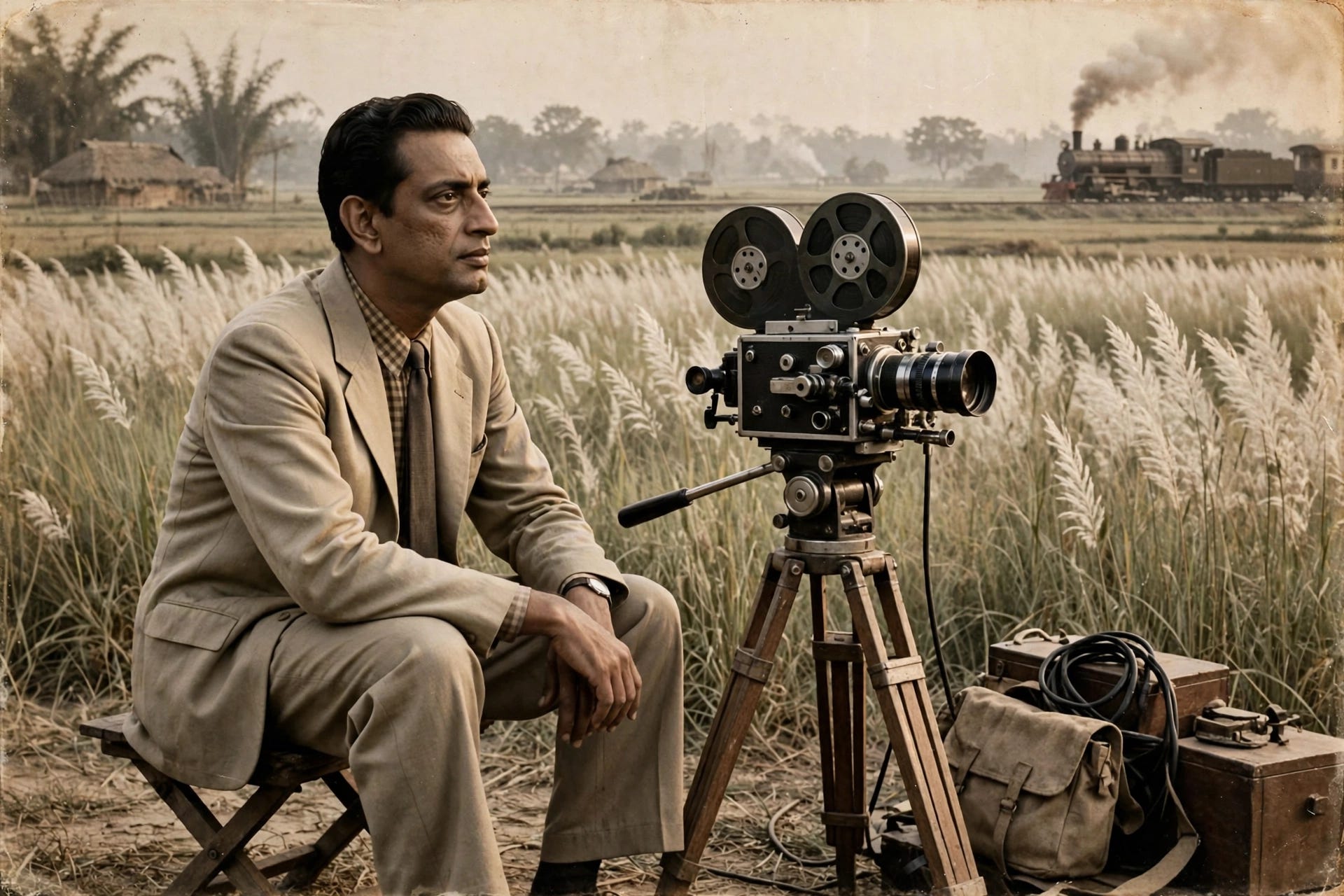
A Name the World Learned to Say
To understand what Ray accomplished, it helps to begin not with a film but with a reputation, because reputations of this scale are never accidents and they are rarely the product of a single success. Ray directed thirty-six films in all, a body of work that includes features, documentaries and shorts, and that number, modest beside the output of many commercial directors of his generation, contains within it an extraordinary range: a trilogy that follows a single boy from village childhood to adult grief and renewal, a portrait of a decaying landlord clinging to music as his world dissolves, a study of a young wife discovering literature and desire inside a large Calcutta house, a children’s adventure full of song, a Hindi film about chess players on the eve of annexation, a thriller-like detective film built around a golden fortress, and, threaded through all of it, documentaries, essays, stories, illustrations and music that he composed himself. The point is not merely versatility, although the versatility is real and was recognised early. The point is coherence. Across genres that in other hands would have pulled a career apart, Ray maintained a single, recognisable attitude toward his material: curiosity without condescension, sympathy without sentimentality, and a refusal to simplify people into types for the sake of an easy effect.
That attitude is what critics mean, at their most precise, when they call Ray a humanist, and the word deserves unpacking because it is often used loosely as praise when it should be used carefully as description. In Ray’s films, humanism is not a slogan placed over the action. It is a method of looking. The camera waits. The editing allows a gesture to complete itself. A scene is permitted to hold both dignity and absurdity in the same frame without forcing the viewer to choose one and discard the other. A poor family is not presented as an emblem of poverty, nor is a wealthy family presented as an emblem of decadence. Each person is allowed the contradiction of being, at once, limited by circumstance and larger than circumstance. That is why the films travel so well across languages and decades. A viewer who knows nothing of Bengal can still recognise the exact social pressure in a glance across a room, the exact mixture of pride and fear in a man who has taken a job he is unsure he can keep, or the exact loneliness of a woman who has been given everything except companionship and meaningful work for her mind.
The world learned Ray’s name through festivals and prizes, and those prizes were substantial by any measure: the Best Human Document at Cannes for his first film, the Golden Lion at Venice for its sequel, the Golden Bear and two Silver Bears at Berlin across his career, more than thirty National Film Awards in India, the Dadasaheb Phalke Award in 1984, appointment as Commander of the Legion of Honour by France in 1987, an Academy Honorary Award in 1992, and the Bharat Ratna, India’s highest civilian honour, in that same final year. Yet the prizes, impressive as they are, explain less than they appear to. Many decorated filmmakers fade. Ray has not faded, and the reason lies in the films themselves and in the unusual completeness of the artist who made them. He wrote his scripts, he cast his actors, he was involved in cinematography and art direction, he edited, he scored the music, he designed his own credit titles and publicity material, he drew, he wrote fiction that generations of Bengali children grew up reading, he revived a children’s magazine founded by his grandfather, and he wrote essays on cinema that still repay reading for their clarity. To call him a film director is accurate and insufficient. He was a complete man of letters and images who happened to find, in cinema, the one form capacious enough to hold all of his gifts at once.
There is also the matter of timing, and timing in cultural history is never a small matter. Ray arrived at the exact moment when Indian cinema needed, without quite knowing it needed, a demonstration that a low budget was not the same as a low ambition, that a regional language was not a barrier to universality, and that fidelity to a specific place, observed closely enough, could become the most reliable route to speaking to everyone. He did not achieve this by imitating European art cinema, although he had studied it closely and learned from it openly. He achieved it by fusing what he had learned from the West with what he knew, in his bones, from Bengal: its literature, its music, its humour, its domestic interiors, its monsoon light, its argumentative, tender, status-conscious, deeply verbal middle-class and village worlds. The confluence he spoke of in interviews, of Eastern and Western cultures meeting in his work, was not a theory imposed afterwards. It was the biography itself, turned into method.
This article follows that biography in full: the house of print and verse into which he was born, the early loss of his father, the schooling that trained his eye before it trained his camera, the years at Santiniketan that he himself called his most important formative years, the advertising office that taught him economy and design, the film society and the London months that turned an illustrator into a director, the almost impossible making of Pather Panchali on Sundays and in instalments, and then the long, disciplined unfolding of a career that never repeated itself merely for safety. It gives the writing its proper weight alongside the films, because for Ray the writing was not a hobby beside the cinema but a second, parallel life. It considers the documentaries, the music, the method, and the unmade epic that haunted him. And it ends where any honest account must end: with the final films made in illness and under constraint, with the honours that arrived almost too late to be enjoyed, and with the question of why, decades after his death, restorations are still undertaken, retrospectives still fill seats, and young filmmakers on several continents still name him, without embarrassment, as a master.
Calcutta 1921: A House of Print and Verse
Satyajit Ray was born on 2 May 1921 in Calcutta, the only child of Sukumar Ray and Suprabha Ray, into a family whose distinction long predated him and whose ancestry can be traced at least ten generations, to Mymensingh, in what is now Bangladesh. That depth of lineage matters, not as aristocratic decoration, but because the Ray family had, over generations, made a particular kind of distinction its habit: distinction in language, in images, in publishing, in reform, in the cheerful and serious business of making Bengali culture modern without making it rootless. To be born a Ray in Calcutta in 1921 was to be born inside a going concern of the imagination. The house contained a printing press. It contained books and journals and the memory of journals. It contained the expectation, never crudely stated but everywhere present, that words and pictures were serious work and that a child might reasonably grow up to do that work himself.
Calcutta in that period was a city that rewarded such a household. It was a centre of publishing, of theatre, of debate, of universities and adda, of reform movements and literary rivalries, and a child raised among printers and writers absorbed, before any formal education began, a lesson that many artists spend a lifetime trying to learn: that culture is not an abstraction that lives in libraries but a daily practice that lives in rooms, in deadlines, in ink, in correction and revision, in the smell of paper and the sound of a press. Ray’s later working habits, so famous for their thoroughness, their storyboards, their attention to titles and posters and every intermediate stage between an idea and its public form, look less mysterious when set against this beginning. He did not come to the total craft of filmmaking as an affectation. He came to it as a grandson of a publisher and a son of a writer-illustrator, for whom the making of a thing had always included the making of its container, its lettering, its presentation to the world.
His grandfather, Upendrakishore Ray Chowdhury, was a writer, illustrator and publisher, and a leader of the Brahmo Samaj, the reform movement that had done so much to shape the intellectual and moral life of educated Bengal. His father, Sukumar Ray, was a writer of nonsense verse, a form that sounds slight until one attempts it and discovers that nonsense, done well, requires perfect control of rhythm, logic and surprise. Between them, grandfather and father established the two poles between which Satyajit’s own sensibility would oscillate for seventy years: on one side, the earnest, reforming, educational impulse, the belief that art should clarify and uplift; on the other, the playful, inventive, linguistically delighted impulse, the belief that art should also surprise, amuse and set the imagination loose from its usual tracks. The filmmaker who would one day move audiences to tears with the death of an old woman in a village or the humiliation of a clerk in a city office is the same writer who would invent a detective beloved for his cool reasoning and a professor beloved for his impossible inventions. The poles never cancelled each other. They corrected each other, and the correction is the style.
It is tempting, with a figure of this stature, to treat childhood as mere prologue, a few facts to be recited before the real story of the films begins. That would be a mistake in Ray’s case, and not only because he himself wrote about his childhood, late in life, in Jakhan Choto Chilam, published in 1982, an autobiography of those early years that suggests how vividly the period remained with him. It would be a mistake because the essential materials of his art were assembled early: the love of drawing, the love of music, the love of stories told with economy, the habit of observing social ritual with both affection and irony, and the experience, arriving painfully soon, of loss inside a house otherwise full of talent and talk. A complete account must linger here, in the house of print and verse, because everything that followed, including the most celebrated tracking shot or musical cue, has its root in a boy learning, at home, how marks on paper become worlds in a reader’s mind.
Upendrakishore and Sukumar: The Inheritance
Upendrakishore Ray Chowdhury deserves more than a genealogical mention in his grandson’s story, because the grandfather’s achievements prefigure the grandson’s in ways that are almost uncanny. Upendrakishore wrote for children, illustrated his own writing, published, and concerned himself with the technical reproduction of images, pursuing the craft of printing and illustration as both an art and a technology. He founded the children’s magazine Sandesh, a title that would pass, after interruption, into his grandson’s hands for revival decades later, so that the magazine becomes one of the clearest threads stitching the generations together: founded by the grandfather, sustained in the family’s memory, and revived by the grandson when he was already famous as a filmmaker and might easily have considered children’s publishing beneath his notice. He did not consider it beneath his notice. That fact alone tells a reader a great deal about Ray’s understanding of cultural duty. Fame, in his handling of it, did not narrow his obligations. It widened them.
As a leader of the Brahmo Samaj, Upendrakishore also embodied a particular Bengali synthesis: rational, reform-minded, open to the West without being servile toward it, committed to education, and inclined to judge tradition by whether it enlarged or diminished human life rather than by whether it was old. That synthesis, transmitted through family culture rather than through any formal doctrine Satyajit ever professed, is visible everywhere in the films. Again and again Ray returns to households caught between an inherited way of life and a new one pressing at the door: the landlord in Jalsaghar watching the feudal world that sustained his music slip away, the family in Devi divided by a father’s devotional certainty, the wife in Mahanagar stepping into paid work and discovering both pride and friction, the young men of the Calcutta films of the nineteen-seventies confronting a city whose promises and whose corruptions had both intensified. Ray rarely preaches the reformer’s sermon outright. Instead he dramatises the reformer’s question, which is the harder and more durable achievement: what in the old world deserves to survive, what in the new world deserves to be trusted, and what does the transition cost the particular people who must live through it?
Sukumar Ray, the father, contributed a different inheritance, lighter in touch and no less profound. His nonsense verse, written for children and loved by adults, depends on invented creatures, inverted logic and a delight in the sound and shape of Bengali itself. A child who grows up as Sukumar’s son, even a child who loses his father in infancy and knows him chiefly through his work and through the reverence of others, grows up with proof that play is a serious literary method. The line from Sukumar’s nonsense to Satyajit’s Professor Shonku stories, with their inventions and their deadpan scientific absurdities, and to Goopy Gyne Bagha Byne, with its singing heroes and its musical exuberance, is not difficult to trace. Nor is the line from Sukumar’s verbal precision to Satyajit’s dialogue, which at its best has the same quality of sounding entirely natural while being, on inspection, perfectly placed, with no syllable wasted and no effect overstated.
There is a further inheritance, less often named, that both men passed on: respect for the child reader and the child viewer as a complete person. Neither grandfather nor father wrote down to children. The humour assumes intelligence, the stories assume curiosity, and the moral sense assumes that a young reader can handle ambiguity if it is presented honestly. When Satyajit later made films and wrote stories that children loved, he was not stooping to a simpler audience. He was continuing a family practice in which the youngest audience received the artist’s full skill, not the leavings of it. In an industry that frequently treats children’s entertainment as a lesser category, that continuity is worth pausing over. It helps explain why Sonar Kella works simultaneously as a children’s adventure, a detective story and a beautifully observed travel film, and why Goopy and Bagha’s songs lodge in the memory of viewers who first heard them at the age of eight and still find them undiminished at forty.
An inheritance, however, is also a burden, and an honest biography should acknowledge the weight as well as the gift. To be the grandson of Upendrakishore and the son of Sukumar was to carry a surname that educated Bengal already honoured before Satyajit had done anything at all. A lesser talent might have coasted on it, or been crushed by it, or spent a career anxiously imitating the ancestors. Ray did none of these things. He honoured the inheritance by extending it into a medium neither man had worked in, and he earned the surname a second time, in a second century of Bengali culture, on entirely new ground. That is the proper way to understand the famous family in this story: not as an explanation that diminishes the achievement, but as a standard that makes the achievement more remarkable, because the standard was high, public, and impossible to fake one’s way past.
A Father Lost, A Mother’s Resolve
Sukumar Ray died when his son was about two or three years old. The small uncertainty in the phrasing, preserved in the sources, matters less than the enormity of the fact itself: Satyajit Ray grew up without a father, in his grandfather’s house, raised by his mother, Suprabha Ray, in a household that contained a printing press and the living memory of the two men whose work had defined the family’s name. Loss of this kind, arriving before conscious memory has fully formed, does not produce the kind of grief that can be narrated as a sequence of remembered scenes. It produces something quieter and more pervasive: a household organised around absence, a mother whose resolve becomes the practical centre of a child’s world, and a father known through paper, through print, through the testimony of a culture that kept his verses alive.
Readers who know the films will feel the resonance immediately, and it should be handled with care, without reducing great art to a biographical symptom. Still, it is legitimate to notice how often Ray’s cinema returns to fathers and sons, to households headed or held together by women, to old people whose deaths reconfigure a family’s understanding of itself, and to children observing adult sorrow with a clarity the adults themselves cannot manage. Apu’s story, across three films, is unthinkable without its pattern of loss and endurance. The mother in Pather Panchali, holding a disintegrating household together with labour, pride and exasperation, is one of the great portraits of maternal resolve in all cinema, and she is drawn, in the source novel and in Ray’s handling of it, with a refusal of idealisation that makes her more moving, not less. Ray does not make mothers into saints. He makes them into people whose strength is visible precisely because their irritation, their vanity and their exhaustion are visible too. That honesty may owe something to observation of life in general; most great artists observe life in general. But it is reasonable to suppose that a boy raised by a widowed mother in a house of distinguished ghosts learned early what resolve actually looks like at close quarters, as opposed to how it looks in a eulogy.
Suprabha Ray’s role in the story is practical as well as emotional, and the practical decisions she took altered the course of Indian cinema, although neither she nor anyone else could have known it at the time. It was she who, in 1940, insisted that her son study at Visva-Bharati in Santiniketan, the institution founded by Rabindranath Tagore, at a moment when the young man, having completed his degree in Calcutta, might otherwise have drifted directly into employment. That insistence, examined later in this article in its proper place, gave Ray the formative years he would credit, thirty years afterwards, as the most important of his life. Maternal resolve, in this biography, is therefore not a sentimental backdrop. It is a causal force. Without it, there is no Santiniketan as Ray experienced it, and without Santiniketan, by Ray’s own testimony, there is no artist as the world came to know him.
There is a second, quieter point to make about the grandfather’s house as the setting of the childhood. A house with a press is a house where work is visible. Children in such houses learn that books do not descend from heaven; they are set, inked, corrected, bound and carried. They learn that an illustrator’s drawing must survive reproduction, that a writer’s sentence must survive the compositor, that art has a material life with costs and constraints. When Ray, as a director, insisted on involving himself in every stage of his films, including stages that celebrated directors routinely delegate without a thought, he was behaving as a man for whom the material life of a work had never been hidden. The press in the grandfather’s house is, in that sense, the first film studio he ever knew: a place where imagination met machinery, where deadlines were real, and where the finished object went out into the city bearing the family’s name and honour.
Schooling and Presidency College: Economics and the Eye
Ray’s formal schooling began at Ballygunge Government High School, and continued at Presidency College in Calcutta, where he took a BA with honours in economics. On paper, it is an unremarkable curriculum vitae for a young Bengali of his class and period, and that unremarkableness is itself instructive. Nothing in the official record of his schooling announces a filmmaker. There was, in the India of his youth, no film school waiting to receive him, no established pathway from a classroom to a camera. The education that mattered most to his future arrived obliquely: through drawing, through music, through reading, through the cinema-going that would later be organised and deepened by the film society he co-founded, and through the discipline of a degree subject, economics, that trains its students to think about scarcity, choice, incentives and the allocation of limited means toward chosen ends.
It would be fanciful to claim that an honours degree in economics made Ray the director he became, and this article makes no such claim. But it is fair to observe that the mature Ray was, among directors, unusually intelligent about means. He made films on budgets that would have paralysed less resourceful artists, and he made a virtue of the constraint without ever romanticising poverty. His sets were prepared, his shooting was economical, his storyboards anticipated problems before money could be wasted on them, and his whole method, examined in detail later, has the quality of a mind that understood, instinctively and perhaps also by training, that every artistic decision is also a decision about the use of something scarce: time, light, film stock, an actor’s energy, an audience’s attention. Economics, at its best, is the study of how human beings choose under constraint. Ray’s cinema, at its best, is the dramatisation of exactly that, in household after household where money is short, dignity is at stake, and every choice closes another door even as it opens one. The degree did not create the sensibility, but the sensibility and the degree suit each other remarkably well.
The eye, meanwhile, was being trained outside the examination hall. Ray drew. He listened. He watched. The illustrator who would soon earn his living at an advertising agency, and the designer who would create the typefaces Ray Roman and Ray Bizarre, was already present in the student who had not yet found his institution. That is why Ray’s later remark about his own education, quoted in the next section, should be read precisely. He did not say that education failed him. He said that he began to function as an artist only after he left the University of Calcutta, which is a claim about sequence and about the kind of formation an artist needs. The university gave him a degree and a discipline. The formation, the functioning, came elsewhere: at Santiniketan, among artists and in the open landscape Tagore had chosen for his experiment in learning, and afterwards in the offices, cinemas and cutting rooms where Ray served his real apprenticeship.
Presidency College also placed him, as it placed generations of Calcutta students, inside a culture of argument. Bengali intellectual life prizes the well-turned objection, the historical allusion deployed at speed, the refusal to let a large claim pass unexamined. Ray’s essays show that training clearly: they are courteous, lucid and quietly merciless toward sloppy thinking about cinema, whether the sloppiness comes from commercial producers underestimating their audience or from critics overestimating their theories. His films show it too, in a subtler form. Hardly a Ray film allows its own apparent thesis to survive uncomplicated. A film that seems to be about the evils of superstition will give the superstitious character the most powerful scene. A film that seems to celebrate the modern working woman will show, honestly, what her employment costs and what it fails to change. That habit of arguing with oneself, in public, through drama, is one of the surest signs of a first-rate mind, and it was cultivated in the debating, reading, examination-passing Calcutta of his student years, even if the artist, by his own account, only switched on afterwards.
Santiniketan 1940-43: The Formative Years
In 1940, at his mother’s insistence, Ray went to study at Visva-Bharati in Santiniketan, the institution founded by Rabindranath Tagore. He left in 1943, before completing the course. A bare recital of those facts conceals their importance, because Ray himself, looking back across three decades and a shelf of masterpieces, assigned to Santiniketan a weight that he assigned to no other period of his education. In a conversation with Folke Isaksson published in Sight and Sound in the summer of 1970, Ray said: “I don’t think I really began to function as an artist until after I left the University of Calcutta.” And of Santiniketan he said that he spent “two and a half years in Santiniketan” and considered them “my most important formative years.” A biographer should take an artist’s self-assessment seriously without treating it as infallible, and in this case the films corroborate the testimony. Something happened at Santiniketan that Calcutta had not provided, and its traces are visible in everything Ray made afterwards.
What Santiniketan offered, first of all, was proximity to art as a living practice rather than as a subject of examination. Tagore’s institution was founded on the conviction that learning should happen in contact with nature, with music, with making, and with teachers who were themselves practitioners. For a young man who drew, who loved music, and who had grown up among printers and poets but had been channelled into economics, the effect was liberating in the most concrete sense: the talents that had been private became public, exercised, judged and encouraged. The landscape mattered too. The open, red-earthed, tree-dotted country around Santiniketan is unlike the dense vertical city of Calcutta, and Ray’s cinema would become famous, among other things, for its feeling for landscape as a moral and emotional presence rather than as scenery. The village world of Pather Panchali, with its ponds, its groves, its kaash fields and its monsoon skies, is observed by a man who had learned, as a young student in the Bengal countryside, to look at such a world slowly and without condescension.
Santiniketan also deepened Ray’s relationship with Tagore, a figure who already stood, for any educated Bengali family and doubly for a Brahmo family, at the centre of cultural life. Ray would go on to make a documentary on Tagore in 1961, to adapt his fiction in Teen Kanya in the same year and in Charulata in 1964 and Ghare Baire in 1984, and to carry Tagore’s songs and Tagore’s example inside his work for his entire career. Those later engagements were not the dutiful homages of a celebrity lending his name to a national icon. They were the work of a man who had lived, as a student, inside Tagore’s own institution, in the last years of Tagore’s era, and who understood the poet’s world from within before he ever presumed to film it. When Charulata adapts Tagore’s Nastanirh and is widely regarded among Ray’s finest films, part of its authority comes from that intimacy. Ray knew the household Tagore described because houses of that kind, and the institution Tagore built, had formed him.
There is a lesson in the Santiniketan episode for every reader who has ever been a student, and it concerns the difference between completing a course and being formed by a place. Ray left in 1943 without completing the course, and by the narrow accounting of certificates the episode might look like a failure or an interruption. By the accounting that matters, his own, it was the foundation. The modern self-directed learner understands this tension intuitively: a syllabus can be finished without anything having changed, and an unfinished period of study can change everything, provided the learner tests himself honestly against the material rather than against the examination alone. It is the discipline behind tools a student today might use to check real understanding, the way practice questions expose the gap between familiarity and knowledge, and it is why a resource such as Azure Troubleshooting Drills belongs, in spirit, to the same family of habits Ray formed at Santiniketan: learn in the presence of real work, then prove to yourself, without flattery, what you actually know. Ray’s proof would come later and publicly, on film sets and in print, but the habit of self-testing against the real thing, rather than against a credential, was Santiniketan’s gift.
Finally, Santiniketan should be understood as the place where Ray’s famous confluence began in earnest. Tagore himself was the great Bengali exemplar of an artist who absorbed the West, argued with it, translated it, and remained unmistakably rooted in his own soil and language. To study in Tagore’s institution was to receive, as a daily atmosphere rather than as a lecture, the proposition that Eastern and Western cultures were not enemies requiring a choice but resources requiring judgement. Ray would make that proposition the explicit philosophy of his cinema, as later sections of this article explore. He did not invent it. He inherited it, at Santiniketan, from the presiding genius of the place, and then he did with it what heirs of genius must do if they are to be more than curators: he took it into a new medium and proved it again, in images, for a world audience Tagore himself never addressed through film.
D.J. Keymer: The Advertising Apprentice
In 1943 Ray joined the British advertising agency D.J. Keymer as a junior visualiser. The step deserves emphasis because posterity, dazzled by the films, tends to hurry past the decade of commercial work that preceded them, as if the agency years were a waiting room where Ray sat until cinema called. They were nothing of the kind. They were his technical education, his professional formation, and, for a crucial period, his livelihood, and the films are unthinkable without the skills the agency drilled into him: how to compose an image that communicates at a glance, how to integrate lettering with picture, how to work to a brief and a budget, how to revise without rancour, and how to finish.
A junior visualiser in an advertising agency learns, quickly, that talent is not an excuse for vagueness. The client wants the product seen, the text read, the layout balanced, and the whole delivered on time. Ray rose in that world to become a leading commercial illustrator and book-jacket designer, which means that clients, publishers and colleagues judged his work excellent by the unforgiving standard of repeated commissions. Book jackets in particular are a stern school for a future filmmaker. A jacket must distil a book’s tone into a single image, must honour the author’s world while enticing a stranger in a shop, and must marry typography to illustration so completely that the reader feels the design before analysing it. Every one of those requirements reappears, enlarged, in Ray’s cinema: the distillation of a novel into essential scenes, the honouring of a source while making it unmistakably one’s own, and the marriage of image and lettering that he carried so far as to design his own credit titles and publicity material throughout his directing career.
Advertising also taught Ray the audience. Commercial art fails in public and immediately; a layout that does not work is not debated for a semester, it is replaced. A decade of that discipline produced a director who, for all his reputation as an artist’s artist, never despised his audience and never made the fashionable error of treating clarity as a compromise. Ray’s films are lucid. Their meanings deepen on reflection, but their surfaces, the who and the where and the what-is-at-stake of a scene, are almost always immediately legible, because the man who made them had spent his twenties ensuring that busy strangers could grasp an image in a second. Depth without obscurity is one of the rarest combinations in cinema, and it is, in Ray’s case, substantially an advertising man’s achievement carried into art.
The Keymer years had one more function, poignant in retrospect: they overlapped with the birth of the filmmaker and very nearly prevented it. When Ray began shooting Pather Panchali in 1952, he was still a Keymer employee, filming on Sundays around his job, financing the production in instalments as money allowed, enduring a break of almost a year when funds ran out. The double life, office by week and film set by Sunday, is usually told as a colourful anecdote. It should also be told as evidence of character. Many talented people intend to make a first film. Ray made his while holding down the job that fed him, without a studio, without a star, without a precedent in his own country for the kind of film he meant to make, and without quitting the security of employment until the work itself had proved it deserved to replace that security. The advertising apprentice and the patient Sunday director are the same person: methodical, unsentimental about obstacles, and willing to let a masterpiece accumulate, frame by frame, at the pace reality permitted.
Book Jackets, Illustration and Two Typefaces
Ray’s design work merits its own section because it is too often treated as a footnote to the films when it is, in truth, a substantial achievement in its own right and a key to the films’ visual character. As a leading commercial illustrator and book-jacket designer at and through D.J. Keymer, Ray produced work that placed him among the notable graphic artists of his generation in India. The line, the economy, the wit with which a figure or a landscape could be suggested rather than laboured, the instinct for the telling detail and the courage to leave the rest of the page empty: these qualities, honed on jackets and advertisements, migrated directly into his frames. Watch any Ray film with the sound down and the design intelligence is still legible in every composition, in the way a doorway frames a figure, a window admits a bar of light, or a courtyard organises a crowd into readable groups. He composed for the camera as he had composed for the page, except that the page now moved.
The most concrete monument to this side of Ray is typographic: he designed the typefaces Ray Roman and Ray Bizarre. A typeface is an unusually revealing artefact for an artist to leave behind. It is art subjected to system, expression forced to repeat itself identically thousands of times without losing its character, and it demands exactly the combination of invention and discipline that defines Ray at his best. That the designer of film posters and credit titles also designed letterforms themselves completes a picture of total craft that has few parallels in cinema history. Directors commonly control what appears inside the frame. Ray, characteristically, extended his control to the letters in which his films announced themselves, because for him the announcement was part of the work, as the jacket had been part of the book in his publishing years.
Illustration also kept Ray connected, throughout his life, to the world of children’s publishing from which his family had come. His drawings for his own stories, for the revived Sandesh, for Feluda and Professor Shonku, gave Bengali children a visual world as distinctive as the verbal one, and they served a practical purpose in the fiction: the Shonku stories, with their inventions, and the Feluda stories, with their clues and locations, benefit enormously from an author who can show as well as tell. There is a unity here that admirers sometimes miss because the outputs sit on different shelves of a library. The filmmaker, the illustrator, the type designer and the children’s author are not four careers awkwardly sharing one lifespan. They are one visual intelligence expressing itself at different scales, and the smallest scale, the letterform, illuminates the largest, the film, because both obey the same law in Ray’s hands: nothing decorative without purpose, nothing purposeful without grace.
It is worth adding that design gave Ray independence, and independence gave him courage. A director who can draw his own poster, design his own titles, write his own script and score his own film is a director who cannot easily be held hostage by the failure or interference of any single collaborator or department. The famous total control examined later in this article was not vanity. It was built, skill by skill, in years like the Keymer years, when a young visualiser quietly acquired every craft his future films would require, including crafts most directors never learn at all. When the money for Pather Panchali ran out and the production stopped for almost a year, what kept the project alive was partly this completeness: Ray was the project’s illustrator, designer, writer and director in one person, and a project that lives inside one person’s complete competence is very hard to kill.
The Calcutta Film Society 1947
In 1947 Ray co-founded the Calcutta Film Society. The date is significant: the year of Indian independence, a year when every cultural institution in the country was, in effect, being asked what it would become in the new nation. A film society was a modest-looking answer with radical implications. It asserted that cinema was an art worthy of serious study, that audiences could be formed as deliberately as filmmakers, and that Calcutta, which already argued about literature and theatre with unmatched intensity, should argue about film with the same seriousness. For Ray personally, the society was the bridge between watching films as an enthusiast and studying them as a practitioner. It organised his viewing, gave him interlocutors, and built the critical vocabulary that his later essays would display.
Film societies matter in film history out of proportion to their budgets because they create the one thing commercial cinema cannot create for itself: a public that has seen enough, and discussed enough, to demand better. In a city served by commercial distribution, the films a society could screen, classics and contemporary works from other countries, constituted an alternative curriculum, and Ray, who would see around a hundred films in five months during his London trip of 1950, was precisely the kind of omnivorous student such a curriculum rewards. The society also normalised a crucial idea for the young illustrator: that a person without studio backing could still participate in cinema at the highest level of discourse, could write about it, programme it, debate it, and thereby prepare, in public, the ground on which an independent film might one day be received. When Pather Panchali finally appeared in 1955, Calcutta contained, partly thanks to the society Ray had helped found eight years earlier, an audience ready to recognise what it was.
There is a broader point about institution-building that Ray’s career illustrates repeatedly. He was not only an artist who produced works; he was an artist who helped produce the conditions under which works like his could exist and be understood. The film society formed the audience. The revived Sandesh formed a readership. The essays formed a critical standard. Even the documentaries, on Tagore, on the artist Binode Behari Mukherjee, on the dancer Balasaraswati, formed a record, preserving for the future the very culture his fiction drew upon. Genius is often imagined as solitary. Ray’s genius was, in significant part, architectural: he built, or rebuilt, small durable structures inside which Bengali culture could remember itself and judge new work fairly. The Calcutta Film Society of 1947 is the first of those structures, and its founding, by a twenty-six-year-old advertising visualiser with no film to his name, is one of the clearest early signs that the young man intended not merely to have opinions about cinema but to change its circumstances.
The society also marks the moment when Ray’s private enthusiasms acquired witnesses. A man who watches a hundred films alone may be a connoisseur; a man who founds a society to watch them with others has become, whether he knows it or not, a public figure in embryo. Within two years of the founding he would meet Jean Renoir in Calcutta. Within three he would be in London, watching Vittorio De Sica’s Bicycle Thieves and understanding, with the clarity that changes lives, what he had to do. The society did not cause those encounters, but it made Ray ready for them. Readiness, in this biography, is a recurring theme: the press in the house made him ready for total craft, Santiniketan made him ready for Tagore, Keymer made him ready for economy, and the film society made him ready for Renoir and De Sica, the two encounters that turned an illustrator who loved cinema into a filmmaker.
Renoir, London and Bicycle Thieves
Every artistic life has a hinge, a short period on which the whole door swings, and for Ray the hinge was the period from 1949 to 1950, when he met Jean Renoir, who was in Calcutta filming The River, and when, on a work trip to London in 1950 lasting some five months, during which he saw around a hundred films, he encountered Vittorio De Sica’s Bicycle Thieves, released in 1948. Britannica and the other standard accounts agree on the consequence: these encounters turned him toward independent filmmaking. The phrasing is calm, but the event it describes was an earthquake. Before it, Ray was a brilliant illustrator who co-founded film societies and thought deeply about cinema. After it, he was a man with a chosen first film, a method in mind, and a standard against which to measure himself.
Renoir’s importance to Ray operated at the level of example. Here was one of the acknowledged masters of world cinema, working in Ray’s own city, on location, with the materials of Bengal around him, demonstrating by his mere presence and practice that a film could be made attentively, humanely and without studio artifice in exactly the landscape Ray knew best. The lesson of Renoir, for a young Indian artist, was permission: the master’s methods were not locked inside Paris or Hollywood; they could be practised on the Hooghly as honourably as on any European river. De Sica’s lesson, delivered in a London cinema, was complementary and even more specific. Bicycle Thieves showed a story of a poor man and his son, played without glamour, shot in real streets, structured around a search whose stakes are simultaneously tiny by the standards of spectacle and absolute by the standards of the man’s life. For Ray, who wanted to film a Bengali village novel about a poor family, the Italian film was proof of concept at the highest level of art: proof that neorealist patience, non-spectacular material and fidelity to ordinary life could produce a masterpiece that the whole world would honour.
The London months themselves deserve a moment’s attention as an education compressed. Around a hundred films in some five months is the viewing programme of a man conducting, deliberately, the film school his country did not possess. He was not sightseeing. He was, in effect, auditing the entire available history and present of his chosen art at the exact moment of decision, the way a young composer might immerse himself in scores before attempting a symphony. That he did this on a work trip, as an employee of an advertising agency, sharpens the picture of the double life already described: the firm sent a visualiser to London and India received back, in the same person, a director in all but name and credits.
It matters, too, what Ray did not take from Renoir and De Sica. He did not take imitation. The surface of Pather Panchali resembles Bicycle Thieves in its humility of means, but its rhythm, its feeling for season and landscape, its structure of accumulation rather than pursuit, and its deep roots in a specific Bengali novel mark it as an original work that had metabolised its influences rather than copied them. This is the template of Ray’s whole relationship with the West, stated early and never abandoned: study the masters completely, learn what their methods make possible, and then return home and do the thing that only your own material, your own language and your own landscape permit. Young artists in every field, and especially in countries whose cultures were long treated as peripheral by the metropolitan centres, can still learn from the sequence. Ray did not wait for permission from London or Paris. He went to London, took the education, and used it in Calcutta, on a Bengali novel, in Bengali, with Bengali actors and a Bengali village, and it was that film, not an imitation of anyone, that Cannes honoured in 1956.
Choosing Pather Panchali
For his first film Ray chose Bibhutibhushan Bandyopadhyay’s novel Pather Panchali, published in 1928, the story of a poor Brahmin family in a Bengal village and, at its heart, of the boy Apu and his sister Durga. The choice repays close attention because first films usually announce their makers’ ambitions by their subjects, and Ray’s choice announced, with perfect clarity, everything he would stand for. He did not choose a historical spectacle that might excuse a beginner’s excesses, nor a fashionable urban melodrama that might hide a beginner’s uncertainties behind plot. He chose a novel whose power lies in accumulation, in seasons, in small joys and irreversible losses, in the texture of a village world rendered by an author who knew it intimately. To film such a book is to accept the hardest test in cinema: with no machinery of suspense to rely on, the film must live by observation alone, or not live at all.
The choice was also an act of literary judgement, continuous with the family inheritance described earlier. Ray came from a house that published, and he read as a publisher’s grandson reads, with an eye for what would endure and what a new medium could reveal in an admired text. The novel gave him a complete world, a family, a village, a childhood, and a structure that moves, as life moves, by addition and subtraction rather than by contrivance. It also gave him Bengal itself as a protagonist: the pond, the bamboo grove, the field of kaash grass, the train that passes at a distance like a rumour of another world. In adapting it, Ray established the pattern of his many later adaptations, of Tagore above all, in which fidelity means loyalty to a book’s spirit and world rather than a timid transcription of its pages. He would cut, rearrange and invent transitions where cinema required them, but he would never betray the moral weather of the source.
There is courage in the choice that should not be understated. A village story, in Bengali, centred on children and an old woman, made by a first-time director with no stars and no studio, was, by every commercial calculation of the day, an unpromising proposition. Ray chose it anyway, and the history of the production, told in the next section, shows what that choice cost in time and uncertainty. Posterity can afford to smile at the calculation now, because the film remade the calculation itself. After Pather Panchali, the unpromising proposition, the regional novel filmed patiently in its own landscape, became one of the recognised roads to greatness in world cinema, and generations of filmmakers in Asia, Africa and Latin America would walk it, often citing Ray explicitly as the man who had shown that the road existed. A choice of subject, made by an advertising visualiser in Calcutta around 1950, thus became a turning point far beyond Bengal. That is what it means to choose well at the beginning: the decision keeps deciding, in other artists’ lives, for decades.
Shooting on Sundays 1952-54: Making a Film out of Instalments
Shooting on Pather Panchali began on 27 October 1952, and the first scene filmed was the one that would become among the most famous in all Indian cinema: Apu and Durga finding a train in a field of kaash grass. Consider the rightness of that beginning. A director starting his career, and starting this film, with children running through tall white grass toward the sound of a distant train is announcing, whether he framed it to himself in those terms or not, the whole poetry of the work to come: childhood wonder, a landscape that dwarfs and shelters at once, and modernity glimpsed from a village as something marvellous, remote and faintly unsettling. The train in Ray will never be mere transport. It is the world beyond the village, arriving and departing on rails the villagers do not control, and the children’s joy in it is shadowed, for the adult viewer, by the knowledge that the same world beyond will eventually take Apu away from everything the film has taught us to love.
The production that followed that luminous first day was anything but luminous in its circumstances. Ray shot on Sundays, around his job at D.J. Keymer. Funding arrived in instalments. At one point the money ran out so completely that production stopped for almost a year, resuming only in early 1954, and the film was completed with money from a loan provided by the Government of West Bengal. Each of those facts is a small drama. Sunday shooting means a cast and a location reassembled weekly, children growing between setups, light and season refusing to hold still for a discontinuous schedule. Instalment funding means a director planning not the film he wants but the sequence of fragments he can afford next, in an order dictated by cash rather than by narrative. A break of almost a year means living, for twelve months, with an unfinished masterpiece in cans and in one’s head, not knowing whether it will ever be finished at all, while continuing to go to the office.
That the finished film shows no trace of these fractures, that its seasons flow and its children seem to grow inside a single continuous world, is one of the quiet miracles of directorial control. Ray’s preparation, his storyboards, his memory for what had been shot and what the light had been, held the film together across its broken calendar. There is a lesson here that transcends cinema and that young creators in every field recognise with a pang: the work is often made not in ideal conditions but in the gaps of an employed life, on Sundays, in instalments, across interruptions, and the difference between the finished work and the abandoned project is frequently nothing more glamorous than the refusal to let an interruption become an ending. Ray refused. The Government of West Bengal’s loan, which completed the financing, also deserves its place in the record as an early and honourable example of a state recognising, however imperfectly the mechanism, that a film of this kind was a public good worth a public risk. The loan was repaid by history many times over, in prestige no ministry could have purchased by any other means.
26 August 1955: Calcutta Sees Apu
Pather Panchali was released in Calcutta on 26 August 1955. The first two weeks were modest. By the third week, the houses were packed. That small arc, from modesty to full houses in a fortnight, contains a whole sociology of how new art finds its public. There was no marketing apparatus capable of manufacturing the turn, no star whose name could be blamed or credited for it. What happened between the second week and the third was conversation: viewers telling other viewers that something unprecedented was playing in their city, that a Bengali film had done what they had not seen a Bengali film do, that the village on the screen was their own world returned to them with its dignity intact and its sorrows unsoftened. Word of mouth is the oldest distribution network in culture, and it remains the most honest, because it cannot be bought at scale and it does not reward mediocrity for long. Calcutta, the argumentative city, argued itself into the cinema halls.
The release also settled, in practice, the question the Calcutta Film Society had posed in theory eight years earlier: whether an audience for serious cinema existed in the city. It did, and it was larger than the sceptics supposed, because the film’s appeal was never confined to connoisseurs. The story of Apu’s family is legible to any viewer who has known a household under pressure, a child’s delight, an old person’s decline, a mother’s temper and tenderness. Ray’s humanism, discussed in general terms at the start of this article, here proved its commercial as well as its artistic worth. Patience was not the opposite of popularity. Given a true story, told truly, patience became popularity’s engine, once the first viewers carried the news out of the hall.
For Ray himself, the release transformed his circumstances. The Sunday director, the agency visualiser who had nursed a film through instalments and a year’s silence, was now the maker of the most talked-about Indian film of its year, and the transformation carried a decision inside it: the double life could end. Cinema, which had been the Sunday occupation, became the life’s work, and the remaining thirty-seven years of his career, thirty-six films in all, flow from the fortnight in late August and September 1955 when Calcutta decided that Apu belonged to it. First films sometimes succeed and imprison their makers in the obligation to repeat them. Pather Panchali succeeded and liberated its maker, because its success rested on qualities, observation, sympathy, economy, that could be carried into any genre, and Ray spent the rest of his career proving exactly that, genre by genre, as the following sections record.
Nehru, Cannes and the Second Screening
The journey from Calcutta acclaim to world fame passed, as such journeys in that era often did, through the intervention of individuals who recognised what they were seeing and used their positions to give it a chance. Prime Minister Jawaharlal Nehru was moved by a screening of Pather Panchali arranged by Dr B. C. Roy, the Chief Minister of West Bengal, and Nehru ensured the film’s entry to the Cannes Film Festival. The detail is worth dwelling on because it shows a young nation’s leadership treating a difficult, uncommercial, regional-language film as an asset of the nation itself, worthy of the world’s most visible festival. Whatever one’s view of governments in art, the episode stands as a reminder that cultural prestige is built by specific acts of recognition, and that in 1955 and 1956 the Indian state, at its highest level, performed such an act for the right film.
At Cannes in 1956 the film won the Prix du document humain, the Best Human Document award, but the manner of the winning is as instructive as the prize. The first screening, held at midnight, was missed by most of the jury. A second screening had to be pressed for, by critics including Lindsay Anderson and André Bazin, men whose advocacy carried weight because their judgement had been earned in public over years. Only then did the film receive the attention, and the award, that its quality warranted. The story has become famous, and it should be handled as more than an anecdote about festival chaos. It demonstrates that even masterpieces do not announce themselves automatically, that institutions overlook, schedules fail, juries sleep, and that the survival of a work can depend on the stubbornness of a handful of witnesses who refuse to let it be missed. Anderson and Bazin, in pressing for that second screening, performed the critic’s highest function, which is not to decorate reputations already made but to insist, at the moment of risk, that a new one be examined fairly.
In total, Pather Panchali won eleven international prizes, a harvest that announced, to anyone in world cinema still uncertain, that the Calcutta success had not been a local enthusiasm. For Indian cinema the consequences were structural. A path now existed, demonstrably, from a Bengali village location to the highest honours in Europe, and it did not pass through imitation of European or American commercial forms. It passed through fidelity to one’s own material. Every subsequent Indian filmmaker who took a regional story to an international festival walked, knowingly or not, through a door that the second screening at Cannes had forced open. And for Ray, the shy illustrator who had watched a hundred films in London six years earlier as a student of an art he had never practised, the Cannes award closed a circle of apprenticeship and opened the career proper: the world had seen Apu, and now it waited, with an attention that would never entirely leave him, to see what Apu, and Apu’s maker, would do next.
Aparajito and the Golden Lion
What Apu did next, in Aparajito, released in 1956, was grow up, leave the village, lose his father, study in Calcutta, and, in one of the most quietly devastating movements in all cinema, discover that his education and his ambitions were slowly estranging him from the mother who had sacrificed everything to make them possible. Sequels are usually commercial calculations. Aparajito is the opposite: a deepening, in which the world of the first film is not repeated but complicated, its village idyll giving way to the city, to examinations, to the ache of a young man who loves his mother and is nevertheless, visit by postponed visit, failing her. That Ray followed a triumph with a film of such emotional severity says everything about his intentions. He was not building a brand. He was following a life, in the novelist’s sense, wherever the life honestly led.
At the Venice Film Festival in 1957 Aparajito won the Golden Lion, the festival’s highest prize, together with the Cinema Nuovo and Critics awards. The Golden Lion transformed Ray’s international position from that of a discovery to that of a major director, a peer in the company of the European masters he had studied. It is worth pausing on the speed of the ascent: a first film in 1955, honoured at Cannes in 1956; a second film in 1956, crowned at Venice in 1957. Within two years of his first release, the Sunday filmmaker from a Calcutta advertising agency held the top prizes of two of the world’s three great festivals. Film history offers few ascents so rapid that were also so fully deserved, and fewer still in which the honoured work was made so far from the industry’s centres, in a language those centres did not speak, about people those centres had never seen portrayed from inside.
Aparajito also refined the trilogy’s central theme, which the third film would complete: the education of a sensibility at the cost of the world that formed it. Apu’s movement from village to city, from his mother’s household to the life of the mind, is the movement of modern India itself in miniature, and Ray treats it without either nostalgia or triumphalism. The village is not a paradise falsely mourned; it contained poverty, death and limitation. The city is not a corruption falsely condemned; it contains books, friendship, possibility. What the film mourns is not the old world but the specific, unrepeatable bond that change dissolves even when change is right. That refusal of easy sides, already identified as Ray’s signature, here reaches an early perfection, and it explains why the trilogy continues to be taught, restored and argued about while more topical films of its decade have become period pieces. It was never about its decade. It was about the permanent cost of becoming oneself.
Apur Sansar: The Trilogy Completed
Apur Sansar, The World of Apu, released in 1959, completed the Apu Trilogy, carrying its hero into adult life, marriage, fatherhood, bereavement and a hard-won return to the world through his child. It also introduced Soumitra Chatterjee, who would become Ray’s most enduring leading actor and one of the defining faces of Bengali cinema. The completion of a trilogy is a test of a different kind from the making of a first film. The first film must prove that a world exists. The third must prove that the world can change, darken and renew itself without breaking faith with what the audience loved in it at the start. Apur Sansar passes that test by risking its hero’s likability: the adult Apu errs, withdraws, grieves selfishly as well as deeply, and must be led back to life rather than simply rewarded with it. The trilogy ends not in triumph but in resumption, a man taking up his responsibilities and his son, which is the most honest ending the material allows and therefore the most moving.
Taken together, the three films constitute one of the supreme achievements of twentieth-century cinema, a judgement that time has ratified rather than revised: the Apu Trilogy appeared in Time magazine’s All-Time 100 Movies list in 2005, half a century after the first film’s release, and the Academy Film Archive preserved many of Ray’s films, most of them in 1996, as part of the permanent record of the art. Restoration and preservation, treated more fully in the Legacy section of this article, are the institutional forms of a simple fact: the world decided that these films must not be allowed to decay, because too much of what cinema knows about itself is stored inside them.
For the purposes of this biography, the trilogy’s completion in 1959 marks the end of Ray’s first period and the beginning of his astonishing diversification. He had spent the nineteen-fifties, in large part, inside one family’s story and one novelist’s world. The nineteen-sixties would show him moving, film by film, through a landlord’s music room, a goddess-possessed household, a working wife’s Calcutta, a lonely wife’s awakening, a matinee idol’s hotel room, and a pair of singing innocents in a kingdom of sweets, without ever losing the thread of attention that made the trilogy great. A lesser artist, having defined himself by a trilogy, might have guarded the definition. Ray treated the trilogy as a foundation and built, on top of it, one of the most various bodies of work any director has produced. The next sections follow that variety in the order the films came, because the order itself is part of the story: again and again, the film that seems the natural next step is the one Ray declined to make, and the surprise, examined closely, turns out to have been the necessity.
Jalsaghar: The Music Room and a Vanishing World
Between the second and third films of the trilogy, in 1958, Ray made two films that announced his range as plainly as any manifesto could have. Parash Pathar appeared in 1958, and in the same year came Jalsaghar, The Music Room, a film whose subject is the slow ruin of a feudal landlord who loves music more than solvency, more than prudence, ultimately more than life itself, and who spends his remaining wealth on concerts in his music room while his estate, his family fortunes and his world contract around him. It is a film about tradition and modernity that refuses, characteristically, to distribute its sympathies simply. The landlord is arrogant, wasteful and doomed, and his love of music is entirely real. The rising moneyed neighbour who eclipses him represents the future, and the future is vulgar in the precise ways the film shows, and it will win, as the film also shows. Ray holds both truths in a single gaze, and the music room itself, glittering and decaying, becomes one of cinema’s great images of a civilisation entertaining itself beautifully on the edge of its own disappearance.
Jalsaghar matters in this biography for a second reason: it demonstrated, early, that Ray’s humanism was not a preference for the poor and the rural, as a careless reading of Pather Panchali might have suggested, but a universal method applicable to any class and any setting. The landlord receives the same patience, the same refusal of caricature, the same attention to the interior logic of his folly, as Apu’s mother received in her poverty. A director who can be equally truthful at both ends of the social scale possesses something rarer than compassion for the underdog. He possesses justice of observation, and it is that justice, more than any single theme, that unifies Ray’s thirty-six films across their extraordinary variety of subjects.
The film also deepened Ray’s lifelong engagement with Indian classical music, not as decoration but as subject, structure and fate. Music in Jalsaghar is what the hero lives for and what ruins him; it fills the room as the room’s world empties. Ray, who would increasingly score his own films, here showed that he understood music from inside a listener’s devotion as well as from inside a composer’s craft. When later sections of this article consider Ray the composer, Jalsaghar should be remembered as the early proof that for this director music was never an accompaniment added after the real work. It was one of the real work’s central subjects, the art against which his own art most liked to measure itself.
Devi: Faith and Its Discontents
Devi, released in 1960, turned Ray’s attention to religious faith inside the household, in a story of a young wife who comes to be treated, within her own family, as a goddess incarnate, and of the human cost exacted by that exaltation. Few subjects require more delicacy, and few films of any country have handled the intersection of devotion, patriarchy and a young woman’s inner life with Devi’s combination of tenderness and rigour. The film neither mocks belief nor surrenders to it. It shows, step by patient step, how a household’s love, a father’s certainty and a community’s hunger for the miraculous can converge into a machine that crushes the very person it claims to worship, and it locates the tragedy not in villains but in sincere people acting on premises they never examine. That is the reforming inheritance of the Brahmo Samaj, transposed into drama: tradition judged, as Upendrakishore’s generation insisted it should be judged, by whether it enlarges or diminishes a human life.
Devi also illustrates Ray’s courage in choosing subjects that could offend. A film questioning the human price of devotional excess, in a society where devotion is woven into daily life, invited controversy, and Ray, who was never a provocateur for its own sake, accepted the risk because the story required it. The pattern recurs across the career: Charulata’s treatment of a wife’s awakening, Ganashatru’s late return, in 1989, to a public battle over faith and reason, and the final film Agantuk’s civilised interrogation of what modern people mean by civilisation itself. Ray’s films argue, but they argue the way his essays argue, lucidly and without raising the voice, which is why they continue to persuade long after louder works have dated. Outrage has a short shelf life. Devi’s quiet demonstration, that a goddess can be a prisoner and a household can be a temple and a trap in the same hour, has lost none of its force in more than six decades.
For the development of Ray’s art, Devi is also a study in interiority. Much of its power lies in faces watched closely, in rituals observed until their emotional mechanics become visible, in the contrast between public veneration and private desolation. The illustrator’s eye and the economist’s understanding of systems meet here: a system of belief, Ray shows, is also an economy, distributing honour, attention, guilt and blame among a household’s members according to rules no one wrote and everyone obeys. To see a family that clearly, from inside its own faith, without the coldness of an outsider’s exposé, required exactly the double position Ray occupied all his life, insider and analyst at once, the grandson of a reform movement filming the world that movement had sought, with love and without mercy, to change.
The Tagore Documentary and Teen Kanya
The year 1961 shows Ray working, characteristically, in two directions at once: toward the past, in homage and record, and toward the present, in fiction of undiminished freshness. His documentary Rabindranath Tagore appeared in 1961, a film about the poet in whose institution Ray had spent his formative years. A documentary of this kind, made by a former student of Santiniketan about its founder, might easily have become ceremonial. Ray’s documentaries, as a group, resist ceremony by attending to work: how a man wrote, painted, built, taught. The Tagore film belongs to the strand of Ray’s career, easily underestimated beside the features, in which he acted as his culture’s recording instrument, preserving the faces, voices and methods of its makers for a future that would otherwise know them only through print and anecdote. The strand would continue through Sikkim in 1971, The Inner Eye in 1972 on the artist Binode Behari Mukherjee, Bala in 1976 on the dancer Balasaraswati, and Sukumar Ray in 1987, a late return to his own father’s life and work that closes, with great poignancy, the circle opened in the house of print.
Teen Kanya, also in 1961, adapted Tagore’s stories for the screen, bringing the literary inheritance into fiction filmmaking in the same year the documentary honoured its source directly. The pairing is instructive. For Ray, Tagore was not a monument to be filmed reverently from a distance but a living author whose stories still had to prove themselves, scene by scene, before a camera and an audience. That dual relationship, reverence without paralysis, is the healthiest any artist can have with a national giant, and Ray maintained it across three decades of Tagore adaptations, from Teen Kanya through Charulata to Ghare Baire in 1984. Each adaptation is an argument that Tagore belongs not to the syllabus alone but to the present tense, to viewers who may never read the stories and who deserve to meet their intelligence and their ache in the medium of their own time.
The documentary habit deserves emphasis because it reveals Ray’s sense of responsibility for memory. Fiction invents worlds; documentary, at its best, rescues actual ones from oblivion. A filmmaker who pauses a celebrated fiction career to record an ageing artist’s hands, a dancer’s art, a poet’s milieu, is declaring that cinema owes a debt to the culture that produced it, payable in preservation. Bengal took the point. The documentaries are screened, taught and treasured as records in their own right, and they complicate, usefully, any account of Ray that treats him purely as a storyteller. He was also an archivist with a camera, and the two callings, the invention of Apu and the preservation of Bala’s dancing, spring from a single conviction: that a civilisation which does not record itself attentively will forget itself carelessly.
Mahanagar: The Big City and the Working Woman
Mahanagar, The Big City, released in 1963, brought Ray’s attention fully into contemporary urban life, in a story of a Calcutta wife who takes paid work and of the rearrangements, exhilarations and frictions her employment sets moving inside her family. The film’s modernity, more than sixty years on, remains startling, not because it lectures about women’s work, which it never does, but because it observes the subject whole: the pride of earning, the pleasure of competence, the husband’s mingled support and unease, the older generation’s disapproval, the employer’s world with its own compromises, and the economic pressure underneath everything, which makes the wife’s job neither a lifestyle choice nor a symbol but a household necessity handled with grace. Ray’s economics degree earns its keep here in the best sense. The film understands money as a moral force inside a family, shaping what love can afford to say.
Mahanagar also confirmed that Ray’s city was as fully realised as his village. The Calcutta of the film, its offices, trams, streets and cramped interiors, is observed with the same patience he had given to ponds and groves, and the continuity matters for the argument of this biography. Ray was not a pastoralist who happened to film a city occasionally. He was a complete observer of Bengali life in both its settings, and the movement from village to city across his work mirrors the movement of Bengal itself in his lifetime. The trilogy had traced that movement in one man’s biography. Mahanagar examines it in one family’s present tense, and the later Calcutta films of the nineteen-seventies, Pratidwandi, Seemabaddha and Jana Aranya, would darken the examination as the city’s own mood darkened, following their director’s unblinking habit of letting the times into the frame without surrendering the frame to the times.
Seen from today, Mahanagar’s deepest quality is its fairness. Every character’s position is given its reasons. The film sides, in the end, with courage and mutual respect, but it earns that siding by first understanding everyone, including those who resist the change it honours. That fairness is the practical form of Ray’s humanism in an urban, contemporary key, and it is why the film continues to be discovered, with astonishment, by young viewers who assume that a film of 1963 must patronise its working heroine or punish her for her independence. It does neither. It watches her become more herself, watches her family adjust at human speed, and closes with husband and wife together in the large, indifferent, promising city, an ending whose hope is credible precisely because the film has refused, for two hours, to lie about the cost of everything it hopes for.
Charulata: The Lonely Wife
Charulata, released in 1964 and adapted from Rabindranath Tagore’s Nastanirh, is widely regarded among Ray’s finest films, and the critical consensus, in this case, merely ratifies what any attentive first viewing discovers: a work of such delicacy, intelligence and formal grace that it seems to think and feel simultaneously, each shot carrying narrative, psychology and beauty in a single, unforced gesture. Its subject is a lonely wife in a wealthy, cultured Calcutta household, a woman of literary gifts and starved companionship, whose husband’s devotion to his newspaper and his politics leaves her days elegantly empty, and whose inner life awakens, through literature, music and the presence of a young relative in the house, into a fullness that is both liberation and danger. Tagore’s story gave Ray a perfect instrument, a household where everyone is civilised, no one is a villain, and unhappiness grows, as it usually grows in life, from neglect and temperament rather than from cruelty.
What Ray does with that instrument defines his maturity. The film’s famous attention to looking, through windows, through opera glasses, across rooms, is not decoration but the drama itself: a woman learning to see, and to see herself, in a world that has arranged for her to be ornamental. Her writing, encouraged and then recognised, becomes the measure of her growth, and the film honours the growth without pretending that growth is painless or cost-free to the marriage at the story’s centre. The ending, celebrated for its suspension between reconciliation and estrangement, refuses the viewer the comfort of a verdict, because Ray understood that the honest ending for such a story is not a door closed or opened but a moment held, in which two people who have hurt and understood each other stand at the threshold of a future the film will not fake for us. Few endings in cinema trust their audience so completely, and few are repaid with such enduring love.
Charulata also gathers, in one film, nearly every strand of this biography. The Tagore inheritance, received at Santiniketan, is here repaid with the greatest of the adaptations. The illustrator’s eye governs compositions of extraordinary refinement inside a single house. The musician’s ear shapes a film in which songs and ambient sound carry the heroine’s inner weather. The economist’s sense of a household as a system of attention and neglect gives the drama its structure. And the humanist’s fairness extends even to the husband, whose failure is real and whose dignity is realer, so that the film’s compassion never curdles into a taking of sides that would shrink its world. If a reader of this article were to watch only one Ray film after the trilogy, the consensus points here, and for once the consensus and the experience coincide exactly. Charulata is the film in which Satyajit Ray,
Nayak and the 1960s City Trilogy’s Beginnings
Nayak, released in 1966, turned Ray’s camera on fame itself, in the story of a film star travelling by train and confronting, through encounter and recollection, the distance between the self the public adores and the self he knows. The choice of subject has an autobiographical wit that Ray, too disciplined to make films about himself directly, allowed himself here at one remove: no living Bengali understood better than Ray what it meant to be turned, by acclaim, into a public object, and Nayak examines that transformation with sympathy and without self-pity. Its hero is neither exposed as a fraud nor worshipped as an artist. He is shown as a man whose talent, luck, compromises and fears have combined into a success that satisfies everyone except, at intervals, himself. The train setting concentrates the drama beautifully, a moving compartment in which a stationary reckoning takes place, and the film stands, in the sequence of Ray’s work, as the beginning of his sustained examination of the modern city and its new professions, its stars, executives, job-seekers and salesmen, the world that Pratidwandi and Seemabaddha would soon anatomise more severely.
Around Nayak the nineteen-sixties in Ray’s filmography show a restlessness that is itself a subject. Kanchenjungha and Abhijan had both appeared in 1962, the first an ensemble drama of a family on holiday, structured around a day and a mountain that withholds its view, the second a sterner tale of pride and transport and caste. The pattern across the decade is of a director systematically testing his method against new materials: the ensemble, the star, the child, the executive, the past, the present. Critics sometimes describe such variety as a search for a subject. In Ray’s case it is better described as a proof, conducted in public, that the method, patient observation, moral fairness, economy of means, was not a trick suited to one kind of story but a complete way of seeing, portable into any genre Bengal or India offered. The nineteen-sixties close with the proof completed in the most unexpected direction of all, a children’s musical that became a classic, and the nineteen-seventies would open with the city trilogy’s full severity. Ray contains both without strain, because the seeing never changes even when the seen world does.
Goopy and Bagha: The Children’s Classic
Goopy Gyne Bagha Byne, released in 1969, is Ray’s joyful excursion into the world his grandfather had helped create for Bengali children: a musical adventure of Goopy, who sings, and Bagha, who drums, two innocents armed with gifts and good hearts in a world of kings, ghosts and impending war. The film’s pleasures are immediate, its songs unforgettable to anyone raised on them, its humour broad without ever becoming coarse, its anti-war heart worn openly and earned dramatically. What deserves emphasis in a serious biography is how completely the film vindicates the family doctrine described earlier, that children deserve the artist’s full skill. Goopy and Bagha is not a master’s relaxation between important works. It is a masterwork in a register many masters cannot reach at all, requiring perfect comic timing, musical invention, visual wit and the moral clarity to make goodness interesting, which is the hardest trick in all storytelling.
The film also connects Ray’s cinema to his writing for children in a way that illuminates both. The same imagination that sustained Sandesh, Feluda and Professor Shonku sustains Goopy and Bagha, and the same respect for the young audience governs all of them. Ray never confuses simplicity with emptiness. The songs advance the story, the jokes carry character, and the climax, in which music and appetite defeat an army more surely than weapons could, states the film’s philosophy in the only form a child should be asked to receive a philosophy: as an adventure that happens to be true. Its sequel in spirit, Hirak Rajar Deshe in 1980, would return to Goopy and Bagha in a darker fable of tyranny, proof that Ray trusted the children’s classic form to carry, a decade later, some of his sharpest political feeling. Few directors in world cinema have a children’s film among their most beloved works. Ray has two, and they are not footnotes to his reputation. In Bengal they are foundations of it, the works through which many of his most devoted adult admirers first met him, aged seven, singing along.
The Calcutta Trilogy: Pratidwandi, Seemabaddha, Jana Aranya
With the nineteen-seventies Ray’s city darkened, because Calcutta’s own mood had darkened, and the director who had always let the times into his frame now made a sequence of films, often grouped as the Calcutta Trilogy, that confront unemployment, corporate compromise and corruption with a directness new in his work. Pratidwandi, released in 1970, follows a young graduate through a city of interviews and humiliations, searching for work and for a stance toward a world that seems to reward everything except merit and gentleness. Seemabaddha, released in 1971, moves up the ladder to an executive whose career advances through a crisis he helps manage at a cost to his integrity that the film measures precisely, in domestic as well as corporate coin. Jana Aranya completes the group’s arc, descending to the level of the middleman, where survival itself seems to require the surrender of scruple. Together the three films form Ray’s most sustained piece of social diagnosis, and their power lies in the continuity of method with everything that preceded them. The anger is new in temperature, not in kind. The observation remains patient, the fairness remains intact, and therefore the indictment, when it lands, lands with the authority of a witness rather than the shrillness of a pamphlet.
Aranyer Din Ratri, also released in 1970, belongs beside this group as its counterweight: city friends on a forest holiday, carrying their urban selves into a landscape that exposes them, gently and comically and finally movingly, to themselves. The pairing of the forest film with the city films in a single year displays Ray’s range at its widest, and his consistency at its clearest. Whether the setting is a boardroom or a rest house, the subject is the same: educated Bengalis discovering the gap between the selves they present and the selves they are, and deciding, or failing to decide, what to do about the discovery. That subject never exhausted Ray because it never exhausted his society, and it has not exhausted ours either, which is why the Calcutta films of the nineteen-seventies, once thought the most topical of his works, have aged into some of his most prophetic. The graduate still queues for interviews. The executive still calculates the price of advancement. The middleman still explains, plausibly, why everyone does it. Ray filmed his decade and caught the permanent in it, as he always did.
Ashani Sanket: Famine at a Distance
Ashani Sanket, Distant Thunder, released in 1973, returned Ray to the village and to history, dramatising the Bengal famine’s approach to a rural community that hears of catastrophe first as rumour and price, as distant thunder, before it arrives as hunger. The film’s method is its meaning. By keeping the famine at the edge of the frame for much of its length, Ray shows how great disasters actually enter ordinary lives: not as a single blow but as a sequence of small corruptions and bewilderments, rice dearer, neighbours altered, decencies quietly repriced, until the world a village thought it lived in has been replaced by another world governed by scarcity. The village couple at the film’s centre embody the process in miniature, their marriage and their caste certainties tested by a pressure that no one in the village caused and no one in the village can stop. It is among Ray’s most beautiful films to look at, and the beauty is deliberately unsettling, because nature’s abundance and human hunger occupy the same frames, indicting not the earth but the arrangements of men.
In the arc of the career, Ashani Sanket demonstrates the late Ray’s undiminished ambition. A director in his fifties, laden with honours, might reasonably have repeated his successes. Ray instead returned to the village of his first triumph and made a film as formally daring and morally unsparing as anything in his youth, on a subject, famine, that tests any artist’s ability to honour suffering without exploiting it. The film honours it by refusing spectacle. Its thunder stays distant until distance itself becomes unbearable, and its final effect is less despair than a grave attention, the feeling that the viewer has been taught how catastrophes actually sound from inside a small place: quiet, incremental, and deniable until they are not. Teachers of history could do worse than to screen it beside the documents, because Ray understood what documents rarely convey, that famine is not only a statistic of death but a corrosion of the ordinary, and that the ordinary, in his films, is sacred ground.
Sonar Kella and the Feluda Films
Sonar Kella, released in 1974, brought Ray’s own detective, Feluda, to the screen in an adventure built around a boy, a remembered past, a journey westward and a golden fortress. The film delights on every level its maker intended: as a children’s adventure it moves, as a detective story it plays fair, as a travel film it makes the landscape an active pleasure, and as a piece of craftsmanship it shows a director in complete command of tone, able to be thrilling without cruelty and funny without condescension. For Bengali audiences it performed a special service, proving that a beloved literary hero could survive translation to the screen intact, because the author and the director were the same man and the illustrator who had drawn the world was the man composing its frames. Adaptations usually lose something to the gap between writer and filmmaker. The Feluda films have no gap to lose anything in, and their wholeness is felt in every scene.
Sonar Kella also completes an argument running through this biography about the unity of Ray’s gifts. The detective story is the most architectural of popular forms, a machine of clues, timings and revelations, and it suited the economist’s and designer’s side of Ray as perfectly as the village novel had suited the humanist. Feluda himself, cool, observant, rational, devoted to evidence and unimpressed by bluster, is in some sense a portrait of his creator’s ideal mind, just as Professor Shonku is a portrait of his creator’s inventive playfulness. That Ray could house both figures, the detective and the professor, the analyst and the fantasist, inside one writing life, and then film the detective with the same seriousness he gave to Tagore, is the final refutation of the idea that his children’s work was a sideline. It was the same line, drawn at a different angle, and Sonar Kella, golden in name and in light, is where the line shines brightest for younger viewers discovering, often for the first time, that a film can respect their intelligence completely.
Shatranj Ke Khilari: The Hindi Film
Shatranj Ke Khilari, The Chess Players, released in 1977, was Ray’s Hindi film, a historical drama of two noblemen absorbed in chess while their kingdom slides toward annexation, interwoven with the story of the ruler and the British power preparing to absorb his realm. The film operates, with great elegance, on two levels at once: the small board, where every move is considered and nothing is risked but pride, and the large board of history, where moves are being made by others and everything is at risk including the kingdom itself. The chess players are not villains. They are cultivated, charming, intelligent men whose refinement has become a method of not seeing, and Ray’s treatment of them, amused and sorrowful in equal measure, extends his lifelong fairness to perhaps its most demanding case: men whose negligence assists a conquest. To understand them without excusing them is the film’s achievement, and it could only have been made by a director whose humanism had been tested, by 1977, on landlords, executives, detectives and kings, and had never yet degenerated into either sentimentality or contempt.
The film’s language and scale also matter. Working in Hindi, with a large historical canvas, Ray demonstrated that his method was not a Bengali miniature technique but a complete cinema, capable of period reconstruction, political argument and comedy of manners at the highest level in the industry’s principal language. He did not repeat the experiment at that scale, characteristically preferring to return to the materials closest to his hand, but the single demonstration stands. The Chess Players has grown steadily in reputation, its chessboard now widely read as one of cinema’s sharpest metaphors for a ruling class at play on the edge of an abyss, and its closing movement, in which the game resumes amid the ruins of the world that made the game possible, as an image of cultural persistence and cultural evasion held, unresolved, in a single frame. Ray rarely resolved what life leaves unresolved, and never more pointedly than here.
The Writer: Feluda, Shonku and Sandesh
No account of Ray that confines itself to the films can explain his place in Bengali life, because for millions of Bengalis Ray is first an author, met in childhood and never outgrown. He revived Sandesh, the children’s magazine founded by his grandfather Upendrakishore, and in its pages and beyond them created the two figures who anchor Bengali popular literature of the second half of the twentieth century: Feluda, the detective, precise, tall, rational and kind, whose cases teach their young readers observation as a moral habit, and Professor Shonku, the scientist-inventor, whose adventures give free rein to the Sukumar inheritance of learned nonsense, impossible machines and deadpan wonder. Between them, the detective and the professor map the two hemispheres of Ray’s mind, analysis and invention, and generations of children absorbed, through stories they devoured for pleasure, the twin lesson that the world rewards both careful looking and daring imagining.
The writing was continuous with the filmmaking in method as well as in spirit. Ray illustrated his own stories, designed their presentation, and wrote with the same economy that governs his scripts, every scene earning its place, every joke placed, every clue honest. His autobiography of childhood, Jakhan Choto Chilam, published in 1982, added the memoirist to the list of his selves, returning to the house of print and verse with a famous man’s gratitude and an artist’s unsentimental eye. It matters that he wrote it at all. A filmmaker of his stature might have left his childhood to biographers. Ray, the publisher’s grandson, understood that some records should be made by the person who lived them, in prose, while memory held, and the book now stands as the primary source through which the world glimpses the boy inside the house with the press, the father present in print and absent in life, the mother whose decisions bent the future.
Sandesh deserves a final word as an institution, because reviving it was an act of cultural stewardship of exactly the kind the Calcutta Film Society had been in 1947. Ray did not need Sandesh; his fame was secure without it. Sandesh needed Ray, and Bengali children needed Sandesh, and that was sufficient reason. In an age that increasingly measures artists by their personal brands, Ray’s career keeps offering an older and better measure: what did the artist build, or rebuild, that will outlast his own performances? A magazine where other writers could publish, a readership formed in childhood, a detective and a professor who now belong to the language itself, these are structures, like the film society, like the documentaries, through which Ray’s influence flows into lives he never touched directly. The films made him immortal. The writing made him intimate, a presence on the childhood shelf, and in Bengal the intimacy may, in the long run, prove the deeper immortality of the two.
The Essayist and Critic: Our Films, Their Films
Ray’s essays on cinema, gathered in Our Films, Their Films, published in 1976, complete the portrait of the complete artist: the practitioner who could also explain, in lucid prose, what his practice meant and what cinema itself was for. The title alone states his lifelong position, a Bengali filmmaker holding his own industry’s work and the world’s work in a single comparative gaze, praising and blaming in both directions by a single standard. The essays are free of jargon, free of vanity, and quietly devastating where devastation is earned, whether the target is a commercial formula that insults its audience or a critical fashion that mistakes obscurity for depth. Reading them beside the films produces a rare pleasure, the sense of a mind entirely transparent to itself, able to do the thing and to say, accurately, what doing the thing involves.
The criticism matters historically as well as literarily. Ray wrote as the most honoured Indian filmmaker of his era, and his insistence that Indian cinema could be judged by world standards, and could meet them without ceasing to be itself, gave younger filmmakers and critics a charter. He had earned the right to the argument at Cannes, Venice and Berlin, and he spent the authority generously, on behalf of standards rather than on behalf of himself. The film society founder of 1947 is recognisable in the essayist of 1976: the same belief that audiences and industries improve when discussion improves, the same patience in explaining first principles, the same refusal to accept that popularity and quality are natural enemies. In the essays, as in Mahanagar and Pather Panchali, Ray’s wager is constant, that ordinary people, viewers and readers alike, will rise to honest work honestly presented. The whole career is that wager, placed again and again for forty years, and the record of its success is the career itself.
The Documentaries: Tagore, Sikkim, Bala, The Inner Eye
Ray’s documentaries, considered together, form a shadow filmography of Bengal’s and India’s creative life, and they deserve the collective attention this section gives them. Rabindranath Tagore, in 1961, honoured the founder of Santiniketan. Sikkim, in 1971, recorded a Himalayan land and its people. The Inner Eye, in 1972, portrayed the artist Binode Behari Mukherjee, a figure connected to the Santiniketan world of Ray’s formation, working with a visual mastery that triumphed over failing sight, a subject guaranteed to concentrate the mind of a director for whom seeing was the whole profession. Bala, in 1976, preserved the art of the dancer Balasaraswati, fixing on film a mastery of movement that, without such recording, would survive only in the memories of those who had seen her dance. Sukumar Ray, in 1987, turned the camera, at last, on his own father, the nonsense poet of the house of print, in an act of filial and cultural remembrance that no other filmmaker could have performed with the same authority.
The documentaries share a discipline that fiction directors often fail to bring to non-fiction: they subordinate the filmmaker’s style to the subject’s work. Ray films dancers so that dancing can be understood, artists so that art can be seen being made, and he trusts duration, letting a process complete itself on screen rather than chopping it into illustrative fragments. The result is an archive of incalculable value. Performances end, artists die, landscapes change, and Ray’s documentaries now stand as primary evidence of what those performances, artists and places were, made by a witness whose own standing guarantees the evidence’s care. When the Legacy section of this article discusses restoration, it should be remembered that Ray himself spent a significant part of his career performing restoration’s forward-looking twin, preservation in advance, recording the culture before it could be lost.
There is also a personal pattern in the choice of subjects that a biographer should not miss. Tagore the teacher, Mukherjee the artist of Santiniketan, Sukumar the father, Balasaraswati the supreme practitioner of an exacting classical form: the documentaries return, again and again, to masters, to people whose lives were given wholly to a discipline. Ray, the most disciplined of artists, recognised his kin. The documentaries are his acts of homage within that kinship, and they quietly refute the caricature of the auteur as a solitary ego. Ray’s ego, whatever its size, spent a remarkable share of its energy ensuring that other people’s mastery would not vanish unrecorded. That generosity, institutionalised on film, is part of why Bengal does not merely admire Ray. It trusts him, as one trusts a witness who has never been caught favouring himself in the testimony.
Music: Scoring His Own Films
Ray’s detailed control over his films extended, famously, to their music, and in his later work he composed his films’ scores himself. The fact is often recited as one more item in the catalogue of his versatility, but its significance is structural, not decorative. Music in Ray is never wallpaper applied to finished scenes. It is a strand of the storytelling, carrying memory, marking season and hour, voicing what characters cannot say, and sometimes, as in Jalsaghar, constituting the very subject of the film. A director who composes thinks about a scene’s music while he is still imagining its images, and the resulting unity, the sense that sound and picture were conceived together because they were, by the same person, is audible across Ray’s mature work to any viewer who attends to it. The songs of Goopy Gyne Bagha Byne, the atmosphere of Charulata, the gravity of Ashani Sanket, all bear the mark of a filmmaker for whom the film existed, from the first storyboard, as an audiovisual whole.
His musical formation, like his visual formation, predated his cinema. The house of print was also a house of music, Santiniketan placed music at the centre of daily learning, and Bengal’s own traditions, from Tagore’s songs to the classical forms honoured in Jalsaghar, surrounded him. Ray’s distinction is that he converted formation into function, refusing the industry habit of commissioning music as a separate commodity and bolting it to the film at the end. In doing so he protected his films from one of commercial cinema’s commonest injuries, the score that tells the audience what to feel more loudly than the scene has earned. Ray’s music trusts the scene, and trusts the viewer, and its restraint is a form of respect that audiences feel even when they cannot name it. Silence, in his films, is also music, placed with a composer’s care, and the monsoon rain, the train, the sounds of a house at midday in Charulata, belong to the score as surely as any melody he wrote.
Method: Control, Economy and the Storyboard
Ray’s working method united all the formations this biography has traced: the publisher’s grandson’s respect for every stage of production, the illustrator’s ability to pre-visualise, the economist’s intelligence about scarcity, and the essayist’s clarity about intention. He scripted his films, cast them, involved himself in cinematography and art direction, edited, scored, and designed his own credit titles and publicity material, exercising a detailed control that has few parallels among major directors. Crucially, the control was exercised in advance, through preparation, above all through storyboards in which the film was essentially composed on paper before it was photographed. A Ray storyboard is not a sketch of intentions. It is the film in embryo, shot by shot, angle by angle, so that the expensive, chaotic business of shooting became the execution of decisions already taken calmly, cheaply and well.
Economy was the method’s necessary partner. Ray worked, for most of his career, with budgets small by the standards of the industries that honoured him, and he converted the limitation into an aesthetic without ever pretending that limitation is a virtue in itself. Because the film was prepared, little was wasted. Because the director could draw, write, design and compose, few intermediaries diluted the intention or inflated the cost. Because the observation was patient, expensive spectacle was unnecessary: a face, a room, a field of kaash grass, properly seen, outlast any number of costly effects improperly motivated. Young filmmakers study Ray’s method for this reason above all others. It is a reproducible discipline, unlike genius, and its lesson is bracing: control is not the enemy of spontaneity but its precondition, since only a production that knows exactly what it needs can afford to welcome the accident, the actor’s inspiration, the weather’s gift, when they arrive. Ray improvised within preparation, as his interviews attest, and the improvisation shines because the preparation held.
The method also explains the films’ famous consistency of tone across thirty-six productions and four decades. A director who delegates the script, the music, the titles and the poster to separate sensibilities must fight, on every production, to keep the work whole. Ray began whole. The wholeness is visible in retrospect as style, but it was produced, day by day, as administration, the unglamorous sovereignty of a man who could do, and therefore could judge, every job on his own set. There have been directors with greater budgets, larger crews and louder reputations. There have been very few whose authority rested, as Ray’s did, on the demonstrable ability to perform, personally, nearly every craft his films required. Authority of that kind does not need to raise its voice, and by every account Ray’s sets were calm places, which is what one would expect. The film had already been made, carefully, on paper, by the time the camera turned.
Humanism: The Moral Attitude
Every account of Ray returns, sooner or later, to the word humanism, and this article has used it from the first section, so it is right that the word now receive a section of its own and the closest definition the films allow. Ray’s humanism is not a doctrine about mankind in the abstract. It is a moral attitude toward particular people in particular rooms, and it can be specified, film by film, as a set of refusals. He refuses to humiliate his characters for the audience’s comfort. He refuses to convert poverty into either nobility or squalor, wealth into either glamour or guilt. He refuses to let an argument, however just, confiscate a character’s full humanity, so that the devout father in Devi, the negligent husband in Charulata, the chess-absorbed noblemen of 1977 and the compromised executive of Seemabaddha all retain, inside films that judge their worlds severely, the dignity of being understood from within. And he refuses, above all, the false ending, the consolation or condemnation that the material has not earned. A cinema built on refusals of that quality is not soft. It is the hardest kind of cinema to make, because every refusal closes an easy effect and obliges the filmmaker to find a truer one.
The positive side of the attitude is attention. Ray attends to children without whimsy, to old people without pity, to servants, clerks, teachers, job-seekers and mothers-in-law with the same compositional respect he gives to landlords and stars. In the moral economy of his frames, importance is distributed by presence, not by rank, and viewers feel the justice of that distribution even when they cannot articulate it. It is why audiences who share nothing with his characters’ circumstances, language or century recognise them instantly. The films assume that inner life is universal and that circumstance is specific, and they get the order right, building outward from the universal to the specific rather than dressing a thesis in local costume. That order is the whole secret of Ray’s international career, and it was visible in the first film’s first fortnight, when Calcutta recognised itself, and at Cannes, when the world recognised itself in Calcutta.
Humanism of this kind has a politics, although Ray was never a party filmmaker. It implies that ordinary people deserve the full resources of art, that their dilemmas are worthy of the patience usually reserved for kings in tragedy, and that no system, feudal, colonial, corporate or devotional, may be excused for crushing them merely because the system is old or efficient or sincere. The implication runs from Pather Panchali’s village to Ganashatru’s public controversy in 1989 and Agantuk’s drawing-room interrogation of civilisation in 1991, unchanged in substance across thirty-six years. Critics who call Ray apolitical mistake his fairness for neutrality. He was not neutral between dignity and its enemies. He was fair to persons, which is a different and more demanding discipline, and his films’ political force, undiminished today, derives precisely from that fairness, because an audience that has been allowed to understand everyone cannot afterwards be fooled by anyone’s caricature, on screen or off it.
East and West: The Confluence He Claimed
In interviews across his career, including the recorded conversations mined for this article’s research, Ray described his cinema in terms of a confluence of Eastern and Western cultures, and the description should be taken as the artist’s own key to his work, offered consistently and borne out by the evidence of the films. The Western strand is neither hidden nor apologised for: the London months and the hundred films, Renoir’s example, De Sica’s proof, the classical clarity of his storytelling, the essayist’s rational standards, the very decision to treat cinema, an imported technology, as the vessel for Bengali life. The Eastern strand is equally explicit: the Bengali language and literature, Tagore above all, the music, the seasons, the joint-family household, the village and the adda, the reforming and playful inheritances of his own family, and a rhythm of attention, patient, cyclical, attuned to ripening rather than to climax, that viewers across the world have recognised as distinctively his and distinctively rooted in the Bengal he filmed.
The confluence claim matters because it refuses the two laziest stories told about artists from formerly colonised cultures: that their excellence is imitation of the West, or that their authenticity requires rejection of the West. Ray’s career refutes both in a single body of work. He learned everything the West could teach him and remained, in language, subject and sensibility, unmistakably Bengali, and the films demonstrate that the two facts strengthen rather than compromise each other. Bicycle Thieves taught him what a poor family’s story could bear; only Bengal could give him Apu. Renoir showed him a master’s ease on location; only Santiniketan could give him the landscape sense that fills the frames. This is why Ray became, for filmmakers far beyond India, a model of how to be modern without being deracinated, and why his example retains its force in a century still arguing, often crudely, about culture and borrowing. Ray’s answer, given not in polemics but in thirty-six films, is that cultures are not fortresses or fashions. They are resources for judgement, and the artist’s task is to judge well, in the open, with both inheritances on the table.
His height, six feet four inches, is recorded in the standard references and may be allowed, once, as the colour it is: the tall, courteous figure, stooping slightly toward collaborators, students and interviewers, became one of Indian culture’s most recognisable silhouettes, and something of the films is in that silhouette, a large frame organised by gentleness, an authority that never needed to loom. The confluence had a person, and the person, by the testimony of the interviews, spoke about his art with the same qualities the art displays: lucidity, modesty about everything except standards, and gratitude toward both the East that formed his subjects and the West that helped form his means. Gratitude, in an artist of this magnitude, toward both sides of his inheritance, is itself a lesson, and perhaps the most portable one in this entire biography.
The Unmade Mahabharata
Among the projects Ray never made, one haunts the record with particular persistence: the epic. In an interview recorded by Prasar Bharati, reported by IANS on 26 April, Ray said: “I’ve always wanted to do an epic. I had been fascinated by the ‘Mahabharata’ and I’m still fascinated by the ‘Mahabharata’, but I don’t think the whole of Mahabharata can be tackled”. He contemplated, in that connection, the possibility of a segment, approached through stylisation such as Kathakali. The admission, from a director who had mastered every scale from the two-person interior to the historical canvas of The Chess Players, is valuable precisely for its humility. Ray, who never doubted that a village household deserved the epic attention of art, doubted that the epic itself, whole, could survive filming, and the doubt is a measure of his respect for the source. The Mahabharata is not a story but a world containing stories, philosophies, genealogies and arguments, and Ray’s judgement was that wholeness was the one quality a film of it could not honestly claim.
The unmade film illuminates the made ones by inversion. Ray’s genius was for the segment that implies the whole: one family implying Bengal, one music room implying a civilisation, one chess game implying a conquest, one village implying a famine’s vast machinery. The Mahabharata tempted him because it is the supreme Indian instance of the whole that every segment implies, and it resisted him for the same reason. That he considered stylisation, the Kathakali route, rather than naturalistic spectacle, shows the illustrator and the man of the theatre solving the problem correctly in imagination even as he declined to solve it in production: an epic of that kind could only be filmed as conscious artifice, never as costume realism. The project joins the honourable company of great unmade films, and its existence in the record performs a service for Ray’s reputation. It proves that his famous economy was not a small imagination’s caution. The imagination reached for the largest text in his civilisation. The judgement, which was larger still, set it down, and made Ashani Sanket and Shatranj Ke Khilari instead, films in which the epic pressures of history are felt, at human scale, in full. Most viewers, given the choice history actually made, will not regret it.
Illness and the Final Films: Ghare Baire to Agantuk
Ray’s final period opened with Ghare Baire, released in 1984, his return to Tagore for a story of home and world, private love and public cause, whose themes, the pull between the household and history, had been his themes since the trilogy and now received the treatment of an old master revisiting the questions of his youth with a lifetime’s technique at his command. Illness increasingly constrained the last years, and the films that followed were made under physical limitations that would have ended most careers: Ganashatru in 1989, returning to the public contest between faith and reason that Devi had explored inside a household three decades earlier, now staged as a civic battle; Shakha Proshakha in 1990, a family drama of age, property and the moral accounting of a long life; and Agantuk, The Stranger, in 1991, his last film, in which a long-absent traveller arrives in a Calcutta household and subjects its civilised certainties, and the audience’s, to a courteous, devastating examination. The final film’s subject is the whole career’s subject in concentrated form: what do modern,
That Agantuk should be the last film feels, in retrospect, like a design no planner could have improved. The stranger asks the questions Ray had been asking, through other mouths, since 1955, and asks them as a guest, which is what Ray always was in his characters’ homes: present, honoured, and never fooled. The late films are sometimes patronised as the works of a diminished Ray, and the patronage should be resisted. They are chamber works by a master whose physical scale had narrowed and whose intellectual scale had not, and their restraint is the restraint of the storyboards and the essays, of a lifetime’s economy, now applied to the director’s own remaining strength. He spent that strength the way his characters spend money in the films, carefully, on what mattered, without waste and without self-pity. There is no late Ray film that exists merely because its maker could not stop. Each exists because a question remained that only he, in Bengali cinema, was positioned to ask in that form, and he asked it, in full possession of his method, within sight of the end.
The Oscar and the Bharat Ratna 1992
In 1992, the last year of his life, the two summits of official honour arrived together, as if the institutions of India and of world cinema had conspired, at the final moment, to say jointly what each had long known separately. The Academy of Motion Picture Arts and Sciences presented Ray with its Honorary Award, in the Academy’s words as reported, for his rare mastery of the art of motion pictures, and the Government of India conferred on him the Bharat Ratna, the nation’s highest civilian honour, listed by the Ministry of Home Affairs among the awards of 1992. The pairing is fitting beyond ceremony. The Oscar acknowledged the filmmaker as the world had known him since Cannes in 1956. The Bharat Ratna acknowledged the citizen and the man of letters, the author of Feluda, the reviver of Sandesh, the essayist and illustrator, as India had known him since childhood, in the house of print. Between the two citations, the whole double life this biography has traced, cinema and letters, world and home, is honoured in a single year.
Honours that arrive at the edge of death have a pathos that no citation can remove, and Ray’s final honours carry it fully. The master who had remade his country’s cinema received its highest civilian award and Hollywood’s highest gesture of respect in the same season in which he was dying, and the timing has often been remarked as a reproach to the slowness of institutions. The remark is just, and yet the record also shows that Ray was never, in truth, an unhonoured artist waiting for recognition. Venice crowned him in 1957, Berlin honoured him repeatedly, France made him a Commander of the Legion of Honour in 1987, India gave him the Dadasaheb Phalke Award in 1984 and more than thirty National Film Awards across his career. The 1992 honours were not discovery. They were summation, the formal closing of an account that had been in credit for thirty-five years, and their lateness says more about the pace of the very highest awards, which wait for a life to complete itself before judging it, than about any neglect of the life itself. Ray’s life, by 1992, was complete, and the summations, when they came, were unanimous.
Death, 23 April 1992, and a City’s Farewell
Satyajit Ray died in Calcutta on 23 April 1992, aged seventy, in the city where he had been born almost seventy-one years earlier, on 2 May 1921. The symmetry of the geography is part of the meaning of the life. Ray travelled, to London as a young visualiser, to festivals as a master, into the confidence of audiences on every continent, and he made his home, his studio, his subject and his grave in one city, whose name is inseparable from his in the world’s imagination. Calcutta gave him the house of print, the college, the film society, the offices, the streets of Mahanagar and the households of Charulata and Agantuk. He repaid the city with the fullest portrait any single artist has given it, across village-edge and metropolis, across the nineteenth century of its drawing rooms and the twentieth century of its offices and interviews, and the farewell the city gave him in April 1992 was the farewell of a place burying not a celebrity but a chronicler, the man who had seen it most clearly and judged it most fairly for four decades.
Death closes a biography but not, in Ray’s case, a career in any ordinary sense, because the structures he built were designed, consciously or not, to operate without him. The films entered archives. The books stayed in print and in childhood. The magazine’s revival had already passed into other hands and other generations of readers. The standards set by the essays continued to discipline the discussion. What ended on 23 April 1992 was the production of new work by the most complete artist Indian cinema has produced. What did not end, what has in fact intensified with every passing decade, is the work’s circulation, restoration, teaching and influence, the subject of the Legacy section that follows the roll of honours. A biographer is permitted one plain sentence at a graveside, and this article’s is this: he was given a great inheritance, in a great city, and he returned both, enlarged beyond recognition, to the world.
Honours at Home: National Awards and the Dadasaheb Phalke
The domestic honours deserve their own reckoning, because Ray’s relationship with his own industry was more complicated than his foreign triumphs suggest, and the Indian state’s recognition of him, measured across a career, was deep and sustained. He received more than thirty National Film Awards, a record haul by the standards of the sources, which vary slightly in their totals and are best honoured by the safe and still astonishing formulation used in this article. The number matters less than the spread: the awards recognised direction, screenwriting, music and individual films across four decades, which means that the national jury system, whatever its fluctuations of taste, kept finding, in decade after decade, that the best Indian work in craft after craft was being done by the same man in Calcutta. Versatility praised in the abstract is common. Versatility certified, repeatedly, by competing juries across a working lifetime is a fact of a different order, and it corroborates from the institutional side what the films corroborate from the artistic side: the control was real, the crafts were really his, and the excellence was not a single peak but a plateau maintained for nearly forty years.
The Dadasaheb Phalke Award, conferred in 1984, is Indian cinema’s own lifetime honour, named for the father of the industry, and its arrival in Ray’s sixties placed him formally where the culture had long placed him informally, at the head of the national pantheon, the successor who had carried the founder’s invention into world art. There is a pleasing historical logic in the line from Phalke to Ray: the first Indian filmmaker showed that Indians could make films; Ray showed that Indian films could stand, unassisted and unapologised for, at the summit of the world’s art. Between those two demonstrations lies the entire coming-of-age of a national cinema, and Ray’s domestic honours, the National Awards in their dozens and the Phalke at their head, are the state’s acknowledgment of its debt in that coming-of-age. He accepted such honours with his characteristic courtesy and returned, characteristically, to work, to Sandesh, to the documentaries, to the late films, as if to demonstrate that the only honour an artist can finally trust is the next piece of work done properly.
The World Stage: Cannes, Venice, Berlin
Ray’s foreign honours form a map of post-war world cinema itself, because the three great European festivals each claimed him in turn and each claim certified a different facet of the achievement. Cannes came first, in 1956, with the Best Human Document award for Pather Panchali, won only after the second screening that Anderson and Bazin pressed for, and Cannes thereby certified the discovery: a new national cinema, a new master, a new proof that humanist realism could still renew an art then dominated by studio product. Venice followed in 1957 with the Golden Lion for Aparajito, together with the Cinema Nuovo and Critics awards, and Venice thereby certified the mastery: the discovery had produced, immediately, a second masterpiece, graver than the first, and the festival’s highest prize placed the thirty-six-year-old Bengali in the direct company of the European directors he had studied in the dark in London seven years before. Berlin completed the triad across the career with the Golden Bear and two Silver Bears, certifying the endurance: decade after decade, in genre after genre, the work kept arriving at the highest level and the festivals kept being obliged, by their own standards, to say so.
The world stage gave Ray something beyond prizes, and he gave the world stage something beyond films. What he gave it was a standing refutation of the assumption, pervasive in his era and not extinct in ours, that the centres of cinematic art were fixed by geography and capital. A director working in Bengali, on small budgets, from a city the festival world could barely place, held that world’s highest honours across thirty-five years, and every young filmmaker working in a minor language on a small budget since 1956 has lived, whether they know it or not, in the world that fact created. What the world stage gave him was the audience his own industry’s economics could never have assembled, and the protection of an international reputation that made his independence at home unassailable. The exchange was fair, and both sides profited, which is perhaps why the relationship never soured into the resentments that often mark the traffic between national artists and foreign festivals. Ray remained grateful and remained Bengali, in that order of feeling and in no order of compromise, exactly as the confluence philosophy of his interviews describes.
Legacy — Restoration, Influence and the Ray Canon
Legacy, for most filmmakers, is a reputation. For Ray it is an infrastructure, maintained at real cost by real institutions, and its material history is the surest measure of his standing. The Academy Film Archive preserved many of his films, most of them in 1996, within four years of his death, an act of archival triage that placed the Bengali master’s work inside the permanent collection of the industry that had honoured him in his final year. The Apu Trilogy’s presence in Time magazine’s All-Time 100 Movies in 2005 demonstrated the canon’s popular as well as institutional durability, half a century after a village boy first ran through kaash grass toward a train. Restorations and retrospectives have continued the work into the present century, and Ray’s birth centenary in 2021 brought worldwide institutional tributes, renewed restorations and fresh retrospectives, while his name and his films return to public conversation in India every year around his birthday on 2 May, a rhythm of remembrance that few artists of any country sustain three decades after death. The canon, in short, is not a list compiled once by critics. It is a living programme of preservation, screening and teaching, renewed annually by people who were not born when the films were made.
The influence runs through the same channels as the honours, only deeper. Filmmakers across Asia and beyond cite the trilogy as permission and as standard: permission to film one’s own place in one’s own language, and the standard of patience, fairness and economy against which such filming is judged. The children’s writing exerts its own parallel influence, quieter and possibly wider, since Feluda taught generations of Bengali readers to reason, to observe and to distrust the plausible story until the evidence supports it, habits of mind that outlast any single book’s plot. And the essays continue to instruct critics in the possibility of writing about cinema lucidly, without jargon, from inside a practice. A complete legacy audit would have to count not only the films preserved but the filmmakers emboldened, the readers formed, the audiences taught to expect better, and the institutions, film society, magazine, archive, that his example founded or fortified. By that audit Ray is not merely the greatest Indian filmmaker. He is one of the great cultural institution-builders of the twentieth century, who happened to build in the ephemeral medium of film and made it, by force of method, unephemeral.
There is a private form of the same legacy, available to any reader of this article, and it is worth naming plainly because Ray himself practised it. His films reward the keeping of notes: the recurring motifs, the music’s returns, the way a household in one film answers a household in another, the slow construction across thirty-six films of a complete moral world. Viewers who keep a personal research archive of their Ray viewing, film by film, with dates, observations and cross-references gathered in a tool such as VaultBook, find that the archive quickly becomes the best commentary on the films they own, because Ray’s work, uniquely, repays accumulation; a note made at twenty about Apu’s mother reads differently at forty, beside a note about Charulata’s solitude, and the pair of notes together understands both films better than either viewing did alone. Ray the publisher’s grandson, who kept his storyboards and designed his own titles, would have recognised the impulse instantly. It is his own method, preparation and record in the service of attention, practised now by his audience, which is the most fitting legacy any teacher, and Ray was always finally a teacher, can leave behind.
Assessment: Why Ray Endures
Why, then, does Ray endure, when so many decorated contemporaries have become names in histories rather than presences in cinemas and classrooms? The answer this long article has assembled, section by section, can now be stated in its shortest form. He endures because the work was built, at every level, to last: built on great literature and on direct observation, built by a method that wasted nothing and faked nothing, built in a language and a landscape he knew to the bottom, built by an artist who commanded every craft his medium required and several it did not, and built in the service of a moral attitude, fairness to every person in the frame, that no change of fashion can make obsolete. Fashions in cinema rotate through spectacle, irony, speed and scale. A film that watches a mother, a clerk, a landlord, a detective or a stranger with complete attention and complete honesty does not date, because attention and honesty do not date, and because every generation contains mothers, clerks, landlords and strangers whose inner lives are waiting, exactly as in 1955, for an artist patient enough to film them as if they mattered most.
He endures, secondly, because he refused every narrowing that success offered him. He would not repeat the trilogy, would not abandon Bengal for larger industries, would not drop the children’s magazine for the master’s dignity, would not let the essayist, the illustrator, the composer or the documentary archivist be sacrificed to the feature director. The refusal kept the whole sensibility alive and feeding the films for forty years, so that the work never thinned into a brand. And he endures, finally, because he solved, in practice, the problem his century set every serious artist outside the metropolitan West: how to learn from the whole world without ceasing to be from somewhere. His answer, the confluence, study everything, imitate nothing, film home, is now so widely absorbed that its originality is easy to miss. It was not obvious in 1952, when a tall illustrator began filming a Bengali novel on Sundays, in instalments, with borrowed money and a year’s silence in the middle of production. It took the whole career, the thirty-six films, the two typefaces, the detective, the professor, the magazine, the essays, the Golden Lion and the Bharat Ratna, to prove it. There is one more reason for the endurance, and it is the simplest: the films are pleasurable. Analysis can make Ray sound austere, a monument of patience and fairness, and the description is accurate and incomplete, because it omits the wit that runs through the work like a second bloodstream, the jokes placed with an illustrator’s timing, the songs that audiences hum for decades, the suspense of a Feluda investigation, the sheer narrative grip of a story in which nothing explodes and everything matters. Ray never asked his viewers to admire him instead of enjoying themselves. He arranged, with the advertising man’s instinct for the audience and the novelist’s instinct for the heart, for admiration and enjoyment to arrive together, each deepening the other. That is why the retrospectives fill with young viewers who owe him nothing and stay, voluntarily, for the second film, and why the restorations find audiences rather than merely archivists. Monuments are visited out of duty. Ray is watched out of love, renewed at every screening by people discovering that the most honoured filmmaker in his country’s history is also, scene by scene, one of the most companionable, a teller of stories whose company, across a crowded century, has never once begun to pall. The proof stands. The train still runs through the kaash field, the music room still glitters as it empties, the lonely wife still looks through her opera glasses at a world she is learning to claim, and somewhere a young filmmaker, in a language the festivals have not yet learned, is watching and understanding, as Ray understood in a London cinema in 1950, that it can be done, at home, with patience, starting on Sundays.
Sources and Acknowledgements
This article is based on the following principal sources, consulted for its facts, dates and quotations. Encyclopaedia Britannica, the biography of Satyajit Ray by W. Andrew Robinson, for the outline of the life, the career, the awards and the assessment of his place among the filmmakers of the twentieth century. The BFI’s Sight and Sound feature presenting Ray’s conversation with Folke Isaksson, published in Sight and Sound in the summer of 1970, for Ray’s own words on his education and on Santiniketan as his most important formative years. Banglapedia and the standard filmography records, for the sequence and years of the films and documentaries. The Satyajit Ray Foundation’s account, as studied in the awards and production research drawn upon for this article, for the making and reception of Pather Panchali, the Cannes screenings of 1956 and the Venice honours of 1957. The Ministry of Home Affairs listing, for the Bharat Ratna of 1992, and the Academy’s citation for the Honorary Award of the same year. The IANS report of 26 April on the Prasar Bharati-recorded interview, for Ray’s remarks on the Mahabharata and the epic he wished to make.
Video sources consulted under the research rules for this publication include: the interview presentation titled Satyajit Ray Interview About Indian Cinema, featuring Ray in conversation with Pierre André Boutang in 1989 and with Shyam Benegal, presented by VoxSpace, at https://www.youtube.com/watch?v=CtuA0n1JQfY, for Ray’s own voice on Indian cinema, his working method and the confluence of East and West; the biographical interview material titled Satyajit Ray Interview Video, at https://www.youtube.com/watch?v=YF7zWCtOywo; and the Prasar Bharati Archives recording titled Rare interview of Captivating Filmmaker Satyajit Ray, cited by title and channel, for the discussion of the unmade epic. Quotations in this article are confined to the two verbatim passages identified in the text, Ray on Santiniketan from the 1970 Sight and Sound conversation, and Ray on the Mahabharata as reported by IANS from the Prasar Bharati recording, each attributed where it appears. The author thanks the keepers of the archives, festivals and film societies whose preservation and programming, from the Calcutta Film Society of 1947 to the restorations of the present century, make an account of this kind possible.